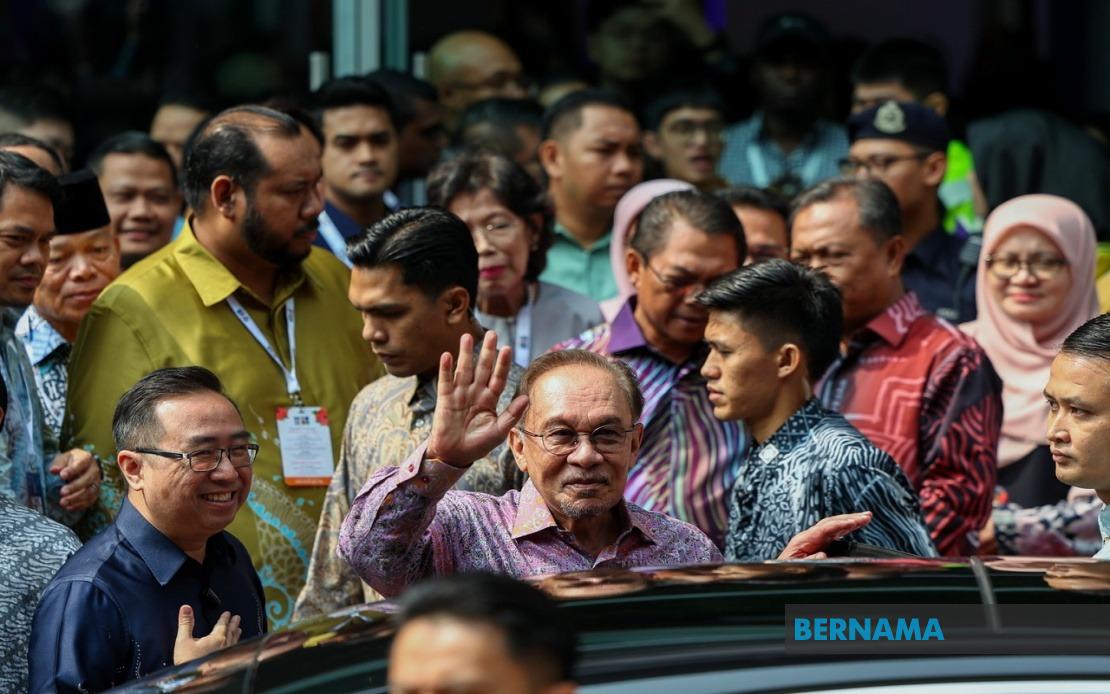
Prime Minister Anwar Ibrahim has distanced himself from reports of an invitation to former PKR deputy president Mohamed Azmin Ali, stating he has received no notification of any such overture. Speaking after opening the National Innovation and Commercialisation Expo (NICE) 2026 at the Kuala Lumpur Convention Centre (KLCC) on Tuesday, Anwar responded with deliberate brevity when pressed on the matter, denying knowledge of the alleged approach.
The Prime Minister's remarks come amid a period of apparent reconciliation within the People's Justice Party, which has been selectively courting former members to bolster its ranks following the party's significant loss of political ground in recent years. The timing of these recruitment efforts suggests PKR is attempting to restore its organisational strength and parliamentary representation as it navigates the complexities of coalition governance.
Azmin, who currently serves as secretary-general of Parti Pribumi Bersatu Malaysia (Bersatu), had publicly rejected the possibility of returning to PKR on Tuesday, despite acknowledging that invitations had been extended. His departure from PKR in 2020 during the internal political turbulence that preceded the formation of the Perikatan Nasional government remains a contentious chapter in Malaysian politics, and his refusal to reverse that decision underscores the deep fractures that continue to shape factional alignments within the ruling coalition.
The broader recruitment drive within PKR encompasses several prominent figures with parliamentary credentials. Former Bandar Tun Razak MP Kamarudin Jaffar and former Nibong Tebal MP Mansor Othman have both been mentioned as likely returnees to the party, signalling that the appeal extends beyond individual senior personalities. These defections of significant parliamentary voices had weakened PKR's presence in the Dewan Rakyat, and their potential return would materially strengthen the government's legislative capacity.
Among those who have confirmed their decision to rejoin PKR is former vice-president Dr Xavier Jayakumar, whose announcement represents a concrete commitment to the party's reconsolidation efforts. Jayakumar's return carries particular symbolic weight given his seniority within the party hierarchy and his visibility in Malaysian political discourse. His confirmation contrasts markedly with Azmin's firm rejection, highlighting the variable receptiveness among displaced PKR figures to the party's reconciliation initiative.
The dynamics of these party manoeuvres must be understood within the context of Malaysia's fragile political equilibrium. The Pakatan Harapan coalition has faced persistent challenges in maintaining cohesion whilst managing its partnership with Bersatu, the party of former Prime Minister Mahathir Mohamad. PKR, as the largest component party within Pakatan Harapan, carries disproportionate responsibility for the coalition's legislative capacity and strategic direction. Any loss of parliamentary seats directly impacts the government's ability to pass legislation and withstand opposition challenges.
Anwar's public disavowal of knowledge regarding Azmin's invitation warrants scrutiny as a political communication strategy. By claiming ignorance, the Prime Minister creates operational distance from the recruitment initiative, potentially allowing negotiations to proceed without his direct involvement whilst preserving his authority should sensitive outcomes require his decision. This compartmentalisation of knowledge and responsibility is a common feature of hierarchical party structures managing delicate political transitions.
The apparent conflict between Anwar's statement and the documented fact that invitations were indeed extended to former members raises questions about the decision-making architecture within PKR's leadership. Either the party's institutional machinery is operating semi-autonomously without the explicit approval of the party president, or Anwar's denial represents a deliberate obfuscation designed to create political cover. The distinction carries implications for understanding PKR's internal governance and the extent to which Anwar exercises centralised control over party operations.
For Malaysian and Southeast Asian observers, these machinations illustrate the precarious nature of coalition governance in the region. Political parties remain intensely personalised organisations where individuals migrate between entities based on calculations of individual advancement and factional loyalty. The fluidity of party membership and the willingness of figures like Azmin to maintain separation despite overtures underscore how political relationships in Malaysia are characterised by persistent mistrust and opportunism even when institutional frameworks suggest cooperation.
The broader implications for Malaysia's political trajectory depend partly on whether PKR successfully reconsolidates around its core identity or continues to experience gradual erosion of membership and parliamentary representation. The return of figures like Jayakumar and potentially Kamarudin and Mansor would provide temporary numerical relief, but sustainable strengthening requires addressing the ideological and personal grievances that prompted their departure in the first place. Until PKR resolves these underlying tensions, further defections remain probable.
Azmin's continued presence in Bersatu and his explicit rejection of PKR overtures suggest that the fractures within Malaysia's reform movement remain unhealed. His refusal to return, despite institutional mechanisms for reconciliation, indicates that personal and factional divisions have acquired sufficient depth to resist formal party mechanisms designed to restore unity. This persistence of division matters significantly for the stability of the Pakatan Harapan-led government and its capacity to implement a coherent policy agenda across its coalition partners.

