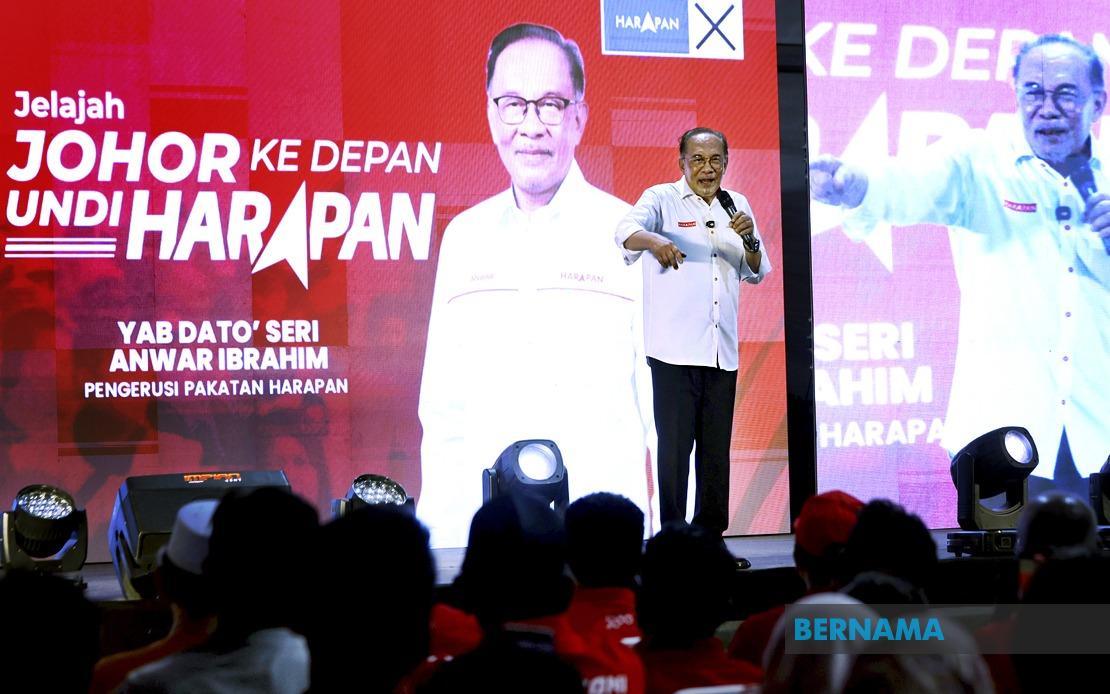
Prime Minister Datuk Seri Anwar Ibrahim has delivered a forceful message to Malaysians that the days of systematic plunder and patronage politics are finished, reaffirming the MADANI Government's determination to establish leadership grounded in integrity across all communities. Speaking at a campaign event in Muar during the Johor State Election push, Anwar drew a stark line between the governance failures of the past and the administrative renewal his administration intends to deliver, framing clean governance as a non-negotiable pillar of national progress.
The Prime Minister's remarks zeroed in on what he characterised as the institutional rot that has long undermined Malaysia's development trajectory. He identified the systematic diversion of public resources through corrupt administrative machinery as a primary barrier to national advancement, emphasising that reclaiming every ringgit of public wealth for genuine public benefit represents a foundational priority for his government. This framing shifts the anti-corruption narrative beyond individual prosecutions to encompass structural reform of the machinery of state itself—a comprehensive reimagining of how government operates at its core.
Central to Anwar's message was a deliberate repudiation of identity-based political messaging that obscures institutional failure. He challenged the notion that voters should select leaders along racial or communal lines, instead insisting that character and honesty must supersede all other considerations in evaluating leadership fitness. By explicitly stating his desire for "Malays who are good, honest and not corrupt" and "Chinese who are good and not corrupt" in positions of leadership, Anwar attempted to reframe the basis of electoral choice around shared commitment to governance standards rather than ethnic representation.
The Prime Minister articulated a scathing critique of crony capitalism and nepotistic resource allocation, specifically targeting the practice of leveraging state power to enrich family networks and connected business interests through government contracts. He identified this behaviour as emblematic of what he termed the "old culture, the culture of plunder," signalling that his administration would actively dismantle the institutional pathways that enable such arrangements. The specificity of his examples—enriching oneself, favouring one's children, awarding contracts to spouses—suggested a direct reference to documented patterns from previous administrations, though without naming specific individuals or cases.
A significant dimension of Anwar's statement involved his assurance that governmental protection would not extend to any individual implicated in corruption during his tenure. This pledge addresses a longstanding Malaysian political concern: that those with sufficient political leverage or patronage connections can effectively insulate themselves from accountability mechanisms. By explicitly foreclosing this avenue of escape, Anwar sought to establish the principle that institutional position confers no immunity from prosecution for financial crimes. This message carries particular resonance given Malaysia's history of high-profile corruption cases involving prominent political and business figures.
The timing of these remarks during Johor's state election campaign deserves contextual consideration. Johor has historically served as a political battleground reflecting broader national dynamics, and the state's governance trajectory influences perceptions of the federal government's legitimacy. By conducting multiple campaign stops across the state and amplifying anti-corruption messaging to Johor voters, Anwar effectively tied electoral performance to the broader national reform agenda, framing votes for Pakatan Harapan-aligned candidates as endorsements of clean governance principles.
Anwar characterised opposition political activities during this period as motivated by personal agendas to recapture federal power rather than genuine policy disagreement. This framing positions criticism of his administration as essentially self-interested rather than substantive, a rhetorical move that attempts to delegitimise opposition oversight functions. The statement reflects the broader polarisation of Malaysian politics, where accusations of institutionalised corruption have become fundamental to competing political narratives.
The event itself, attended by Penang Chief Minister Chow Kon Yeow and Ledang MP Syed Ibrahim Syed Noh, illustrated the coalition-building nature of contemporary Malaysian politics. The presence of Penang's chief minister—from a state widely regarded as having implemented meaningful anti-corruption measures—served as implicit validation of the federal government's commitment to the same agenda. This geographic and hierarchical diversity in attendance underscored the multi-layered governance structures through which anti-corruption efforts would need to operate.
For Southeast Asian observers, Anwar's articulation of anti-corruption commitment reflects a broader regional struggle between personalistic governance models and institutional reform. Malaysia's experience in confronting entrenched corrupt networks carries implications for other democracies in the region grappling with similar challenges. The success or failure of Anwar's anti-corruption agenda will likely influence assessments of whether genuinely transformative governance reform remains possible in Southeast Asia's established democracies.
The Johor State Election, scheduled for July 11 with 172 candidates contesting 56 seats, provided a relatively proximate test of whether voters would reward the government's anti-corruption messaging with electoral support. Anwar's intensive campaign schedule—completing fifteen engagements across two days—demonstrated significant investment in translating anti-corruption rhetoric into electoral momentum. The extent to which Johor voters' choices reflected endorsement of this governance philosophy would offer insights into public appetite for institutional reform versus other political considerations.
Looking forward, the critical question facing Malaysia concerns whether pledges of governance renewal will translate into sustained institutional change or remain largely rhetorical. Anwar's public commitments establish benchmarks against which his administration's record will inevitably be measured. The absence of any individual or institution enjoying governmental protection from corruption prosecution represents the ultimate test of these declared principles, requiring consistent application across all political tiers and organisational levels throughout his tenure. The credibility of Malaysia's democratic institutions may depend substantially on whether this promise withstands the inevitable pressures that emerge when clean governance principles intersect with political survival instincts.

