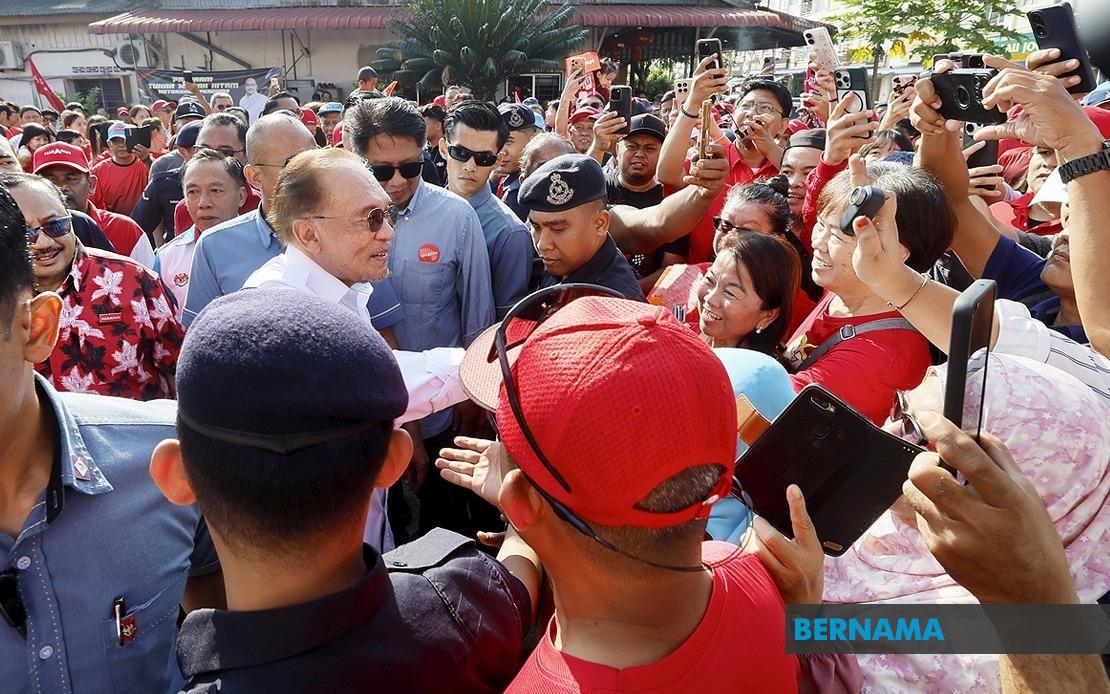
Prime Minister Datuk Seri Anwar Ibrahim has moved to counter perceptions of political favouritism in federal funding and development, declaring that his government allocates resources equitably across Malaysia regardless of whether states are governed by his Pakatan Harapan coalition or opposition parties. Speaking at a campaign rally in Batu Pahat on July 9, Anwar emphasised that the commitment to fair distribution extends beyond rhetorical gestures made during election campaigns, reflecting instead a substantive pattern of developmental investment implemented since the coalition assumed federal office.
The Prime Minister's remarks carry particular significance given the historical pattern of Malaysian federal-state relations, where resource allocation has frequently become entangled with partisan considerations. By explicitly referencing development initiatives in states such as Johor, Kelantan and Kedah—jurisdictions with varying political control—Anwar sought to demonstrate that infrastructure spending and welfare programmes transcend party lines. This messaging proves especially relevant in the context of rising concerns among state governments, particularly those governed by opposition parties, regarding their ability to secure adequate federal development allocations.
Anwar highlighted several concrete examples to substantiate his position. The Johor-Singapore Special Economic Zone (JS-SEZ) represents a flagship regional development initiative promising to enhance economic linkages between Malaysia and Singapore while generating employment and investment opportunities within Johor state. Simultaneously, the federal government has allocated billions of ringgit for flood mitigation infrastructure in Segamat and Muar, addressing critical vulnerabilities that affect both urban and rural communities across the state. These projects, according to Anwar's framing, exemplify a government approach that prioritises addressing genuine developmental needs and citizen welfare above political calculation.
The remarks were delivered during the 'Yok! Meriahkan Johor! Undi Harapan' programme held in Senggarang, where Anwar appeared alongside senior coalition figures and candidates contesting in the 16th Johor state election. The event itself represented a convergence of campaign activity and policy advocacy, with Anwar utilising the platform to articulate the federal government's developmental record while simultaneously encouraging electoral support for Pakatan Harapan candidates. This dual messaging strategy seeks to frame the forthcoming state election as a choice between parties aligned with a development-focused federal administration and those outside such alignment.
Communications Minister Datuk Fahmi Fadzil, serving also as Pakatan Harapan's communications director, participated in the programme alongside coalition candidates representing the Senggarang, Semerah and Penggaram constituencies. The presence of such senior figures underscores the coalition's commitment to competitive engagement in Johor, a state of substantial political and economic significance within Malaysia. Johor's economic importance stems from its position as a manufacturing hub, its role in regional trade with Singapore, and its substantial population base that influences national electoral mathematics.
Anwar's assertion that his government has avoided sidelining communities based on political identity speaks to broader concerns within Malaysian governance frameworks. Historically, federal development allocations have reflected partisan considerations, with governing coalitions sometimes prioritising resources toward constituencies offering electoral advantage or reward to coalition partners. The Prime Minister's counter-narrative suggests a deliberate recalibration of such practices, positioning the federal government as implementing developmental programmes determined by objective criteria related to need, economic potential, and citizen welfare rather than partisan advantage.
The specific mention of flood mitigation projects in Segamat and Muar carries practical significance for Johor residents who have endured recurrent flooding challenges affecting agricultural output, commercial activity, and household stability. These investments, if executed effectively, could meaningfully enhance community resilience and economic productivity. The infrastructure improvements implicit in JS-SEZ development similarly promise expanded economic opportunities within Johor, particularly for workers and small-to-medium enterprises engaged in regional trade and manufacturing sectors.
The timing of Anwar's remarks, coinciding with the 16th Johor state election campaign, means his message functions simultaneously as policy articulation and electoral argument. Opposition parties contesting the election will likely scrutinise the extent to which federal development claims match substantive implementation on the ground. The credibility of assertions regarding impartial development allocation depends significantly on demonstrable outcomes visible to Johor voters, including project completion rates, employment generation, and tangible improvements in public infrastructure and services.
For Malaysian observers beyond Johor, Anwar's emphasis on federal impartiality addresses persistent anxieties regarding development equity across the federation. States governed by opposition coalitions have periodically expressed frustration regarding perceived disadvantages in securing federal funding for critical projects ranging from transportation infrastructure to educational facilities. Whether through institutional reform or deliberate resource allocation policies, the federal government's approach to such questions ultimately determines the viability of competitive federalism and fair inter-governmental relations within Malaysia's system.
The Prime Minister's framing also responds implicitly to broader regional dynamics within Southeast Asia, where federal systems frequently struggle to balance developmental imperatives with political considerations. Malaysia's experience with such tensions offers instructive lessons regarding governance legitimacy and public confidence in institutional fairness. By positioning his government as transcending partisan logic in development allocation, Anwar constructs a governance narrative emphasising competence and impartiality over factional advantage, positioning Pakatan Harapan as capable stewards of national resources and development priorities.

