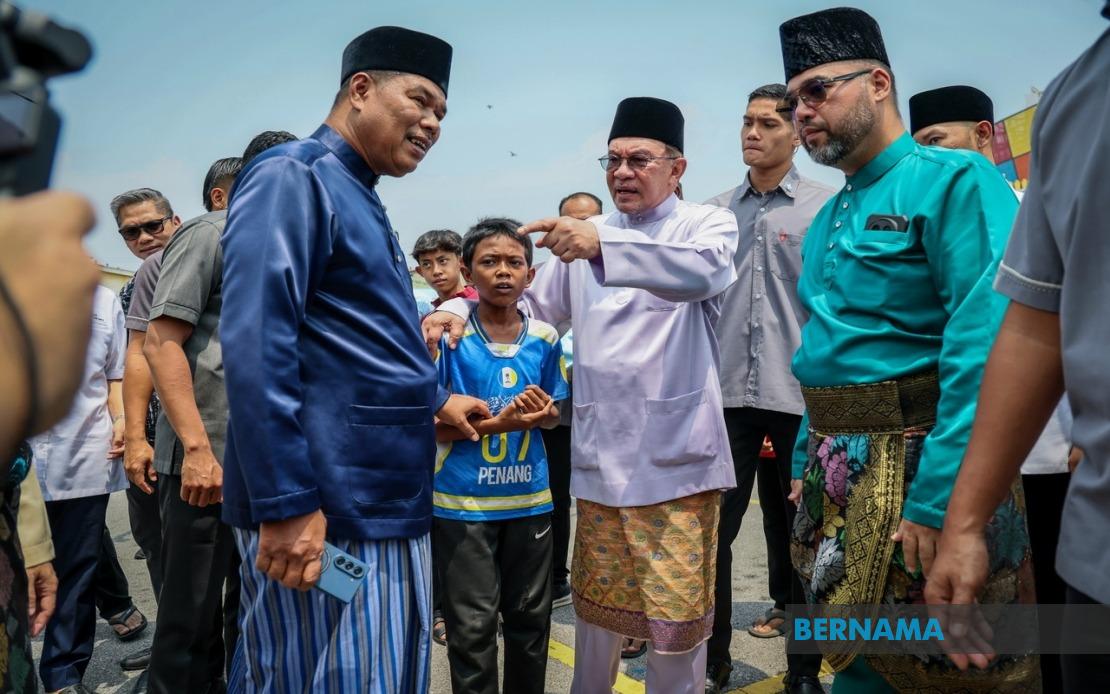
Prime Minister Datuk Seri Anwar Ibrahim has made clear that the corruption investigation and prosecution of former Human Resources Minister Datuk Seri M. Saravanan remain wholly within the purview of the Malaysian Anti-Corruption Commission (MACC) and the Attorney-General's Chambers (AGC), effectively signalling he will not involve himself in the proceedings despite receiving correspondence from the accused minister.
Anwar's statement came after Saravanan forwarded a letter to the Prime Minister's office regarding his legal predicament. The former minister was at pains to emphasise that the communication was not an attempt to seek executive intervention or have his charges withdrawn, but rather an explanation of his position in the matter. Nonetheless, Anwar's response underscores a deliberate separation between the political leadership and the country's anti-corruption machinery—a stance that carries significant weight given Malaysia's recent tumultuous history with perceived political interference in prosecutions.
The timing of Anwar's remarks is notable, coming after the Tapah MP made his initial court appearance at the Kuala Lumpur Sessions Court, where he entered a not guilty plea to three corruption charges totalling RM1.097 million. These charges relate to alleged irregularities in approvals for foreign worker quotas during his tenure as Human Resources Minister, a portfolio he held until his arrest and suspension from his ministerial duties earlier this month.
By explicitly stating that once such matters reach the investigative and prosecutorial stage they cease to be his concern, Anwar is reinforcing the principle of institutional independence that has become increasingly important to Malaysia's democratic governance. The distinction he draws between political responsibility and judicial process reflects an attempt to insulate the prosecution from accusations of political motivation—a concern that has dogged Malaysia's anti-corruption efforts for decades, particularly during the previous administration when selective prosecutions were viewed as weaponised against political opponents.
The case against Saravanan arrives at a delicate moment for the Anwar administration. As a member of the Prime Minister's cabinet and a fellow parliamentarian, Saravanan's prosecution could invite scrutiny about whether the government is using its enforcement machinery evenhandedly. By publicly disassociating himself from the case and directing all inquiries to the MACC and AGC, Anwar is attempting to demonstrate that no preferential treatment exists within his government, regardless of personal or party connections.
Understanding the context of Saravanan's alleged misconduct is essential for grasping the broader implications. Foreign worker quota approvals have long been a contentious issue in Malaysia, with allegations that approval processes can be subject to corruption and political patronage. The specificity of the charges—involving RM1.097 million linked to foreign worker quota approvals—suggests a pattern of alleged abuse rather than isolated incidents, which could indicate a systemic problem within the ministry's administration.
For Malaysian readers and regional observers, the handling of high-profile corruption cases involving sitting or recently-seated ministers remains a barometer of institutional strength and political will. The question of whether the MACC and AGC can prosecute such cases free from political pressure, and whether political leaders will genuinely step aside, continues to shape public confidence in Malaysia's fight against graft. Anwar's apparent adherence to this principle, at least in his public messaging, contrasts sharply with earlier periods when ministerial figures escaped accountability or faced prosecution widely perceived as politically motivated.
The next stages of Saravanan's trial will test whether Anwar's deference to investigative and prosecutorial independence is genuine or merely rhetorical. Should the case proceed without interruption or apparent political interference, it would signal a maturation of Malaysia's institutional safeguards. Conversely, any suggestion of political manoeuvring or pressure on the MACC or AGC would quickly undermine the credibility that Anwar is attempting to establish.
For the broader Southeast Asian region, Malaysia's handling of anti-corruption prosecutions against high-ranking officials carries implications for how neighbouring countries approach similar challenges. A government that can successfully prosecute its own members while maintaining political legitimacy sets a precedent for institutional integrity. Yet this remains an unproven test for Anwar's administration, which took office amid promises to restore institutional independence after years of perceived erosion.
Saravanan's letter itself warrants closer examination as a window into how accused officials approach their predicament. By emphasising that he was not seeking intervention, Saravanan appears to be protecting both himself and the Prime Minister from perceptions of impropriety. Should Anwar be seen as granting any special consideration or private hearings, it could trigger accusations of corruption at the highest levels—a reputational risk neither the Prime Minister nor the accused minister would welcome.
The separation Anwar has articulated between political leadership and prosecutorial authority represents an important constitutional principle, though one that Malaysia has struggled to maintain consistently. His statement effectively puts the burden on the MACC and AGC to conduct their investigation and prosecution with integrity, while simultaneously putting him on record as having recused himself from any involvement. This creates a clear evidentiary trail should questions later arise about political interference.

