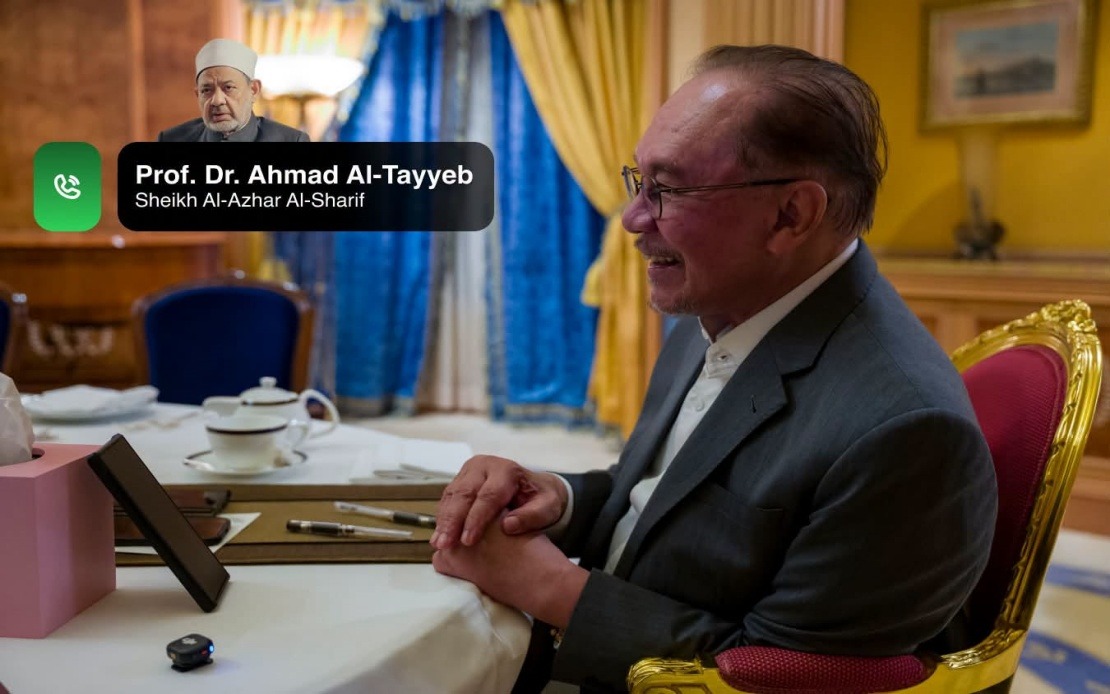
Prime Minister Datuk Seri Anwar Ibrahim has engaged in high-level discussions with one of Islam's most respected intellectual leaders, Sheikh al-Azhar al-Sharif Prof Dr Ahmad al-Tayyeb, focusing on collaborative efforts to deepen understanding of Islamic teachings across the community. The conversation took place over the phone after the prominent Egyptian cleric reached out to check on Anwar's wellbeing and extend his prayers during the Prime Minister's recovery period following a recent surgical procedure.
Anwar used the platform of a Facebook statement to detail the substance of his exchange with Sheikh al-Azhar al-Sharif, emphasising the positive trajectory of his health and the smooth nature of both the operation and subsequent recuperation. The discussion between the two leaders extended well beyond courtesy exchanges, touching upon substantive matters relating to the continuation and expansion of dakwah—the Islamic concept of spreading faith—alongside formal Islamic studies initiatives intended to cultivate deeper religious comprehension within Malaysian society.
The Prime Minister expressed profound gratitude for the spiritual support extended by Sheikh al-Azhar al-Sharif, who heads one of the Islamic world's most ancient and influential institutions based in Cairo. Anwar highlighted the value he places on the cleric's counsel and wisdom, positioning such guidance as instrumental in maintaining the integrity of Islamic scholarly traditions while ensuring that religious knowledge serves the broader community interest. This alignment of perspectives on Islamic education reflects Malaysia's strategic positioning within the global Islamic intellectual landscape.
During their conversation, Anwar referenced a previous visit by Sheikh al-Azhar al-Sharif to Malaysia, describing the impact of that engagement as having resonated deeply with the nation's Muslim population. The Prime Minister seized the opportunity to propose future meetings in either Cairo or Kuala Lumpur, framing such encounters as opportunities to reinvigorate collaborative dakwah initiatives and advance knowledge-sharing programmes beneficial to Muslims across both nations. This suggests a deliberate effort to institutionalise an ongoing relationship between Malaysia's leadership and al-Azhar's intellectual authority.
Beyond his interaction with Sheikh al-Azhar al-Sharif, Anwar also spoke separately with Mohamed Abdelsalam, who serves as Secretary-General of the Council of Muslim Elders (Majlis Hukama Muslimin), an influential pan-Islamic organisation. This second conversation demonstrated Anwar's wider engagement with significant figures in the contemporary Islamic establishment, with the discussion again touching upon matters of health and mutual support. The Prime Minister notably extended his sympathies to Abdelsalam regarding the hospitalisation of the latter's wife, offering prayers for her swift recovery.
The dialogue with Abdelsalam further developed themes around Sheikh al-Azhar al-Sharif's anticipated return visit to Malaysia and several emerging initiatives aimed at strengthening bilateral relations between Malaysia and al-Azhar as an institution. Significantly, Anwar articulated a vision centred on promoting what he characterised as a simple, uncomplicated, and authoritative interpretation of Islam—language that carries particular weight in Malaysia's religious context where questions of Islamic authenticity and moderation remain subjects of active public discourse.
These conversations underscore a deliberate diplomatic strategy by the Malaysian Prime Minister to position the country as an active participant in contemporary global Islamic discourse while simultaneously drawing upon the intellectual resources and credibility of established Islamic scholarly institutions. Al-Azhar's stature as one of Sunni Islam's foremost centres of learning, combined with its historical role in Islamic thought across more than a millennium, renders engagement with its leadership a significant marker of Malaysia's aspirations within Muslim-majority international relations.
Anwar's public articulation of these exchanges also reflects his personal investment in matters of Islamic education and interfaith understanding, themes that have featured prominently throughout his political career. By sharing these conversations with the Malaysian public through social media, the Prime Minister connects personal recovery narratives with substantive policy objectives, suggesting an integrated approach to leadership that encompasses both personal resilience and national religious positioning.
The emphasis on dakwah and Islamic study expansion carries particular relevance in Malaysia's contemporary religious landscape, where tensions sometimes emerge between various interpretations of Islamic practice and where questions of religious authority generate significant public attention. By aligning himself with internationally recognised Islamic scholarship centred on educational expansion and community benefit, Anwar appears intent on advocating for an Islam-centred governance approach that emphasises knowledge, engagement, and inclusive community wellbeing.
Notably, Anwar extended public recognition to his wife, Datuk Seri Dr Wan Azizah Wan Ismail, characterising her as exemplary in her steadfastness and sacrifice throughout his sustained political engagement. This inclusion in his statement about Islamic and diplomatic efforts acknowledges the personal dimensions of public leadership while affirming family as foundational to his political mission and values. The framing aligns personal commitment with broader organisational and community objectives in a manner that has become characteristic of Anwar's public communication style.

