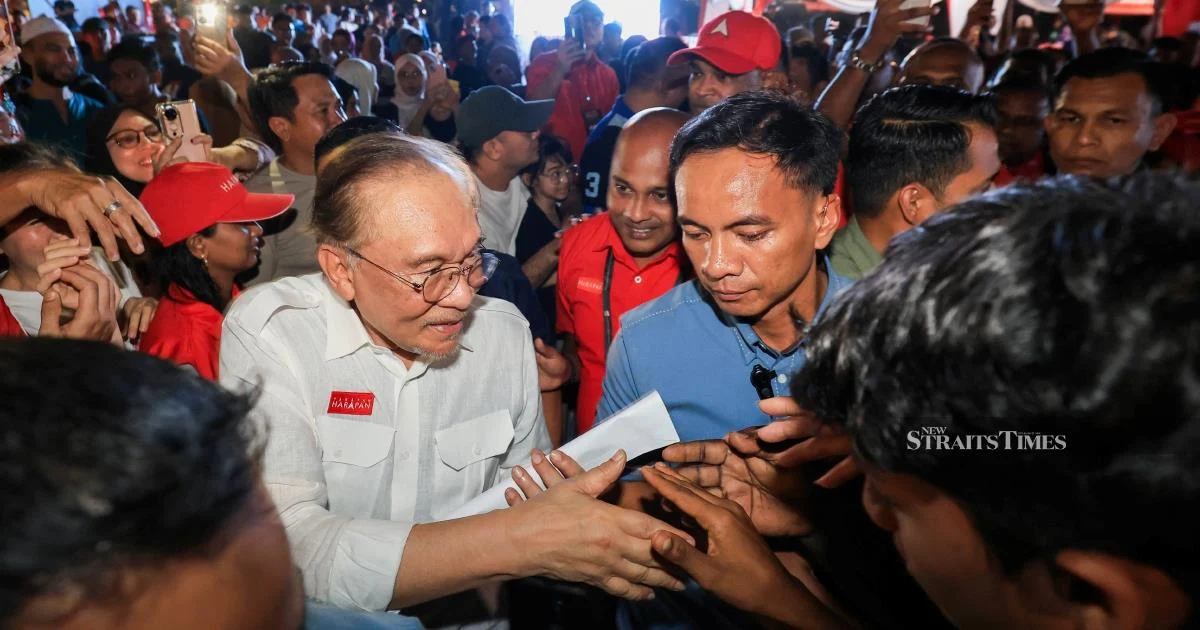
Prime Minister Datuk Seri Anwar Ibrahim has firmly rejected mounting pressure to call for snap elections, instead reaffirming his administration's conviction that the current coalition government retains the democratic mandate necessary to serve its full term. The remarks come amid periodic speculation about early dissolution of Parliament, a recurring theme in Malaysian political discourse that has intensified following various political realignments and shifting coalition dynamics.
The unity government, formed through an unprecedented gathering of formerly adversarial political parties, has faced persistent questions about its durability and cohesion since its inception. Opposition figures and political commentators have occasionally suggested that early elections might provide greater certainty, while others have questioned whether the coalition can maintain internal discipline across multiple parties with divergent agendas. Anwar's statements represent a calculated move to project stability and decisiveness at a time when maintaining coalition unity remains essential for legislative continuity.
The composition of the current parliamentary arithmetic fundamentally shapes the government's tactical approach to governance. With sufficient numbers to navigate contentious legislation and budgetary measures, the administration has demonstrated its capacity to pass critical initiatives. However, the complexity of managing multiple coalition partners with distinct constituencies and policy preferences creates constant pressure to balance competing interests while maintaining forward momentum on its economic and social agenda.
Anwar's assertion of the government's mandate carries particular significance in the Malaysian context, where electoral cycles and political transitions have historically shaped investor confidence and economic planning. Businesses and foreign observers monitor political stability closely, recognizing that extended periods of uncertainty can dampen investment appetite and complicate long-term strategic planning. By declaring his administration's readiness to complete its mandate, Anwar signals to these constituencies that institutional continuity remains assured.
The timing of such declarations reflects broader regional patterns. Across Southeast Asia, coalition governments have become increasingly common, creating novel governance challenges that require unprecedented cooperation among politically diverse parties. Malaysia's unity government represents a significant departure from the zero-sum electoral competitions that previously dominated the nation's politics, suggesting a potential evolution toward more consensus-oriented governance models, despite their inherent complexities.
Opposition parties have periodically leveraged populist arguments about government legitimacy and electoral mandates, contending that the current arrangement lacks the direct endorsement of voters casting ballots for a unified platform. These arguments resonate with segments of the electorate skeptical of elite-brokered political deals conducted outside the ballot box. Anwar's counter-narrative emphasizes parliamentary mathematics and the constitutional framework that permits coalition formation without requiring fresh elections immediately following political reorganization.
The economic calendar provides an additional constraint on electoral timing. Implementing substantial policy initiatives, managing fiscal obligations, and maintaining macroeconomic stability demands sustained governmental focus and planning horizons that early elections would necessarily disrupt. Senior officials within the administration have indicated that completing critical initiatives—from infrastructure development to financial sector reforms—requires the working space that a full parliamentary term provides.
Internal coalition management presents perhaps the most delicate balancing act facing Anwar's administration. Different coalition partners bring different voter bases, policy preferences, and organizational imperatives. While unified in their commitment to keep the previous government out of power, these parties do not necessarily align on substantive policy issues. Periodically, tensions surface around ministerial appointments, budget allocations, or legislative priorities. Demonstrating resolve about completing the mandate serves partly as internal messaging, signaling that the Prime Minister will not allow short-term squabbles to destabilize the entire enterprise.
The institutional memory of Malaysia's previous political cycles informs contemporary calculations about electoral timing. Governments that have called early elections seeking expanded mandates have sometimes discovered that such gambits backfired, producing unforeseen consequences or reduced majorities. Anwar's apparent determination to serve a full term reflects lessons drawn from this recent history, suggesting that assured access to parliamentary time through a known term horizon exceeds the speculative benefits of seeking fresh voter endorsement.
Regional observers note that Malaysia's political trajectory carries implications extending beyond its borders. As Southeast Asian nations grapple with questions about democratic legitimacy, coalition governance, and institutional stability, the Malaysian experiment in unity government offers a practical case study. Successful completion of a full term by a genuinely multi-partisan coalition would demonstrate that such arrangements can deliver stable governance and policy continuity, potentially influencing how neighboring countries approach political transitions and institutional design.
Looking ahead, Anwar's declarations about completing the government's mandate will face periodic testing as parliamentary sessions proceed and coalition pressures inevitably emerge. The capacity of the administration to maintain cohesion while delivering on its economic and social commitments will ultimately determine whether such reassurances prove substantive or merely rhetorical. For now, however, the Prime Minister has clearly signaled his intention to resist what he views as premature speculation about electoral dissolution.

