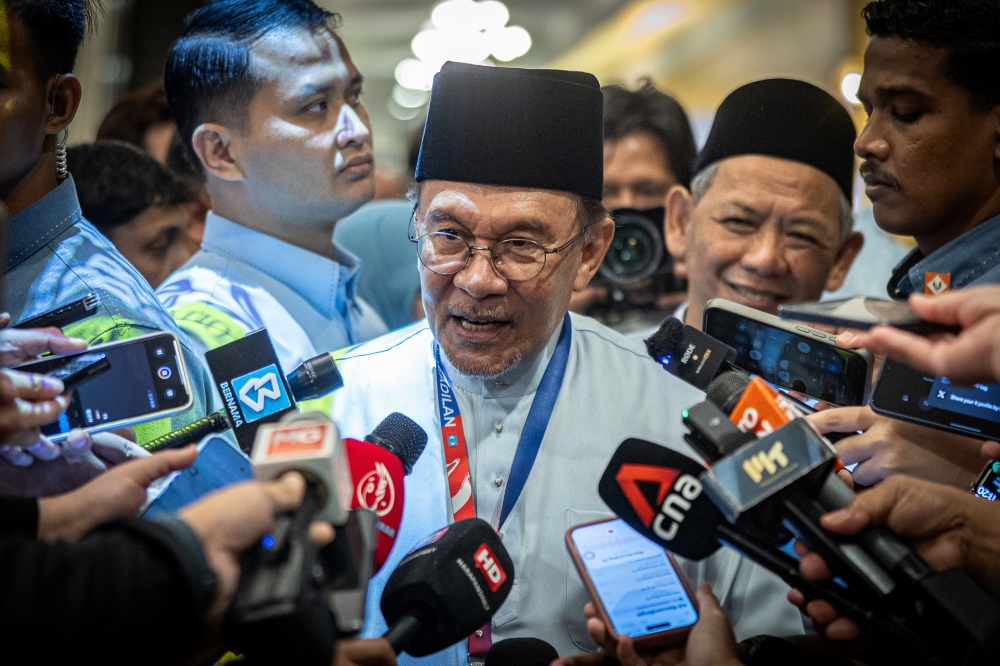
Prime Minister Datuk Seri Anwar Ibrahim has moved swiftly to extinguish flames of speculation about internal discord within Malaysia's federal administration, declaring that he remains committed to fostering harmonious working relationships across the ruling coalition. Speaking in Melaka on August 15, Anwar responded directly to suggestions that strains had emerged between himself and Deputy Prime Minister Datuk Seri Zahid Hamidi, insisting instead that he pursues what he characterised as a peaceful approach to navigating the complexities of multi-party governance.
The Prime Minister's public statement comes in the wake of comments attributed to Khairy Jamaluddin, signalling that tensions may be brewing beneath the surface of Malaysia's broadly representative government structure. Rather than engage in prolonged rebuttals or counterattacks, Anwar chose to reframe the narrative around his personal philosophy of conflict resolution, emphasising dialogue and consensus-building as the foundation of his leadership style. This measured response reflects an awareness that premature escalation of such disputes can undermine public confidence in institutional stability, particularly when coalition cohesion remains essential to parliamentary majorities.
The context surrounding these claims deserves careful examination, as Malaysia's governing coalition represents a delicate balancing act between multiple factions with distinct political traditions and constituency bases. Anwar's administration brings together elements from Pakatan Harapan, Barisan Nasional, and GPS, creating a governing structure that by definition requires constant negotiation and compromise. Within this framework, occasional friction between senior figures is arguably inevitable, yet how leadership chooses to address such frictions can determine whether they escalate into genuine governance crises or remain manageable within the normal bounds of coalition politics.
The Deputy Prime Minister's portfolio positions Zahid Hamidi as a figure of considerable influence within both the government and the United Malays National Organisation, the dominant component of Barisan Nasional. His standing in the coalition reflects the ongoing significance of traditional Malay-Muslim political forces in Malaysian governance, even as the current administration incorporates diverse regional and urban constituencies. Any sustained rift between Anwar and Zahid could theoretically trigger broader realignments, making public reassurances about their working relationship strategically important for maintaining coalition stability.
Anwar's invocation of a "peaceful path" carries particular resonance given his own political trajectory and personal experiences. Throughout his career, the Prime Minister has advocated for dialogue-based approaches to resolving political differences, contrasting this philosophy with more adversarial or confrontational methods. By consciously framing his response in these terms, he signals to coalition partners and the broader public that he prioritises institutional continuity and cooperative governance over point-scoring or deepening internal divisions. This rhetorical strategy helps position him as a stabilising force within a coalition that observers have occasionally questioned regarding its durability.
The timing of Anwar's public remarks in Melaka, the heartland of Zahid Hamidi's political influence, carries additional significance. By addressing the matter directly within Deputy Prime Minister's regional stronghold, Anwar demonstrates both confidence and respect, underscoring that any working differences remain manageable and grounded in professional disagreements rather than personal animosity or fundamental incompatibility. Such gestures, though subtle, communicate important messages to local party structures and voters about the state of top-level relationships.
From a broader Southeast Asian perspective, Malaysia's ability to maintain coalition stability carries ramifications beyond its own borders. As a major regional economy and diplomatic player, Malaysia's internal political stability influences investor confidence, trade relationships, and regional diplomacy. During periods of genuine governmental discord, neighbouring nations and international business interests often adopt wait-and-see positions, delaying major decisions until the political landscape clarifies. Conversely, governments that project stability and cohesion tend to attract longer-term commitments and confidence.
The mechanics of Malaysian coalition governance present distinct challenges compared to single-party or more ideologically unified administrations. When partners hold fundamentally different policy preferences or represent constituencies with divergent interests, leadership must continuously balance competing demands. Anwar's emphasis on peaceful problem-solving reflects a pragmatic recognition that this balancing act requires good faith effort from all participants. Without such commitment, seemingly routine policy disagreements can rapidly metastasise into broader political crises that destabilise governance.
Speculation about rifts within ruling coalitions typically reflects underlying uncertainties about either policy directions or leadership intentions. The fact that such questions have arisen suggests that observers, whether media commentators or political analysts, have detected signs of strain warranting attention. Anwar's response neither fully dismisses these observations nor allows them to dominate public discourse, instead repositioning them within a framework of normal administrative diversity being managed through established channels. This approach protects both his own leadership credibility and that of coalition partners by normalising disagreement while emphasising commitment to broader institutional objectives.
Moving forward, the test of Anwar's peaceful approach will emerge through concrete governance outcomes and visible cooperation between senior figures in pursuing coalition policy priorities. Public statements, however reassuring, carry limited weight if underlying institutional tensions resurface through policy paralysis or public finger-pointing. Observers both domestically and internationally will monitor whether the government can demonstrate practical coordination in addressing pressing economic challenges, managing regional relationships, and advancing legislative priorities that require sustained coalition commitment.
The Prime Minister's remarks ultimately reflect a deliberate choice about how Malaysian leadership handles internal tensions in the public domain. Rather than allowing media-generated speculation to frame governance narratives, Anwar has attempted to establish his preferred interpretive framework emphasising dialogue and stability. Whether this proves sufficient to head off further speculation or whether deeper structural issues require more substantive resolution remains to be demonstrated through the government's actual performance in coming months.

