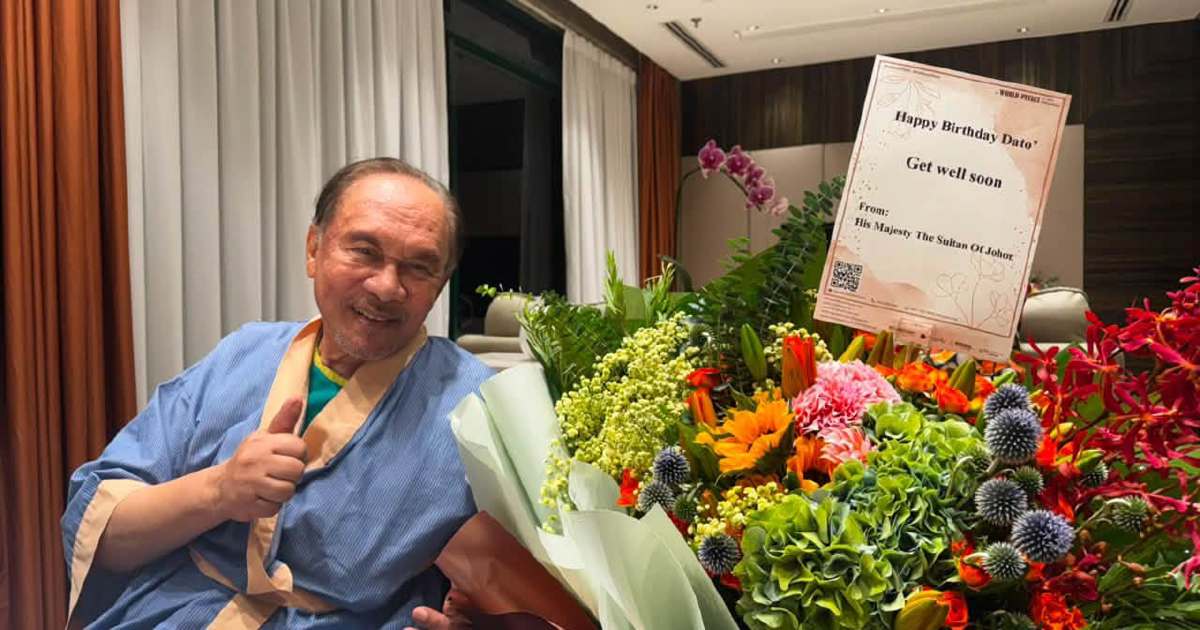
Prime Minister Datuk Seri Anwar Ibrahim has conveyed his appreciation to His Majesty Sultan Ibrahim, King of Malaysia, and Her Majesty Raja Zarith Sofiah, Queen of Malaysia, for extending birthday greetings and offering prayers for his full recovery. The acknowledgment reflects the ongoing relationship between the nation's highest political office and its constitutional monarchy, a cornerstone of Malaysia's governmental structure.
The expression of gratitude underscores the formal protocols and mutual respect that characterise interactions between Malaysia's government leadership and the institution of the monarchy. Such public acknowledgments, while ceremonial in nature, carry significance within the Malaysian constitutional framework where the Agong's role as ceremonial head of state intertwines with the practical governance functions of the Prime Minister.
Anwar's recovery has been a matter of public interest, given his position as the nation's chief executive and his central role in navigating Malaysia through various economic, political, and social challenges. The Prime Minister's health status inevitably affects investor confidence, domestic stability, and Malaysia's standing in regional affairs. Public declarations regarding his well-being, particularly when endorsed by the highest echelons of the state, help maintain continuity and reassure both local and international stakeholders about governmental stability.
The gesture from the royal palace also exemplifies the inclusive nature of Malaysia's institutions, where personalities from different sectors of society—regardless of their political backgrounds or personal histories—receive acknowledgment during significant personal moments. Such displays of unity from the apex institutions reinforce the notion of a cohesive national leadership, particularly important in a diverse, multi-ethnic democracy like Malaysia where symbolic gestures from state institutions carry considerable weight.
Anwar's journey to the Prime Minister's office represents a notable chapter in contemporary Malaysian politics. His appointment in November 2022 concluded a prolonged period of political uncertainty and was widely viewed as a stabilising force. Since assuming office, his administration has faced the immediate task of restoring fiscal discipline, managing inflation, and addressing concerns about political governance. Any disruption to his leadership due to health considerations would necessitate constitutional procedures and succession planning, matters that attract keen attention from political observers and international observers alike.
The monarchy's engagement in such courtesies reflects its institutional role as a unifying symbol above partisan politics. By extending birthday wishes and prayers, the royal household demonstrates the conventional expectations of their position—to transcend political divisions and maintain goodwill across the entire governmental apparatus. This approach has traditionally helped Malaysia avoid the kind of institutional conflicts that have destabilised other regional democracies.
For ordinary Malaysians, the public health and well-being of senior government officials carries practical implications. A functioning Prime Minister's office is essential for policy continuity, economic management, and the steady administration of public services. Health-related absences or incapacities among top officials can create administrative bottlenecks, confuse market signals, and create uncertainty among investors and business communities that depend on clear leadership direction.
The interplay between Malaysia's political and royal institutions has evolved considerably over the nation's post-independence history. While tensions have occasionally surfaced, both sides generally recognise the constitutional balance that has enabled Malaysia's relative stability compared to some neighbouring jurisdictions. Public courtesies, such as birthday wishes, serve as low-cost methods of reinforcing this institutional harmony.
Regionally, Malaysia's governmental stability matters beyond its borders. As a significant Southeast Asian economy and an important player in regional organisations like ASEAN, the Prime Minister's health and the continuity of his administration influence regional dynamics, trade negotiations, and diplomatic initiatives. Partners and competitors alike monitor leadership changes and institutional stability in the country closely.
The recovery wishes extended to Anwar also reflect broader cultural and religious values embedded within Malaysian society. In the Muslim-majority nation, prayers for recovery form a natural part of well-wishes, and the royal household's inclusion of prayers in their message resonates with the spiritual dimensions that Malaysians typically expect from their leadership. This integration of constitutional formality with religious and cultural expression is characteristic of how Malaysian institutions operate.
Looking forward, Anwar's continued leadership provides the context for Malaysia to advance several reform initiatives and policy objectives that require sustained attention and consistency. The Prime Minister's recovery and the public assurance of his well-being thus represents more than a personal matter—it carries implications for the entire apparatus of government and the plans his administration is pursuing.

