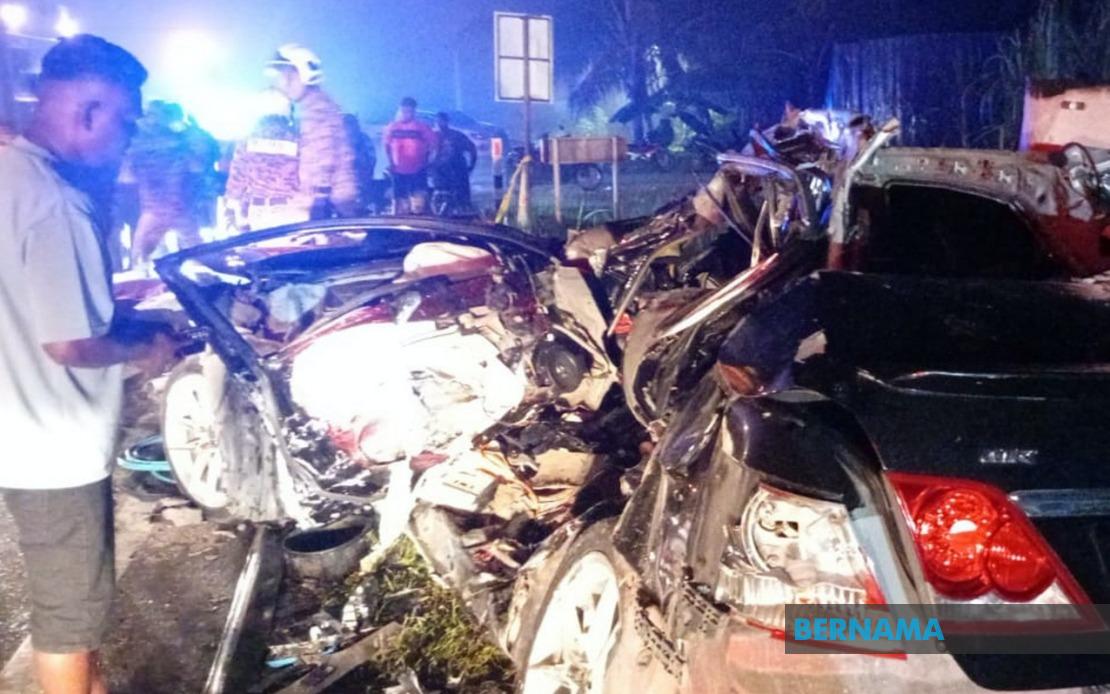
Prime Minister Datuk Seri Anwar Ibrahim has offered his sympathies to the families of six individuals who lost their lives in a severe motor vehicle collision that occurred in the early hours of July 25 along Jalan Karak Lama in Bentong, Pahang. Through a statement posted on X, Anwar conveyed the deep sorrow felt by himself and his wife, Datuk Seri Dr Wan Azizah Wan Ismail, in response to the tragedy that claimed multiple young lives.
The fatal incident unfolded at approximately 4 am when a Toyota Vios car collided head-on with a one-tonne lorry near Klink Desa Jambu Rias, along the stretch of road connecting Kuantan and Kuala Lumpur. The vehicle was in descent along a hilly section of the highway when preliminary investigations suggest it veered across the centre line into oncoming traffic. The impact proved catastrophic for the six occupants of the smaller vehicle, all of whom were pronounced dead at the scene.
Those who perished in the collision comprised primarily young men and teenagers. The driver, V. Mugilan, was 25 years old, while passengers included K. Dineshvaran, 22, K. Alaganathan, 21, A. Kanabati Raja, 19, S. Kiisven, 17, and M. Paranthaman, 16. The lorry operator, a 31-year-old man, sustained serious injuries in the impact but survived the crash. The loss of five individuals under the age of 25 underscores the particularly tragic nature of this incident, with several victims still in their teenage years.
In his public statement, the Prime Minister emphasised the broader implications of the accident, framing it as an urgent call to action on highway safety. "This tragedy serves as a reminder to all of us that road safety must never be taken lightly," Anwar stated, directing attention toward systematic measures needed to prevent similar occurrences. He requested divine blessings for the families affected, praying that they would be granted the resilience to endure their loss, whilst also hoping for full recovery for those injured.
The location of this crash on Jalan Karak Lama is particularly significant for Malaysian road safety discourse. This stretch of highway, which connects major urban centres and passes through hilly terrain in Pahang, has been the site of multiple serious accidents over the years. The challenging topography, combined with the volume of traffic using the route, creates conditions where driver fatigue, speed, and loss of vehicle control become critical risk factors.
Police investigations into the incident have pointed to loss of control as the likely primary cause, with the vehicle drifting across the road division during a descent. This pattern mirrors findings from numerous other fatal crashes on Malaysian highways, where drivers lose traction or control on downward slopes, particularly during dawn hours when visibility may be compromised and alertness diminished. The question of whether the vehicle experienced mechanical failure, whether the driver fell asleep, or whether excessive speed contributed remains under examination.
The age profile of the victims raises questions about driver experience and passenger safety practices among younger road users. With the driver only 25 years old and several passengers in their late teens, the group represents a demographic that road safety researchers identify as particularly vulnerable to serious crashes. Young drivers statistically show higher rates of risky behaviours, including speeding and distracted driving, whilst their passengers may not consistently enforce safety practices such as seatbelt usage.
For Malaysian policymakers and road safety advocates, incidents such as this frequently trigger renewed calls for enhanced enforcement, improved road infrastructure, and public awareness campaigns. The Jalan Karak Lama, as a federally maintained highway corridor, falls under specific safety standards and maintenance protocols. Whether the road surface condition, lane markings, or warning signage contributed to the driver's loss of control will form part of the comprehensive police investigation.
The timing of the crash during early morning hours—a period associated with reduced visibility and driver fatigue—also factors into the broader safety analysis. Long-distance travellers, particularly those undertaking overnight journeys between Kuantan and Kuala Lumpur, face accumulated fatigue that degrades reaction times and decision-making capacity. The absence of adequate rest stops or driver alertness interventions on certain highway sections continues to be identified as a systemic vulnerability.
Regionally, this incident reflects patterns seen across Southeast Asian countries where rapid motorisation, expanding highway networks, and younger demographic profiles behind the wheel have created a perfect storm for rising road fatalities. Malaysia, whilst possessing relatively modern infrastructure compared to neighbouring nations, continues to record road death rates that exceed safety targets set by the World Health Organisation and international transport bodies.
The Prime Minister's intervention in offering public condolences signals the gravity with which the federal government treats road safety issues, positioning it as a matter of national concern rather than a purely regulatory matter. Such high-level acknowledgment often precedes policy reviews, enforcement intensification, or infrastructural improvements. The challenge remains translating sympathies into concrete, measurable reductions in fatal crashes through sustained investment in prevention, enforcement, and education.
As investigations proceed and the community mourns the loss of six individuals, the incident serves as a sobering reminder of the fragility of life on Malaysian highways and the critical importance of comprehensive approaches to road safety that address driver behaviour, vehicle standards, infrastructure design, and enforcement mechanisms simultaneously.

