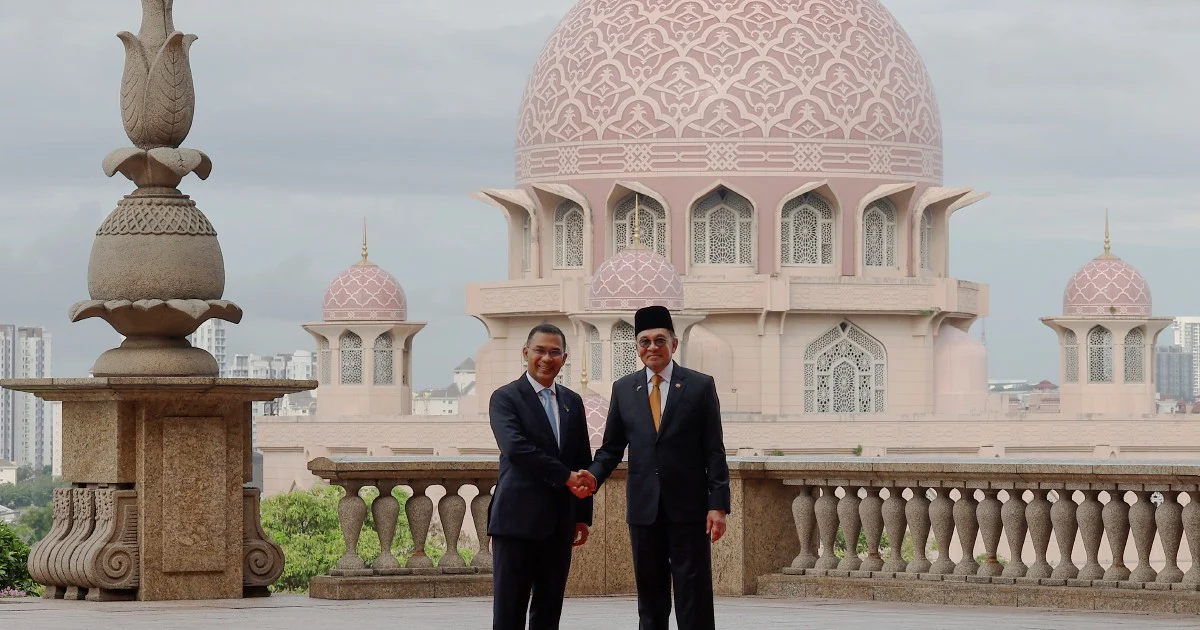
Prime Minister Anwar Ibrahim welcomed Bangladesh's newly ascended leader, Tarique Rahman, to Malaysia with full official honours at the Perdana Putra Complex in Putrajaya today, marking a significant diplomatic engagement as both nations navigate evolving regional dynamics. The ceremonial reception underscores the importance Kuala Lumpur places on its relationship with Dhaka, the most populous Muslim-majority nation in South Asia and a key partner in regional multilateral forums.
Rahman's two-day visit represents his first official journey abroad following his assumption of the Bangladesh premiership, a symbolic choice that reflects the diplomatic weight attached to the Malaysia-Bangladesh relationship. The timing of this visit carries considerable significance given the recent political transition in Bangladesh and the broader context of regional geopolitical realignments in South and Southeast Asia. By hosting Rahman in Putrajaya's seat of government power, Malaysia demonstrates its commitment to maintaining strategic continuity with Dhaka across the transition period.
The official welcome ceremony at the Perdana Putra Complex, Malaysia's principal seat of executive authority, represents the highest level of diplomatic protocol afforded to visiting heads of government. Such ceremonial arrangements are typically reserved for state visits or official visits of paramount importance, reflecting the bilateral relationship's priority status within Malaysia's foreign policy framework. The choice of venue and the formal nature of the reception signal to both the Malaysian and international audiences the government's desire to position Bangladesh relations as a cornerstone of regional engagement.
Bangladesh maintains considerable strategic relevance for Malaysia across multiple dimensions. As a major labour-exporting nation, Bangladesh supplies a significant portion of Malaysia's migrant workforce across construction, manufacturing, and service sectors, making labour policy coordination and worker welfare matters of mutual concern. Additionally, both countries share maritime interests in the Bay of Bengal and broader Indian Ocean region, where questions of shipping lanes, fishing rights, and naval presence have grown increasingly pertinent.
The visit also provides an opportunity to advance bilateral trade and economic cooperation. Malaysia and Bangladesh maintain commercial ties spanning textiles, garments, electronics, and agricultural products, though trade volumes remain below their potential given the size of both economies. High-level diplomatic engagement typically paves the way for business delegations and investment discussions, making such visits economically consequential beyond their political symbolism.
Regionally, Malaysia and Bangladesh share membership in the Association of Southeast Asian Nations (ASEAN) through Bangladesh's dialogue partner status and various multilateral arrangements. Both nations are invested in the stability of Southeast Asia and the Indian Ocean region, and both maintain careful diplomatic postures regarding great power competition between China and the United States. Coordination between Dhaka and Kuala Lumpur on regional security matters, maritime concerns, and economic initiatives carries implications for the broader stability of the Indo-Pacific region.
The recent political developments in Bangladesh, which led to Rahman's rise to the premiership, have drawn international attention and scrutiny. Malaysia's warm reception of the new Bangladesh leadership projects a message of normalcy and continuity in bilateral relations, reassuring both domestic constituencies in Bangladesh and international observers that the transition enjoys regional acceptance. This diplomatic gesture may also serve to encourage stability and constructive governance in Bangladesh during what could be a sensitive transition period.
Rahman's selection of Malaysia as the destination for his first official international visit carries its own diplomatic messaging. The choice elevates Malaysia's standing as a preferred regional partner and suggests that Dhaka values its Southeast Asian connections alongside its traditional South Asian and international partnerships. This preference may reflect shared Islamic heritage, economic complementarities, or strategic alignment on regional issues, all of which serve as foundations for deeper engagement.
During such official visits, delegations typically engage in bilateral talks addressing trade agreements, defence cooperation, cultural exchanges, and multilateral coordination. While the specific agenda items for Rahman's visit remain to be detailed, these discussions will likely address the full spectrum of bilateral relations and explore opportunities for expanded cooperation. The visit may also yield joint statements or memoranda of understanding signalling commitment to enhanced partnership.
For Malaysia, hosting Bangladesh's premier demonstrates its continuing relevance as a diplomatic hub and trusted partner within both Southeast Asian and broader Asian contexts. The country has long positioned itself as a bridge between the Arab world, South Asia, and Southeast Asia, leveraging its Muslim-majority status and geographic position. Deepening ties with Bangladesh reinforces this role and strengthens Malaysia's diplomatic networks across an increasingly important region.
The warmth of Malaysia's reception also reflects broader regional interests in maintaining stable, productive relationships across South and Southeast Asia. As regional competition intensifies and great power tensions persist, countries like Malaysia and Bangladesh benefit from strong bilateral relationships that provide predictability and mutual support. This visit exemplifies how summit diplomacy, through its ceremonial and substantive dimensions, continues to serve as a crucial mechanism for maintaining and advancing state interests in contemporary international relations.