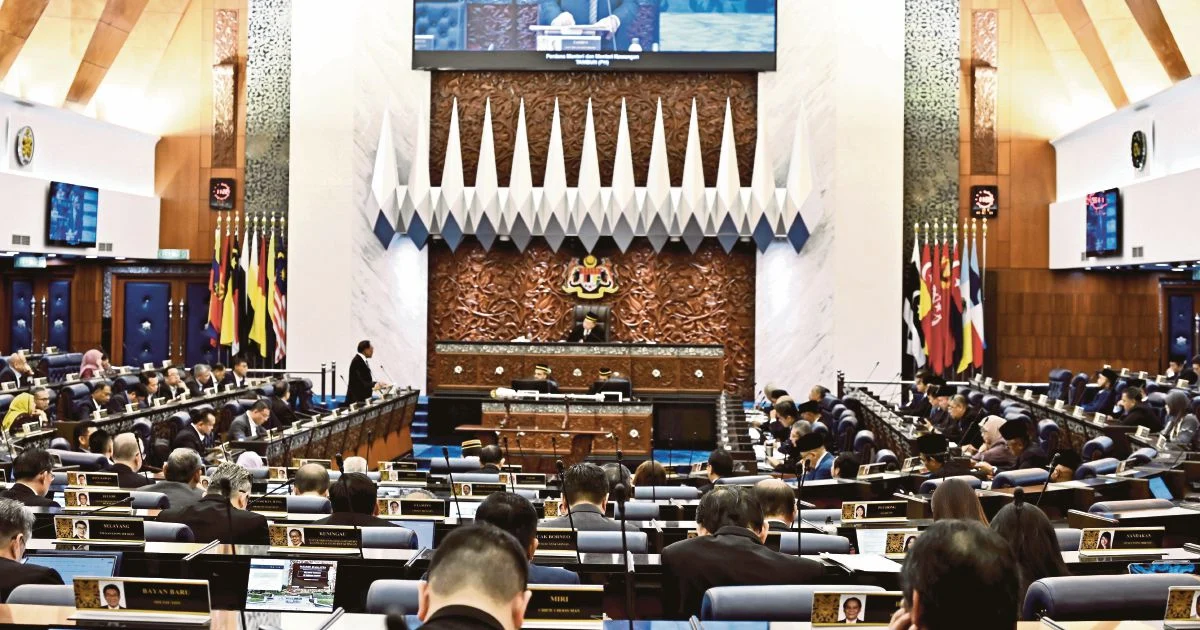
Barely an hour into today's sitting of the Dewan Rakyat, the chamber descended into acrimonious exchanges as tensions simmering within Malaysia's coalition politics exploded across the parliamentary floor. The friction emerged from a substantive disagreement regarding the official status of the opposition leader, transforming what might have appeared as a procedural matter into a broader confrontation about the treatment of coalition partners and the stability of political alliances.
The dust-up revealed fractures that extend far beyond the immediate parliamentary dispute. At its core lies a fundamental tension between two significant opposition partners—PAS and Bersatu—whose relationship has deteriorated markedly despite their shared opposition status. The allegation that PAS has been bullying its coalition partner strikes at the heart of opposition unity, a matter of considerable consequence for any bloc attempting to challenge the current government. If opposition parties cannot maintain functional relationships within their own camp, their collective credibility as an alternative governing force becomes questionable.
Takiyuddin, representing opposition interests in the exchange, found himself defending what appears to be Bersatu's position within the broader opposition coalition. His intervention suggests concerns that one partner within the opposition alliance—specifically PAS—may be overreaching its influence or using its stronger organisational machinery to marginalise other coalition members. Such internal jostling is not uncommon in multi-party alliances, but when it spills openly onto the parliamentary stage, it signals that behind-the-scenes management has broken down.
The government MP who engaged Takiyuddin appears to have seized upon this discord as an opportunity to expose opposition vulnerabilities. Parliamentary exchanges of this nature often serve dual purposes: they allow lawmakers to make their substantive point for the record, but they also function as public theatre, demonstrating to observers—both within and outside parliament—that the opposing coalition harbours serious internal contradictions. For government backbenchers, highlighting opposition dysfunction becomes a useful tool in the broader political narrative.
The timing of the eruption carries particular significance. The early stage of today's parliamentary session suggests this was not a carefully orchestrated moment but rather a genuine flare-up that could not be contained through standard parliamentary procedures. This spontaneity indicates that the underlying grievance has festered sufficiently to overcome the usual courtesies and procedural mechanisms that typically regulate parliamentary discourse. The fact that multiple lawmakers engaged in the exchange rather than a single bilateral dispute further demonstrates how broadly the frustration extends.
For Malaysian political observers, this incident illuminates the complex landscape of coalition politics that characterises the current parliament. The government coalition itself has navigated similar internal tensions since its formation, though typically with greater success in maintaining a unified public facade. The opposition's struggle to manage internal relationships with greater discretion may reflect either genuine philosophical or strategic differences that prove harder to reconcile, or simply less developed mechanisms for conflict resolution compared to the ruling coalition.
The implications extend beyond parliament into the wider political economy of Malaysia's multiethnic democracy. Coalition partners like PAS and Bersatu command support from distinct constituencies with potentially divergent interests. PAS draws primarily from its traditional Malay-Muslim base, while Bersatu has positioned itself as a multiethnic formation. When personal and organisational tensions manifest in disagreements over leadership roles and status within coalitions, they often mask deeper questions about policy direction, resource allocation, and ideological orientation.
From a Southeast Asian perspective, Malaysia's coalition politics demonstrate how larger democratic frameworks manage competing power centres within opposition blocs. Unlike systems with stronger institutional consolidation, Malaysian politics relies heavily on personal relationships, party machinery, and informal negotiation to maintain stability. When these informal mechanisms fail, as the parliamentary eruption suggests they have between PAS and Bersatu, the entire coalition becomes vulnerable to both internal fragmentation and external exploitation by rival political forces.
The government's positioning relative to this opposition discord deserves careful consideration. While a backbench MP's intervention might appear opportunistic, it likely reflects broader strategic thinking within the ruling coalition about how to maximise advantage from opposition vulnerabilities. If the opposition cannot convincingly manage its own affairs, voter confidence in its readiness to govern collectively diminishes proportionally. This calculus shapes not just parliamentary exchanges but the broader electoral competition that will ultimately determine Malaysia's political trajectory.
The resolution—or lack thereof—of this specific dispute between opposition partners will serve as a barometer for whether Malaysian opposition politics can mature into a sufficiently cohesive alternative to the current government. The ease with which parliamentary conflict erupted suggests that confidence between PAS and Bersatu remains fragile, undermining the possibility of constructing the kind of unified political challenge that historically has proven necessary to dislodge entrenched governing coalitions in Malaysian politics.
%22%2F%3E%3C%2Fpattern%3E%3C%2Fdefs%3E%3Crect%20width%3D%22100%25%22%20height%3D%22100%25%22%20fill%3D%22url(%23ph523q3g)%22%2F%3E%3Crect%20width%3D%22100%25%22%20height%3D%22100%25%22%20fill%3D%22url(%23ph523q3p)%22%2F%3E%3Ctext%20x%3D%2250%25%22%20y%3D%2250%25%22%20text-anchor%3D%22middle%22%20dominant-baseline%3D%22central%22%20fill%3D%22rgba(255%2C255%2C255%2C0.95)%22%20font-family%3D%22Georgia%2C%20'Times%20New%20Roman'%2C%20serif%22%20font-weight%3D%22700%22%20font-size%3D%22320%22%20letter-spacing%3D%22-0.02em%22%3EKing%3C%2Ftext%3E%3C%2Fsvg%3E)