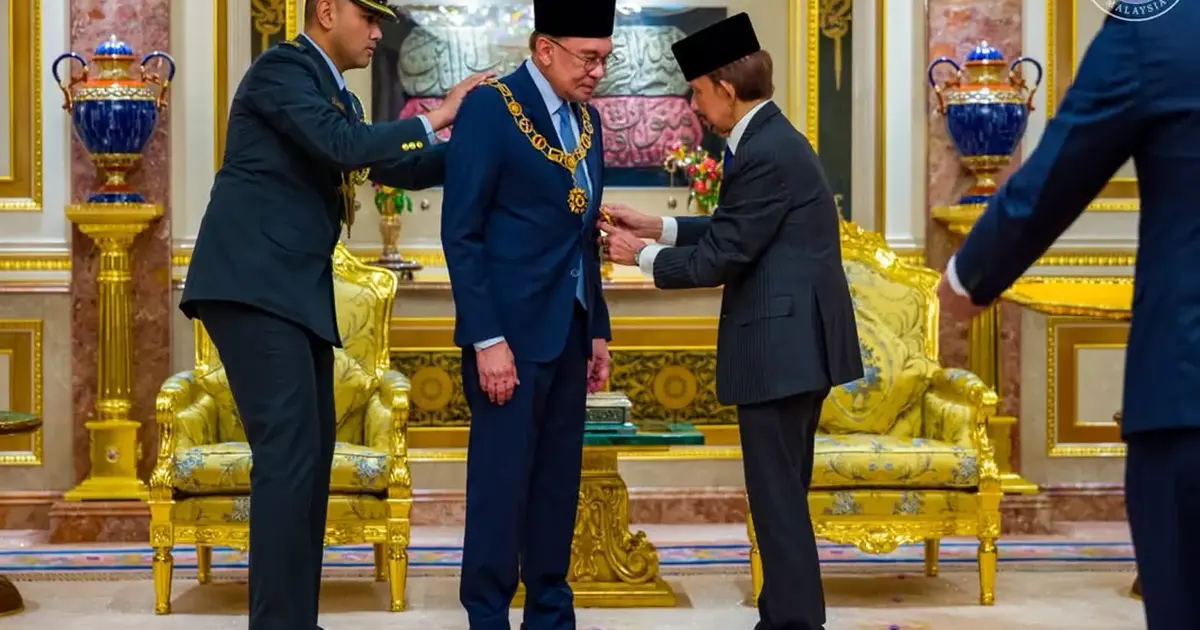
Prime Minister Anwar Ibrahim has received the Darjah Kerabat Laila Utama Yang Amat Dihormati (D.K.), one of Brunei Darussalam's most elevated orders of honour, from Sultan Hassanal Bolkiah. The distinction underscores the personal regard with which Malaysia's leader is held in Brunei's royal court and signals deepening bonds between the two neighbouring Southeast Asian nations.
The awarding of such a prestigious distinction carries considerable diplomatic weight in the region. The D.K. honour, which translates to the Most Esteemed Order of Royal Kinship, is typically conferred upon foreign dignitaries and leaders who have demonstrated exceptional commitment to fostering bilateral relationships or who hold special significance to Brunei's interests. The conferment reflects Sultan Hassanal Bolkiah's recognition of Anwar's leadership and his efforts to strengthen Malaysia-Brunei relations during his tenure as Prime Minister.
Malaysia and Brunei share deep historical and cultural ties rooted in their common Islamic heritage and membership within regional organisations. The two nations maintain robust diplomatic channels and collaborate extensively through various multilateral frameworks, including ASEAN, where coordinated positions often carry considerable influence. Brunei, as a smaller nation with significant economic interests tied to oil and gas revenues, places particular emphasis on maintaining stable relationships with its larger neighbours, making gestures such as this honour strategically meaningful.
Anwar Ibrahim's receipt of this honour comes at a time when Malaysia-Brunei relations have experienced renewed momentum. The gesture from Sultan Hassanal Bolkiah indicates the strength of personal relationships between leadership figures in both countries and their shared commitment to advancing regional cooperation. Such honours serve not merely as ceremonial recognition but as public reaffirmation of diplomatic bonds that underpin practical collaboration across multiple sectors, from trade and investment to security and cultural exchange.
The broader context of Malaysian-Brunei ties encompasses significant bilateral trade and investment flows, with both nations benefiting from proximity, shared maritime interests, and complementary economic structures. Beyond commerce, the two countries collaborate on matters of mutual concern including maritime security, counterterrorism efforts, and environmental protection initiatives in the region. Brunei's small but wealthy economy has made it an attractive investment destination for Malaysian companies, while Malaysian firms provide substantial expertise and services to Brunei's oil and gas sector.
Within ASEAN, Malaysia and Brunei often find common ground on regional issues, and their diplomatic alignment carries weight in shaping bloc positions. Sultan Hassanal Bolkiah's decision to honour Anwar Ibrahim signals his confidence in Malaysia's leadership direction and its commitment to maintaining constructive regional engagement. This becomes particularly significant given Malaysia's strategic location and economic influence within Southeast Asia, where its policies and diplomatic initiatives substantially influence regional dynamics.
For Anwar Ibrahim personally, such recognition from a respected neighbour enhances his international standing and reinforces Malaysia's role as a significant player in regional affairs. Honours from fellow Southeast Asian leaders carry particular symbolic value, as they emanate from peers who understand the regional context intimately and who have close stakes in Malaysia's domestic and foreign policy orientations. The distinction also acknowledges Anwar's own background and contributions to Malaysian-Brunei relations throughout his political career.
The timing of this honour may also reflect broader regional considerations. Southeast Asia continues to navigate complex geopolitical pressures from major powers and faces numerous transnational challenges requiring coordinated responses. In this environment, strengthen relationships between ASEAN member states become increasingly valuable. Brunei's gesture towards Malaysia's Prime Minister can be interpreted as reinforcing the importance of intra-ASEAN solidarity and cooperation at a moment when such unity remains crucial for the bloc's relevance and influence.
From a Malaysian perspective, the honour carries domestic resonance as well. Recognition from foreign heads of state, particularly from neighbouring nations with which Malaysia maintains significant strategic interests, enhances the prestige of Malaysia's leadership on both the international and domestic stages. Such diplomatic courtesies contribute to the narrative of Malaysia's constructive engagement in regional affairs and its acceptance as a responsible stakeholder in Southeast Asia's evolving political landscape.
The conferment of the D.K. honour represents a continuation of the tradition of formal diplomatic recognition that characterises the relationship between Malaysia and Brunei. Both nations have long maintained protocols for honouring each other's leaders and dignitaries, and these ceremonies serve as important markers of the state of bilateral relations. Looking forward, this gesture suggests that Malaysia-Brunei relations will likely continue on their cooperative trajectory, with both nations recognising mutual benefit in maintaining strong institutional and personal ties.

