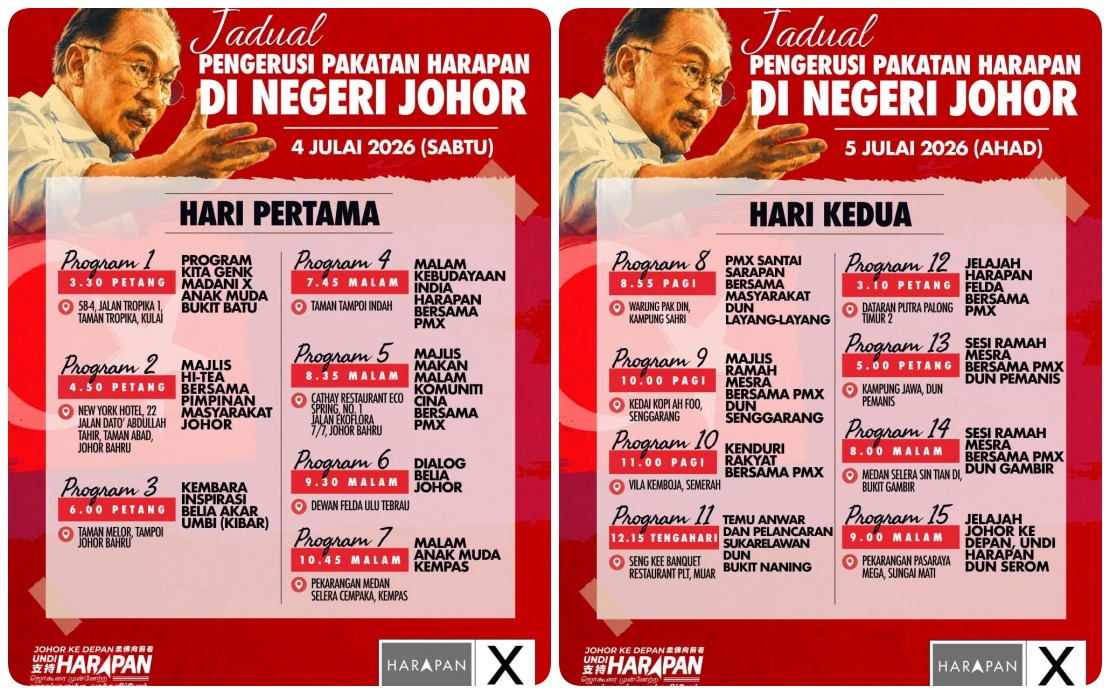
Prime Minister Datuk Seri Anwar Ibrahim is throwing the full weight of his leadership behind Pakatan Harapan's campaign for the Johor state election, embarking on an ambitious seven-programme tour across the state on July 4. The comprehensive itinerary demonstrates the federal government's determination to secure a strong mandate in Malaysia's second-largest state, where political dynamics have shifted considerably since the last electoral exercise. With voting scheduled for July 11 and early polling on July 7, the campaign is entering its critical final week.
Anwar's schedule reflects a deliberate strategy to reach across multiple voter demographics and constituencies. The day's activities encompass everything from grassroots voter engagement to high-level networking with community leaders, indicating that PH is leaving nothing to chance in what has become a closely contested contest. His presence on the campaign trail carries symbolic weight, signalling to the electorate that the coalition's leadership is personally invested in securing victory in a state that historically plays a pivotal role in determining Malaysia's overall political trajectory.
The afternoon segment of Anwar's tour includes a high tea reception with Johor community leaders at a local hotel at 4.50 pm. These gatherings serve multiple purposes in contemporary campaign strategy—they allow party leadership to hear concerns directly from influential voices in civil society, demonstrate responsiveness to grassroots constituencies, and generate positive media coverage. In the Malaysian context, where community leaders and religious figures wield considerable influence over voter sentiment, such sessions can meaningfully shift electoral momentum in closely contested districts.
Youth engagement forms a crucial pillar of PH's campaign architecture, recognising that younger voters have increasingly become the swing demographic in Malaysian elections. Accordingly, Anwar's schedule includes a Youth Dialogue session at Felda Ulu Tebrau Hall at 9.30 pm, providing a platform for frank discussions between the Prime Minister and young constituents. This focus reflects broader recognition that Johor's youth population has distinct concerns around economic opportunity, educational advancement, and climate policy—issues that differ markedly from those preoccupying older voter cohorts.
Pakatan Harapan is fielding candidates in all 56 state assembly seats, representing an ambitious full-slate approach that contrasts with more conservative strategies employed in previous contests. The coalition's composition reflects negotiated power-sharing among its constituent parties: PKR is contesting 20 seats, Amanah 19, and DAP 17. This distribution represents a careful balance of political influence and electoral viability, with each party positioned to maximise its vote share while maintaining overall coalition coherence. In Malaysian state elections, such internal coalition dynamics often determine ultimate campaign effectiveness as much as external opposition messaging does.
The broader electoral landscape in Johor has undergone considerable transformation over recent years. The state remains economically significant, with its port facilities, manufacturing base, and position as a major trading hub making it strategically important to any federal government. Electoral outcomes in Johor have historically foreshadowed national political trends, lending particular significance to how voters respond to PH's campaign messaging and governance record.
With 172 candidates competing across 56 seats, the election features a more fragmented field than some observers anticipated. This multiplicity of candidates can both complicate and clarify electoral outcomes—while it creates genuine voter choice, it also potentially fragments anti-government votes if opposition figures compete against one another rather than maintaining unified candidacy. PH's strategy of contesting all seats represents a confidence in its organisational capacity and polling assessments, though it also carries inherent risks if campaign momentum dissipates or if candidates prove unable to mobilise sufficient ground support in their respective constituencies.
Anwar's campaign continuation into July 5 with eight additional programmes demonstrates the intensity with which PH is pursuing victory. This sustained effort reflects both confidence and perhaps underlying concern about the competitive nature of the contest. Extended campaign schedules at the leadership level serve to energise party machinery at lower levels—when voters see the Prime Minister personally campaigning in their state, it reinforces messaging about the importance of the election and signals organisational vitality.
The significance of the Johor election extends beyond state-level governance. For Anwar's federal administration, strong performance would provide a political mandate for continued implementation of his policy agenda, particularly regarding economic reforms and efforts to address cost-of-living pressures affecting Malaysian households. Conversely, disappointing results could complicate his political position heading into discussions about future national elections and coalition stability.
From a Southeast Asian perspective, Malaysian state elections often reflect regional trends in how citizens are responding to incumbent governments facing inflationary pressures, stagnant wage growth, and concerns about democratic institutions. The Johor election provides insight into whether regional voters are rewarding or punishing incumbent coalitions for their macroeconomic management and whether populist or reformist messaging proves more resonant with electorates navigating post-pandemic economic recovery.
The early voting on July 7 represents an important tactical consideration in PH's campaign mathematics. Early polling traditionally benefits well-organised parties with strong ground machinery capable of mobilising voters before the main election day. PH's extensive pre-poll campaign schedule suggests confidence in its capacity to convert campaign activities into actual voting behaviour among those eligible for early voting—a crucial demographic often comprising civil servants and government workers.

