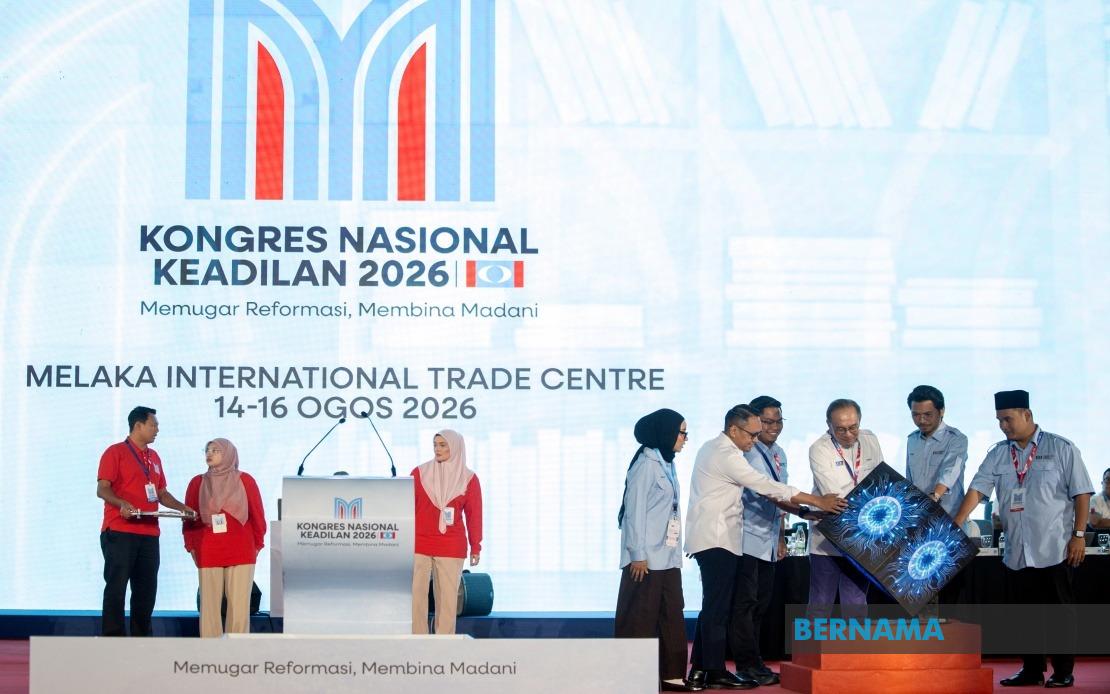
Prime Minister Datuk Seri Anwar Ibrahim launched a significant ideological document in Melaka this week, marking what appears to be a deliberate effort to deepen intellectual engagement within Parti Keadilan Rakyat's youth wing and beyond. The 113-page publication, authored by Angkatan Muda Keadilan (AMK) chief Muhammad Kamil Ahmad Munim alongside executive committee member Ashraf Ahmad Hadi, represents an attempt to crystallise the party's evolving philosophy on contemporary governance challenges at a moment when Malaysia grapples with pressing social and economic transformations.
In characterising the document's significance, Anwar framed it not as routine party literature but as an instrument of what he termed civilisational renewal. His language deliberately contrasts this initiative with what he dismisses as mere technocratic posturing or superficial seasonal political messaging, suggesting an underlying concern that Malaysia's youth leadership may be drifting toward pragmatism unmoored from principled moorings. This framing carries particular weight given the fractious state of Malaysian coalition politics, where competing narratives about national purpose frequently obscure substantive policy discussion.
The timing of this launch deserves scrutiny. Coinciding with the adoption of what the source text suggests is a broader strategic framework, the publication appears positioned as PKR's intellectual response to governing demands that have proven more complex than anticipated. For Malaysian observers tracking the government's trajectory since 2022, such interventions signal leadership awareness that maintaining coalition cohesion and party discipline requires continual reinforcement of ideological consensus, particularly among younger cadres who may lack direct connection to the party's reform origins.
Central to Anwar's messaging was a deliberate redirection of youth attention away from what he implicitly criticised as shallow celebrations of achievement. He characterised the responsibility incumbent on younger party members not primarily as an opportunity for advancement or institutional comfort, but as a test of personal piety and moral integrity. This language carries unmistakable echoes of Islamist political philosophy, though deployed here within a multiethnic, constitutionally secular framework, suggesting PKR's ongoing negotiation between its Islamist heritage and its multiethnic present.
The substance of Anwar's framing emphasises the magnitude of reconstruction required across Malaysia's institutional landscape. His reference to a nation scarred by past injustices and systemic leakages directly invokes the corruption narratives that defined PKR's opposition identity for two decades. Yet deployed from the prime minister's office, such language becomes both more pointed and more problematic: it simultaneously validates institutional renewal while inviting questions about whether governmental power has translated into measurable anti-corruption outcomes or merely rhetorical continuity.
Responsibility for generating solutions, according to Anwar's statement, demands what he specifically identifies as extraordinary creativity, intellectual courage and spiritual resilience. This triad is analytically revealing. Creativity suggests problem-solving beyond bureaucratic convention; intellectual courage implies willingness to challenge received wisdom; spiritual resilience indicates capacity to maintain principled positions amid political compromise. For Southeast Asian governance contexts, where elite capture frequently constrains reform implementation, such emphasis on individual qualities rather than structural reform mechanisms potentially overstates the autonomy of well-intentioned cadres within hierarchical party systems.
The publication itself functions on multiple levels simultaneously. Ostensibly, it serves as a training resource for AMK members, offering historical context about PKR's struggle for political reform and clarifying foundational party ideology. More subtly, it addresses what party leadership apparently perceives as slippage in younger members' commitment to Reformasi principles—a concept that originated as shorthand for systemic political renewal but risks becoming hollowed of meaning as administering government proves less galvanising than opposing it.
The emphasis on transforming members into knowledgeable and principled actors rather than merely efficient administrators deserves particular attention. This distinction implies acknowledgement that governmental routine can domesticate radical intent, that institutionalisation poses dangers distinct from external opposition. For Malaysian politics, where power transitions frequently dissipate reform momentum through absorption into existing bureaucratic cultures, such preventive messaging suggests PKR strategists recognise the historical pattern and are attempting counter-insurgency against it.
What remains conspicuously absent from available descriptions is concrete policy content. The publication apparently prioritises ideological coherence and moral framework over programmatic specifics, which invites alternative readings: either sophisticated recognition that principles must precede policy within party cadre training, or concerning indication that PKR lacks clarity on substantive policy directions beyond anti-corruption messaging. For Malaysian observers, particularly those tracking the government's performance on economic restructuring, institutional strengthening and regional integration, such ambiguity carries practical consequences.
The launch itself occurred in Melaka, a state of neither overwhelming strategic importance nor obvious electoral significance in immediate PKR calculations, suggesting the event aimed at internal party communication rather than broader public messaging. This targeted approach aligns with framing the publication as cadre-building material, yet raises questions about whether such ideological labour, however intellectually rigorous, adequately addresses the concrete governance challenges that define public evaluation of the administration's performance.
For Southeast Asian context, PKR's investment in youth ideological formation reflects broader regional trends whereby parties governing after transitions from opposition face legitimacy pressures requiring simultaneous institutional consolidation and programmatic delivery. The emphasis on moral renewal and spiritual resilience, deployed within Malaysia's specific Islamic cultural context, illustrates how explicitly religious vocabulary enters secular governance discourse across Muslim-majority democracies, shaping both opportunity and constraint for policy implementation.
The broader implication for Malaysian readers involves recognising that government maintenance of coalition coherence increasingly relies on ideological reinforcement rather than material distribution of patronage or institutional rewards. This shift potentially stabilises governance arrangements dependent on volunteer commitment across diverse constituencies, but equally risks reduced flexibility when policy demands diverge from received principles. Whether this publication successfully regenerates youthful commitment to Reformasi ideals or merely documents its calcification into institutional orthodoxy will become apparent only through subsequent governmental performance and the actual evolution of policy outcomes addressing systemic injustices Anwar's language invokes.

