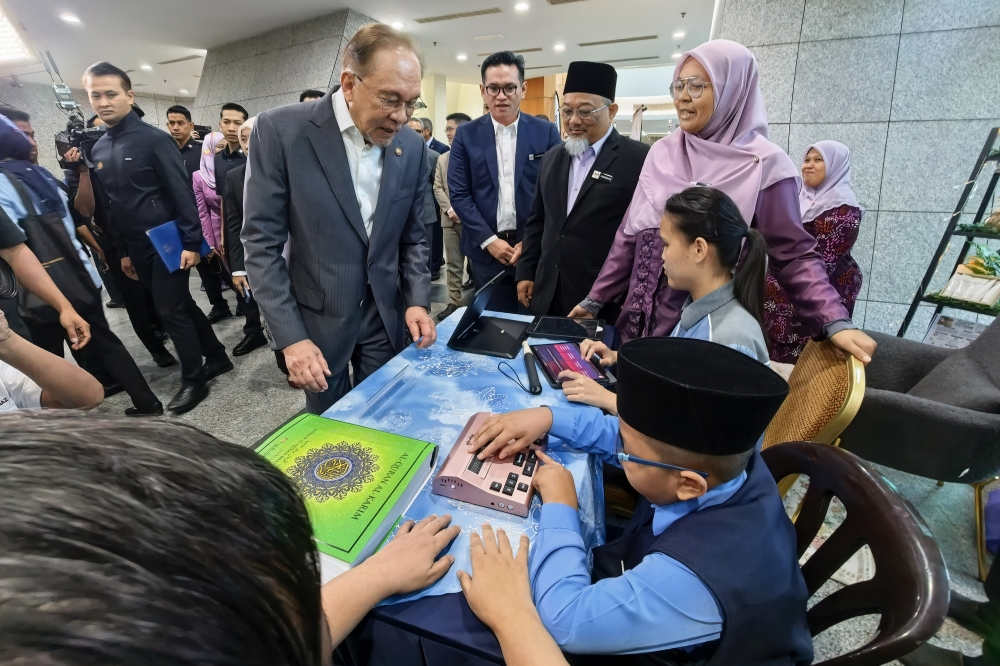
Prime Minister Datuk Seri Anwar Ibrahim has moved to allay widespread concerns among language advocates and cultural custodians that encouraging Malaysians to become fluent in English, Mandarin, or other international languages represents a threat to Bahasa Melayu's constitutional standing and cultural significance. Speaking in Putrajaya on July 28, Anwar reframed the debate around linguistic proficiency, positioning multilingualism not as a challenge to national identity but as an essential economic and diplomatic asset in an increasingly interconnected world.
Anwar's intervention comes amid growing anxiety within segments of Malaysian society about the perceived erosion of Bahasa Melayu's primacy. Language remains one of the most sensitive pillars of the Federal Constitution, with Article 152 enshrining Bahasa Melayu as the sole official language. Any perceived dilution of this status touches fundamental questions about national identity, sovereignty, and the social contract that underpins the Malaysian federation. The Prime Minister's framing sought to separate the constitutional guarantee—which remains unassailable—from practical educational and professional policy.
The distinction Anwar drew is analytically important for understanding contemporary challenges facing Malaysia's education system. The nation faces competing pressures: maintaining constitutional commitments while equipping citizens for participation in global commerce, academia, and diplomacy where English proficiency is virtually mandatory. Many Malaysian students graduate without functional English ability despite years of classroom instruction, a deficit that hampers their employability and limits career trajectories. Simultaneously, there exists genuine apprehension, particularly among Bahasa Melayu educators and cultural organizations, that reduced emphasis on the national language could gradually weaken its institutional presence and prestige within the education sector.
Anwar's statement reflects a pragmatic understanding of Malaysia's position within Southeast Asia and the broader global economy. Singapore's model—where English serves as the working language while Mandarin, Malay, and Tamil maintain cultural and community roles—demonstrates that multilingualism need not create a zero-sum competition between languages. The Prime Minister appears to be advocating for a similar framework where Bahasa Melayu retains constitutional and ceremonial primacy while other languages serve functional purposes in commerce and international relations. This represents a departure from more defensive postures that frame language questions primarily through a protectionist lens.
The timing of Anwar's remarks suggests engagement with broader currents in Malaysian public discourse. Recent years have witnessed heated debates over English-medium instruction in schools, with different stakeholder groups articulating incompatible visions of educational priorities. Some argue that strengthening English capabilities is essential for Malaysian competitiveness in technology and higher education, where English dominates as the lingua franca. Others contend that such shifts inevitably reduce institutional investment in Bahasa Melayu instruction and diminish its social prestige among younger generations. Anwar's intervention attempts to transcend this polarization by asserting that both objectives can be pursued simultaneously.
For regional observers, Anwar's stance carries implications for Malaysia's educational trajectory. The country has historically maintained stronger Bahasa Melayu instruction than many Southeast Asian neighbors, reflecting constitutional requirements and nationalist ideology. Yet this has come with measurable costs: Malaysian university graduates frequently score lower on international English proficiency indices than counterparts from Thailand, Vietnam, or the Philippines, where educational systems prioritize English more heavily. If Anwar's framework gains institutional traction, it could lead to curriculum reforms emphasizing sequential or parallel language acquisition, beginning with strong foundational Bahasa Melayu but progressively integrating rigorous English instruction.
The political dimensions of Anwar's statement merit consideration. Language nationalism remains a potent force within Malaysian politics, with Bahasa Melayu advocates occupying influential positions within the education ministry, cultural institutions, and Islamist political parties. By publicly endorsing multilingualism while reaffirming Bahasa Melayu's constitutional standing, Anwar attempts to preempt criticism from these quarters while establishing policy space for educational innovation. This represents a delicate balancing act, requiring rhetorical finesse to avoid accusations of cultural betrayal from nationalist constituencies while simultaneously addressing economic anxieties about Malaysian graduates' international competitiveness.
The practical implementation of such a vision presents significant institutional challenges. Malaysia's education system suffers from resource constraints, teacher shortages in specialized fields, and existing curriculum overcrowding. Simultaneously elevating standards in both Bahasa Melayu and English instruction requires substantial investment in teacher training, curriculum development, and pedagogical resources that may not be readily available. The international experience suggests that effective multilingual education demands careful planning and sustained funding rather than rhetorical commitment alone.
Anwar's remarks also implicitly address concerns within Malaysia's business community and multinational corporations operating locally. These entities consistently identify language proficiency gaps as impediments to productivity and innovation. Many international companies conduct business operations in English, and employees lacking adequate proficiency find themselves disadvantaged in advancement opportunities. By articulating that multilingual capability strengthens rather than weakens the nation, Anwar signals receptiveness to corporate and developmental concerns while maintaining political credibility with nationalist constituencies.
Looking forward, the resonance of Anwar's framework within the education ministry and among curriculum planners will determine whether this represents substantive policy direction or rhetorical positioning. Malaysia possesses genuine institutional expertise in multilingual education, having successfully maintained multiple language streams in secondary schools for decades. Scaling this model more comprehensively across the education system while improving English instruction quality presents an ambitious agenda, but one theoretically achievable given adequate resources and political commitment. The Prime Minister's July 28 remarks suggest at least rhetorical openness to such evolution.

