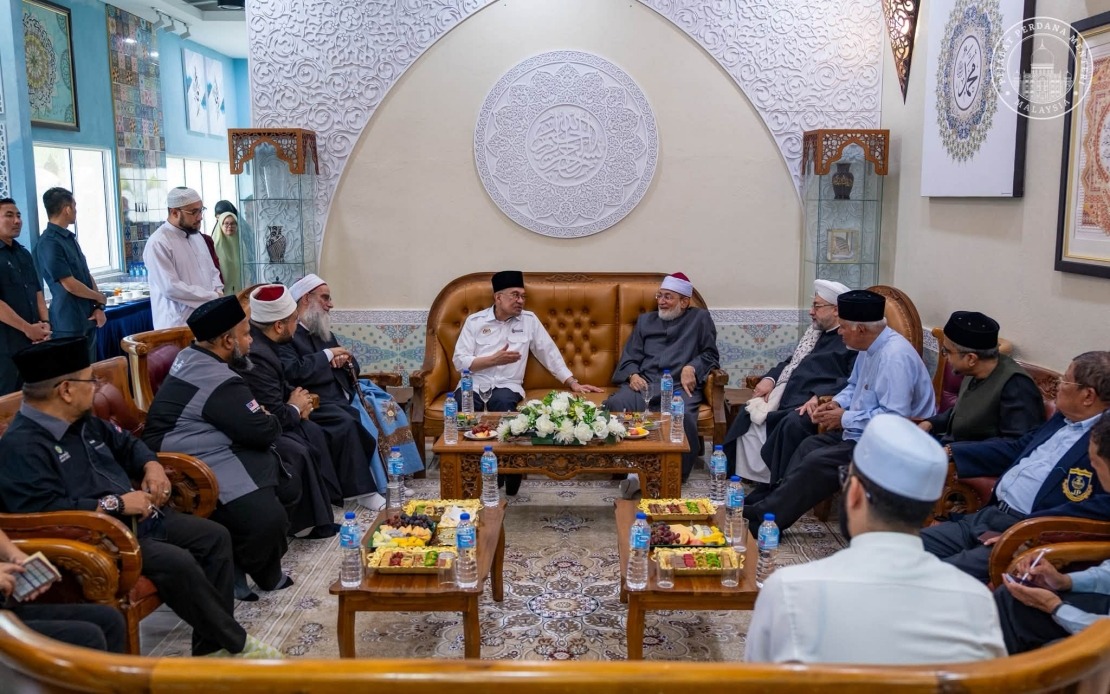
Prime Minister Datuk Seri Anwar Ibrahim carved time from his demanding schedule to meet with three internationally respected Islamic scholars who are currently in the country, underscoring the government's engagement with influential figures in the Muslim world and its commitment to strengthening Islamic discourse within Malaysian society.
The three visitors represent different but equally significant pillars of Islamic scholarship and practice. Al-Fadhil Al-Allamah Al-Muhaddith Syeikh Dr Mustafa al-Nadwi Al-Hasani brings considerable expertise as an Egyptian hadith specialist, contributing to the scientific study of Islamic traditions. Al-Fadhil Al-Allamah Al-Muqri' Syeikh Dr Ahmad Isa Al-Ma'sarawy, renowned globally for his Quranic recitation prowess, embodies the devotional dimension of Islamic learning through his mastery of tajweed and melodious rendering of sacred text. The third visitor, Al-Fadhil Al-Syeikh Maulana Al-Sayyid Afeefuddin Al-Jailani, serves as custodian of the waqf endowments, mosques, and spiritual sites connected to the venerated Syeikh Abdul Qadir Al-Jailani, a figure of immense importance in Sufi Islam across the Muslim world.
According to remarks Anwar shared on social media, the encounter at Nasyrul Quran allowed him to inquire into the wellbeing of his distinguished guests while seeking their wisdom and spiritual supplications. This gesture reflects a broader diplomatic approach in which Malaysia positions itself as a hub for Islamic learning and interfaith harmony in Southeast Asia. The Prime Minister's visible engagement with such figures sends a message both domestically and internationally about the nation's dedication to nurturing Islamic scholarship and maintaining strong ties with respected Islamic institutions and leaders.
Anwar's public acknowledgement of the visit emphasises the value he places on the scholars' presence in Malaysia and their contribution to enriching the country's religious knowledge base. In his statement, he expressed sincere appreciation for their willingness to travel to the nation specifically to disseminate Islamic teachings and wisdom. This framing positions their visit not merely as a courtesy call but as a substantive contribution to Malaysia's intellectual and spiritual development, particularly at a time when many Muslim-majority nations grapple with questions about how to preserve traditional Islamic learning while engaging with contemporary challenges.
The location of the meeting at Nasyrul Quran, an institution focused on Quranic studies and promotion, carries symbolic weight. By choosing this venue, Anwar demonstrated that the government views Quranic education and Islamic scholarship as foundational to national development and social cohesion. This aligns with Malaysia's historical positioning as a centre for Islamic moderation and reasoned interpretation of faith, distinctions the country has cultivated over decades through its religious institutions, universities, and government-sponsored Islamic education initiatives.
For Malaysia's broader Islamic ecosystem, such high-level diplomatic engagement with foreign scholars reinforces the nation's openness to knowledge exchange and cross-border intellectual dialogue within the Muslim world. It also signals to domestic religious communities that government leadership takes seriously the role of Islamic scholars in society. The presence of Egypt's Al-Nadwi, for instance, connects Malaysia to the broader Arab Islamic scholarly tradition, while Al-Ma'sarawy's prominence in Quranic recitation circles demonstrates engagement with one of Islam's most widely appreciated and practiced dimensions across cultures and languages.
The timing of these visits often relates to specific religious occasions, international conferences, or formal invitations extended by Malaysian Islamic organisations and government agencies. Such arrangements facilitate knowledge transfer, expose Malaysian scholars and students to international expertise, and strengthen institutional networks. For visiting scholars, Malaysia offers a stable, developed Muslim-majority nation where their teachings can reach audiences directly and where partnerships with local institutions can be formalised for longer-term collaboration.
The Prime Minister's emphasis on seeking prayers and counsel from the visiting scholars reflects traditional protocols in Islamic diplomacy and governance, where leaders have historically sought blessings and wisdom from respected religious authorities. This practice, maintained even in modern contexts, underscores continuity with Islamic governance traditions while serving practical purposes in building relationships and demonstrating respect for religious authority structures that command significant influence among Muslim populations.
For Malaysian society, such initiatives contribute to an environment in which Islamic scholarship is viewed as compatible with modern governance and in which religious learning is presented as an asset to national development rather than an obstacle to progress. This positioning has helped Malaysia navigate potential tensions between secular governance structures and the expectations of its Muslim majority, offering a model of integration that other Muslim-majority nations sometimes study and attempt to emulate.
Anwar's engagement also reflects the broader diplomatic role that Malaysia seeks to play within the Organisation of Islamic Cooperation and among Muslim-majority nations. By hosting prominent scholars and demonstrating high-level government interest in their work, Malaysia reinforces its credentials as a responsible custodian of Islamic heritage and a credible voice in discussions about Islam's role in contemporary society. Such positioning carries weight in regional and international forums where Malaysia often advocates for moderate Islamic perspectives and interfaith dialogue.

