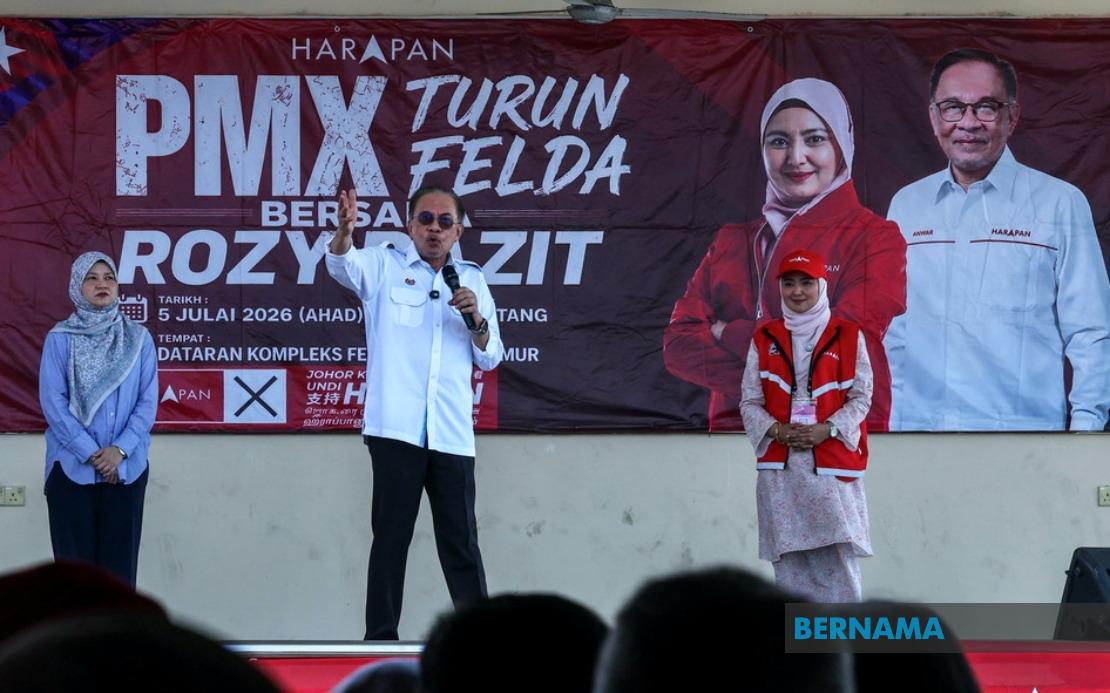
Prime Minister Datuk Seri Anwar Ibrahim has given his personal commitment to addressing one of Malaysia's most persistent rural development challenges: securing housing sites for the second generation of Federal Land Development Authority (FELDA) settlers. Speaking during a community engagement programme in Segamat, Anwar underscored the urgency of tackling a problem that has festered unresolved for decades, framing it as a priority that demands immediate attention from his administration.
The housing crisis affecting FELDA's second generation represents a significant governance gap in Malaysia's land settlement scheme. When FELDA was established to transform rural communities through agricultural development, the original settlers and their families were provided with plots and housing within planned schemes. However, as these settlements matured and the first generation aged, the second generation—their adult children—faced a structural barrier: insufficient allocated land for new housing sites, leaving many unable to secure their own property within their home communities.
Anwar's statement carries political weight precisely because he has chosen to make this a personal policy commitment rather than delegating it solely to responsible ministries. He explicitly stated his intention to ensure that solutions protecting second-generation housing entitlements would be implemented during his tenure as Prime Minister, working alongside the minister responsible for FELDA affairs. This framing suggests recognition that despite the issue's visibility, bureaucratic inertia has prevented meaningful resolution without executive-level intervention.
The Prime Minister's acknowledgment that resolving the issue depends on state cooperation reflects the constitutional reality of Malaysian federalism. Land administration and the provision of basic infrastructure—water, electricity, roads, and waste management—fall under state jurisdiction, not federal control. This jurisdictional split has historically complicated FELDA-related policy implementation, as state governments must align their land use planning and infrastructure development budgets with federal FELDA expansion goals. Without state-level political will and fiscal commitment, federal policy directives lack implementation mechanisms.
Segamat, where Anwar made these remarks, sits within Selangor, and the presence of Selangor Menteri Besar and PKR Vice-President Datuk Seri Amirudin Shari at the event signals potential alignment between state and federal levels on this issue. Amirudin's dual role as the top state administrator and coalition partner within Anwar's government may facilitate the inter-governmental coordination necessary to unlock land identification and infrastructure provision for FELDA expansion. However, such coordination remains contingent on sustained political prioritization and budget allocation in subsequent state administrations should leadership change.
The second-generation housing problem carries broader implications for rural social stability and FELDA's institutional legitimacy. When settlers' children face barriers to property ownership within their ancestral communities, several outcomes follow: young families migrate to urban areas seeking housing and employment, draining rural human capital; community cohesion weakens as intergenerational continuity breaks; and FELDA schemes risk demographic stagnation as aging populations lose younger members' participation in cooperative governance structures. Economically, displaced youth represent lost productivity in agricultural sectors where FELDA schemes operate.
The decades-long lag in addressing this issue reflects deeper governance challenges within FELDA itself. As a statutory authority, FELDA operates under federal oversight but must coordinate with state governments, creating accountability gaps when problems persist without resolution. The involvement of Education Minister Fadhlina Sidek and Deputy National Unity Minister R. Yuneswaran alongside state officials suggests the government's recognition that this is not merely a housing or agricultural issue, but one intersecting education access, intercommunal relations, and equitable development.
From a Southeast Asian perspective, Malaysia's experience with planned settlement schemes offers instructive lessons. Indonesia's transmigration programmes, Thailand's agricultural extension initiatives, and Vietnam's land redistribution efforts have all confronted similar second-generation dynamics. The common challenge across these contexts is that first-generation beneficiaries' success does not automatically translate to institutional capacity for supporting their descendants' integration into the same schemes. Solutions require explicit policy design, not merely incremental expansion of existing frameworks.
The political timing of Anwar's commitment during a community engagement programme in a FELDA-adjacent constituency reflects constituency politics as well as governance intent. Segamat's Buloh Kasap state constituency includes FELDA settlements, and R. Yuneswaran's attendance in his capacity as the local MP underscores that housing discontent among second-generation settlers registers politically. By publicly pledging resolution, Anwar addresses both material grievances and political expectations within rural constituencies that form important electoral blocs for his coalition.
Moving forward, translating commitment into implementation requires defining several specifics: What constitutes adequate housing site allocation per second-generation settler? How will land acquisition be funded—through state budgets, federal transfers, or FELDA internal resources? Which FELDA schemes will be prioritized for expansion? What timeline is realistic given existing state administrative capacity? Without operational clarity, the Prime Minister's pledge, however sincere, risks becoming another unfulfilled promise in a lengthy history of rural development declarations.
The involvement of the FELDA minister, not named in the announcement, will prove critical. This individual must broker state cooperation, secure budget allocations, and establish measurable progress indicators. Given Malaysia's political dynamics, where state governments represent various coalition partners with competing priorities, the capacity to coordinate a multi-state FELDA expansion programme demands sustained political capital and executive attention. Anwar's personal investment in this issue suggests he recognizes its symbolic importance for rural constituencies and institutional legitimacy, factors that may sustain the necessary momentum beyond initial announcements.

