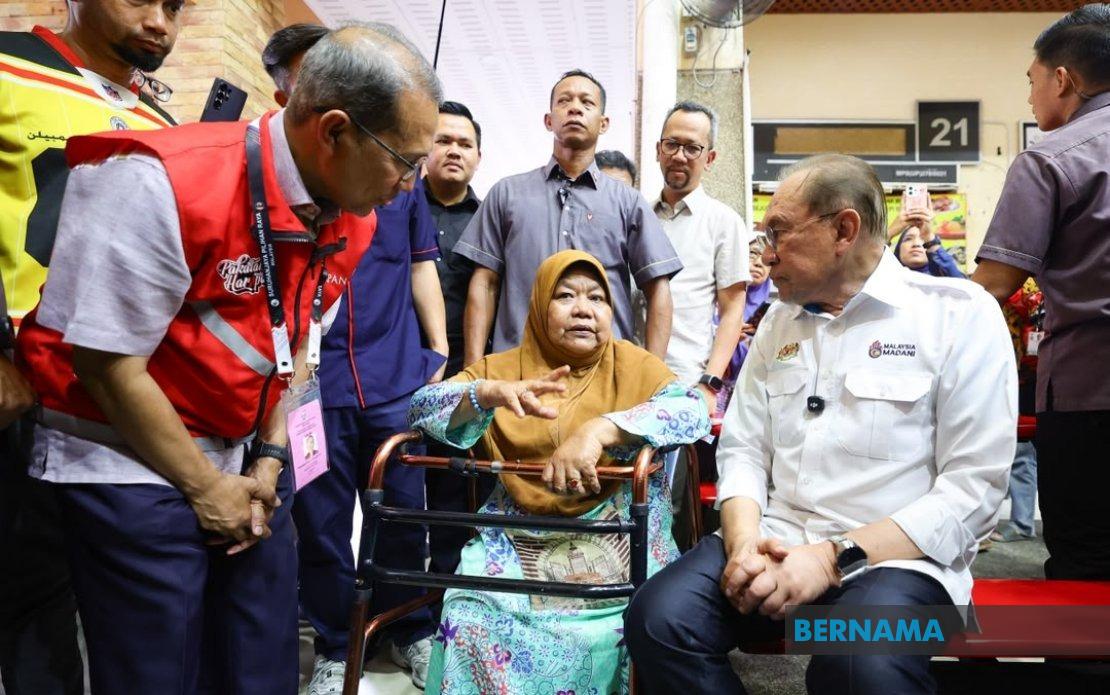
Prime Minister Datuk Seri Anwar Ibrahim has pointed to river widening and deepening projects across Negeri Sembilan as concrete evidence that the Pakatan Harapan-led state administration can deliver tangible benefits to constituents while maintaining transparent stewardship of public resources. Speaking at a community engagement event in Ampangan on July 22, Anwar underscored how such initiatives represent the kind of people-centred governance that should define development across the nation. The remarks come as PH mobilises campaign efforts ahead of the 16th Negeri Sembilan State Election, scheduled for August 1, with early voting set for July 28.
The Ampangan river project exemplifies the administration's strategy of addressing multiple development challenges simultaneously. By undertaking the widening and deepening work on a reciprocal basis—a framework in which extracted materials serve productive purposes—the state government tackles flooding vulnerabilities while generating revenue for ongoing maintenance and infrastructure upgrades. This approach contrasts with conventional project models where extracted resources may represent sunk costs or be underutilised. For communities historically vulnerable to seasonal inundation, the dual outcome of enhanced flood resilience and improved riverine infrastructure carries substantial practical value.
Anwar's emphasis on resource recycling through sand extraction reveals an underlying economic logic that resonates beyond Negeri Sembilan's borders. Throughout Southeast Asia, where rapid urbanisation and climate-related flood risks have intensified pressure on state budgets, demonstrating efficient resource deployment attracts voter confidence. The model suggests that development need not exhaust public finances if projects generate revenue streams for reinvestment. This fiscal discipline aligns with broader narratives about accountable governance, a concern elevated across Malaysia following earlier administrations' financial controversies.
The Prime Minister stressed that integrity-based governance must constitute the bedrock upon which development programmes rest, particularly in how governments allocate resources and prioritise community welfare. This framing positions PH's approach as fundamentally distinct from previous administrations, though such assertions require scrutiny against actual implementation records. Nevertheless, for voters evaluating competing governance claims, the coherence between stated principles and visible project outcomes carries persuasive weight. The Ampangan initiative provides tangible proof points that can be referenced in broader arguments about institutional accountability.
Anwar drew parallels to his involvement in Port Dickson development negotiations, recounting how project design incorporated protections for the local fishing community through educational investment and residential improvements. This narrative demonstrates awareness that development should distribute benefits across social strata rather than concentrate gains among urban elites or commercial investors. Such framing appeals particularly to rural and semi-urban constituencies where infrastructure provision has historically lagged, a crucial consideration in states like Negeri Sembilan where township and village populations represent significant voting blocs.
The political dimension of this campaign messaging warrants analysis. By highlighting completed or ongoing projects, PH establishes a performance record distinct from opposition parties who may lack comparable administrative experience in the state. The August 1 polling date arrives during a period when monsoon-related flooding typically concerns residents across the peninsular interior, making river management initiatives especially salient electoral subjects. Voters confronting recent flood experiences may view such projects as directly responsive to their lived concerns.
PH's electoral strategy in Negeri Sembilan involves contesting all 36 state seats through a coalition structure: 16 candidates from PKR, 11 from DAP, and nine from Amanah. This distribution reflects negotiated power-sharing arrangements within the coalition, with PKR's dominant position reflecting its largest membership base. For Malaysian observers tracking inter-coalition dynamics, such seat allocations signal how PH manages internal tensions while maintaining electoral unity against opposition Barisan Nasional and Perikatan Nasional formations.
Anwar's appeal for voters to choose candidates of integrity and character—explicitly mentioning the availability of trustworthy individuals across Malay, Indian, and Chinese communities—attempts to transcend communal voting patterns that have characterised Malaysian politics. This inclusive messaging acknowledges the state's multiethnic composition while implicitly criticising opposition parties that may rely on more polarised rhetoric. Whether such appeals meaningfully shift voter behaviour remains uncertain, but they reflect PH's strategic positioning as a multiethnic coalition.
The broader context involves Negeri Sembilan's political trajectory. The state has witnessed competitive contests between BN and opposition coalitions, with varying outcomes across different election cycles. PH's control of the state machinery since previous transitions provides advantages in resource allocation for campaigning and policy visibility. Conversely, entrenched BN networks and communal organisational structures continue representing significant opposition assets. The August 1 election will test whether infrastructure-focused governance messaging and coalition unity prove sufficient to consolidate PH's position or whether alternative political forces can capitalise on any governance performance gaps.
For Malaysian and Southeast Asian observers, the Negeri Sembilan election offers insights into how regional democracies balance infrastructural delivery, transparent governance claims, and electoral competition. The emphasis on visible projects addressing community concerns—flooding in this instance—reflects broader patterns where voters increasingly evaluate governments on concrete service provision rather than solely on ideological appeals. This shift has implications for how political formations across the region calibrate campaign strategies and governance priorities.
The implementation of such river management initiatives also carries environmental dimensions worthy of consideration. Responsible extraction and reinvestment in riverine infrastructure can support ecosystem health if managed according to environmental standards. Conversely, poorly regulated sand extraction has damaged waterways across Southeast Asia, degrading habitats and destabilising banks. Anwar's emphasis on transparency should ideally extend to environmental governance, ensuring that resource extraction aligns with sustainability principles alongside immediate community benefits.
As PH consolidates messaging around development delivery and integrity-based governance, the Negeri Sembilan campaign provides a testing ground for these themes ahead of potential future national contests. Early voting on July 28 and polling on August 1 will reveal whether voter sentiment has shifted toward the governing coalition or whether opposition formations can reverse recent trends. The outcome will influence broader calculations about electoral trajectories across Malaysia's peninsular states and may signal emerging patterns in how Southeast Asian electorates evaluate competing governance models.

