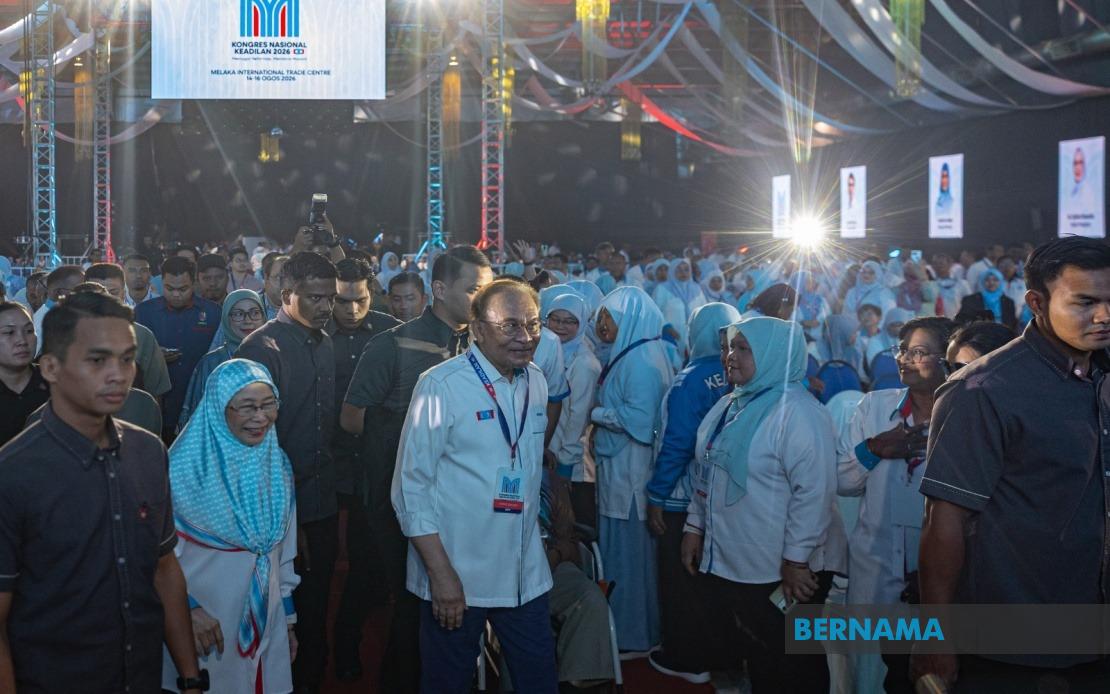
Prime Minister Datuk Seri Anwar Ibrahim has moved to solidify the political alliance underpinning Malaysia's federal government by declaring his preference for sustained cooperation with UMNO-Barisan Nasional, even as the coalition faces periodic tensions. Speaking at the PKR National Congress 2026 in Melaka on August 16, Anwar struck a notably pragmatic tone, suggesting that the ruling partnership's continuation serves the broader national interest rather than the narrow ambitions of any single party.
The timing of Anwar's statement carries weight, coming in the wake of unspecified recent developments that have prompted questions about the stability of the Unity Government arrangement. Rather than engage in public dispute, the Prime Minister chose instead to address the matter directly by reaffirming his commitment to the existing federal-level coalition, essentially signalling that temporary frictions should not derail what has become Malaysia's dominant political structure since 2022.
Anwar's framing of the partnership reveals his governing philosophy: that political decisions must be guided by what benefits the nation and its people, not by the personal grievances, career ambitions, or emotional responses of individual politicians or factions. This appeal to rational governance suggests an awareness that coalition politics, particularly one as complex as the Unity Government, requires leaders willing to subordinate party interests to collective stability. For Malaysian readers observing the constant manoeuvring within the coalition's various component parties, this message represents a plea for institutional maturity.
The emphasis on stability carries particular resonance in Malaysia's economic context. International investors and rating agencies routinely cite political predictability as a factor in their assessments of Malaysia's investment climate. Repeated coalition tensions or threats of realignment risk sending signals that undermine business confidence and foreign direct investment flows. By publicly committing to the UMNO-BN partnership, Anwar is indirectly reassuring the market that the government will not be distracted by internal political jockeying.
Economic growth remains at the heart of Anwar's pitch. The Prime Minister has positioned himself as focused on inclusive prosperity and narrowing inequality, agendas that depend on sustained policy implementation and investor confidence. Coalition instability creates legislative uncertainty, complicates long-term planning, and can delay critical economic measures. The government's approach to digital economy development, renewable energy transition, and fiscal consolidation all require a degree of parliamentary coherence that the Unity Government coalition, despite its occasional strains, has thus far provided.
As PKR president, Anwar's remarks also carry significance for his own party base. Some within PKR harbour ambitions of moving beyond the current arrangement, either to govern alone or to form a different coalition that might elevate their party's political weight. By publicly committing to the UMNO-BN partnership, Anwar is signalling to his internal critics that this remains the strategic choice, at least for the foreseeable term. This may frustrate reformist elements within PKR who remain sceptical of Barisan Nasional, but it reflects Anwar's assessment that coalition mathematics make alternatives impractical.
The Unity Government coalition, formed in September 2022 following electoral fragmentation, represents a significant departure from Malaysia's historical two-coalition contest between Barisan Nasional and Pakatan Harapan. This multiparty arrangement includes not only PKR and UMNO-BN, but also Amanah, Muda, and various smaller partners. Maintaining cohesion across such ideological and organisational diversity demands constant negotiation. Anwar's insistence on prioritising stability over factional advantage reflects the pragmatism necessary to prevent the coalition from fragmenting.
Recent Malaysian political history demonstrates the costs of coalition failure. The Sheraton Move in 2020 and subsequent realignments destabilised governance for months, delayed economic response to the pandemic, and deepened public cynicism about political leadership. That experience appears to inform Anwar's determination to maintain the current arrangement, even when individual UMNO leaders occasionally test the partnership's boundaries or when PKR members grumble about power-sharing arrangements.
From a broader Southeast Asian perspective, Malaysia's political stability remains consequential. As a major trading nation and a key player in regional institutions, domestic political uncertainty reverberates through the region's investment and security calculations. Anwar's statement, therefore, carries implications beyond Malaysia's borders, signalling to regional partners and international observers that the government possesses sufficient coherence to pursue consistent foreign and economic policies.
The question of whether this commitment will survive future tensions remains open. Coalition politics in Malaysia has a history of unexpected ruptures, often triggered by personal disputes, succession concerns, or changing electoral calculations. However, by staking out this position publicly and repeatedly, Anwar is creating political costs for any party—including his own—that might subsequently move to destabilise the arrangement. The PKR president appears to have calculated that the benefits of the current partnership exceed the costs of remaining within it, and he is betting that his coalition partners share this assessment.

