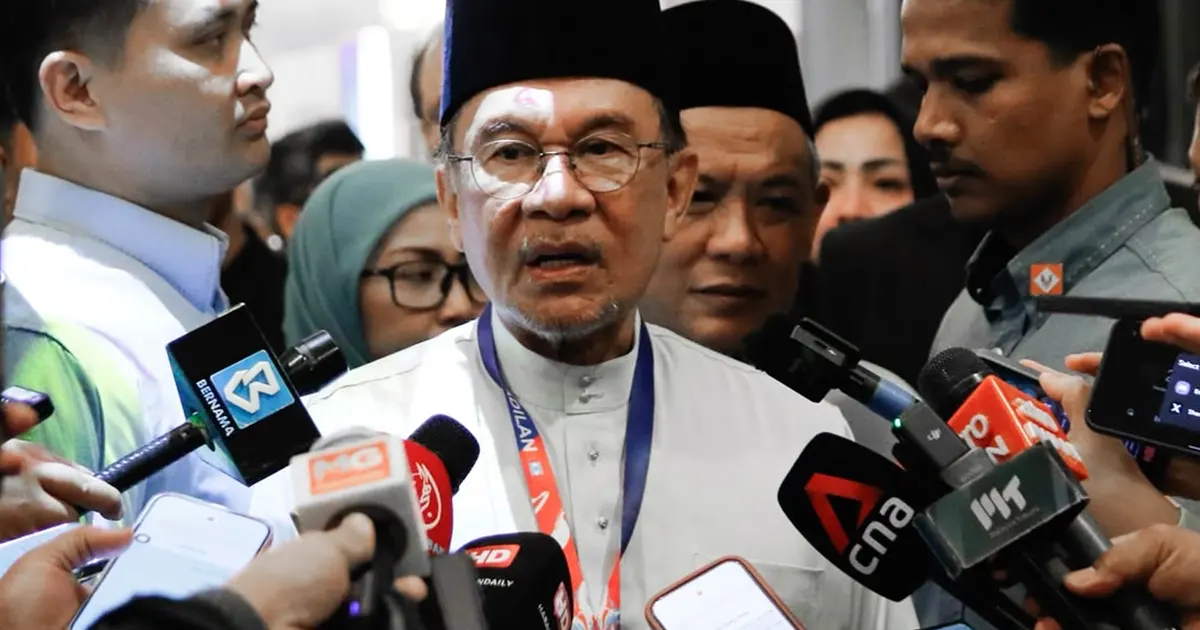
Prime Minister Anwar Ibrahim has moved to defuse suggestions of deeper trust fractures within the governing coalition, pushing back against recent commentary from former Umno Youth chief Khairy Jamaluddin with the assertion that the two leaders simply inhabit different perspectives on the matter. The denial comes in response to remarks Khairy aired during a podcast appearance, in which the ex-party official appeared to question the stability of the relationship between Malaysia's top two government figures.
Anwar's measured response reflects the delicate balancing act required to maintain coalition cohesion at a time when unity among the multiethnic, multifactional alliance backing his administration remains a recurring concern for political observers. By characterizing Khairy's commentary as reflecting that individual's own views rather than a shared assessment within Umno or the broader government, the prime minister sought to contain what might otherwise escalate into a more damaging public dispute. The framing suggests that while disagreement exists, it remains compartmentalized rather than indicative of systemic fracture.
Khairy Jamaluddin, who once commanded significant influence within Umno's youth wing before his political fortunes shifted, has maintained a visible if sometimes contentious presence in public discourse since losing his parliamentary seat and formal party positions. His podcast appearance appears to have touched on governance dynamics and the working relationship between Anwar and Zahid Hamidi, the latter of whom serves as Deputy Prime Minister and maintains substantial sway within Umno's traditional power structure. That Khairy would offer commentary on coalition dynamics is unsurprising given his historical prominence, though the timing and framing of his remarks evidently prompted clarification from the highest level.
For Malaysian political watchers, such exchanges matter considerably because they can signal deeper currents within the complex arrangement that keeps the government operational. The Pakatan Harapan-led coalition governing since 2022 relies upon the support of Umno, a party with which it had previously been in fierce opposition, creating inherent tensions that periodically surface in public. Any suggestion that the prime minister and his deputy harbour significant mutual suspicion could undermine investor confidence, foreign relations, and the government's ability to pass legislation through parliament.
Anwar's intervention to clarify his position with regard to Zahid appears calibrated to prevent minor disagreements from metastasizing into broader political instability. By explicitly denying trust deficits and attributing critical remarks to one individual's perspective, he accomplishes multiple objectives simultaneously. He acknowledges Khairy's statement without validating it, he reassures coalition partners of his commitment to the working relationship, and he subtly reminds the broader political ecosystem that governmental operations depend upon maintaining workable relationships across party lines.
The nature of Khairy's podcast comments remains somewhat opaque from public reporting, yet the substance appears to concern perceptions of wariness or miscommunication between the prime minister and deputy prime minister. Such observations, whether grounded in specific incidents or reflecting general impressions, carry weight in Malaysia's media environment and can influence how political insiders and foreign observers assess governmental stability. Anwar's need to respond publicly suggests the remarks gained sufficient traction to warrant direct correction.
Zahid Hamidi's position within this dynamic deserves consideration as well. As deputy prime minister and a figure of consequence within Umno, he maintains leverage that Anwar requires for legislative majorities and policy implementation. Simultaneously, Zahid navigates his own constraints, including his historical legal troubles and the need to maintain credibility with Umno's base. Any public acknowledgment of tension between the two would complicate both leaders' political calculations, making Anwar's swift denial a rational strategic move.
The broader political context involves ongoing negotiations within the governing coalition regarding power-sharing, policy direction, and the distribution of ministerial portfolios and economic opportunities. These negotiations inevitably generate friction, yet successful governments manage such tensions behind closed doors while presenting unified fronts publicly. Khairy's comments, whether intended as insider analysis or something more pointed, threatened to move internal disagreements into public view.
From a Southeast Asian perspective, Malaysia's coalition government represents one of the region's more complex political arrangements, combining parties with fundamentally different ideological foundations and voter bases. This experimental nature means that perceived instability at the top can have outsized consequences for regional confidence in Malaysian governance. Foreign investors, neighbouring governments, and regional institutions all monitor such signals closely, making even apparently minor public disputes worth managing carefully.
Anwar's response also implicitly acknowledges the reality that not all government members will agree on all matters. Rather than denying the existence of differing views entirely, he positioned disagreement as normal while distinguishing between individual opinion and systemic mistrust. This nuanced approach allows coalition partners to maintain their own political identities and perspectives while preserving the fiction of unified governance necessary for parliamentary stability.
Looking forward, such exchanges may become increasingly common as Malaysia's coalition government matures and the pressures of governance create genuine friction points. The question for the administration becomes whether such tensions can be managed through careful public messaging and private negotiation, or whether they will eventually overwhelm the coalition's ability to function effectively. Anwar's proactive response suggests confidence in his ability to manage the former scenario, at least for the present.

