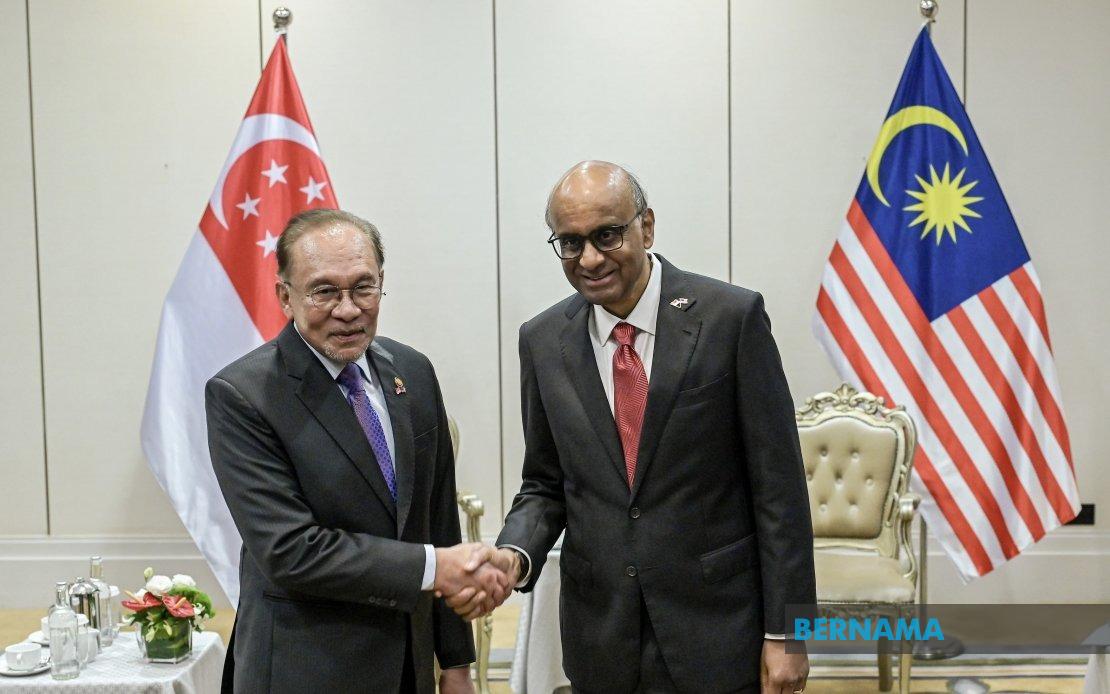
Prime Minister Datuk Seri Anwar Ibrahim received Singapore President Tharman Shanmugaratnam in Kuala Lumpur on Monday, marking a significant moment in the two countries' diplomatic relations. The 40-minute courtesy meeting underscored the strategic importance Malaysia places on its relationship with its economically vibrant neighbour, with the engagement reflecting mutual respect between the leadership of both nations.
The high-level conversation brought together senior officials from both governments, with Malaysia represented by Foreign Minister Datuk Seri Mohamad Hasan, Investment, Trade and Industry Minister Datuk Seri Johari Abdul Ghani, and Entrepreneur and Cooperatives Development Minister Steven Sim Chee Keong. The presence of this economic-focused ministerial delegation signalled that discussions would likely concentrate on strengthening commercial partnerships and exploring investment opportunities that benefit both economies.
President Tharman's visit, extending from July 13 to 15, came at the invitation of His Majesty Sultan Ibrahim, reciprocating the Malaysian monarch's state visit to Singapore in May 2024. Such formal exchanges represent the backbone of bilateral diplomacy in Southeast Asia, allowing leaders to discuss matters of mutual concern beyond routine diplomatic channels. The ceremonial reception accorded by the Yang di-Pertuan Agong at Istana Negara earlier on the day of the courtesy call demonstrated the ceremonial weight Malaysia attaches to this engagement.
The underlying context of this visit speaks to Malaysia and Singapore's interconnected economies, which have flourished despite occasional political tensions. Singapore stands as Malaysia's second-largest trading partner globally, a position that reflects decades of commercial integration. Within the ASEAN framework, Singapore holds even greater significance as Malaysia's largest trading partner among member states—a distinction that illustrates the depth of economic cooperation across the Strait of Johor.
Bilateral trade figures reveal the robust health of commercial ties between the nations. In 2025, total trade reached RM402.35 billion, equivalent to approximately US$93.97 billion, marking a 1.5 per cent increase from the previous year. While this growth rate may appear modest in absolute terms, it demonstrates resilience and consistency in trade volumes during a period of global economic uncertainty and shifting geopolitical dynamics.
More impressively, the first five months of 2025 showed accelerated momentum, with bilateral trade climbing 14.5 per cent year-on-year to RM189.90 billion (US$47.87 billion). This performance substantially exceeded the corresponding period in 2024, when trade stood at RM165.93 billion (US$37.65 billion). Such acceleration suggests growing business confidence and expanding commercial activity across multiple sectors, potentially driven by supply chain adjustments, increased manufacturing investments, or expanded services trade.
For Malaysian businesses and policymakers, Singapore's role extends beyond simple trade statistics. The island republic serves as a crucial financial hub, investment gateway, and logistics centre for Malaysian enterprises seeking to access broader Asian and global markets. Many Malaysian companies use Singapore as a regional headquarters or investment vehicle, leveraging its stable regulatory environment and strategic location on major shipping lanes.
Conversely, Singapore's investments in Malaysia—particularly in real estate, manufacturing, and financial services—contribute significantly to Malaysia's economic growth and employment. Petronas, the Malaysian national oil company, maintains substantial operations and partnerships involving Singaporean entities. The two nations also collaborate extensively in energy, banking, telecommunications, and technology sectors, creating interdependencies that make strong diplomatic relations economically essential.
The timing of President Tharman's visit carries additional significance given regional developments. As ASEAN nations navigate US-China strategic competition, trade tensions, and evolving regional security dynamics, Malaysia-Singapore cooperation takes on broader strategic importance. Both countries have vested interests in maintaining regional stability, protecting maritime security in the South China Sea, and ensuring free passage through the Strait of Malacca—one of the world's most critical shipping arteries.
For Malaysian readers and stakeholders, this state visit represents an opportunity to assess whether bilateral relations will deepen beyond existing frameworks. Potential areas for expanded cooperation could include digital economy initiatives, green energy transition partnerships, and collaborative responses to transnational challenges like climate change and pandemic preparedness. The strong showing of trade growth in the first half of 2025 suggests that businesses on both sides are already identifying and pursuing new opportunities.
The ministerial composition of Malaysia's delegation reflects particular attention to investment and trade promotion, suggesting that economic expansion remains a central focus of bilateral engagement. Both Prime Minister Anwar and President Tharman lead governments committed to regional integration and economic growth, creating alignment on fundamental policy objectives.
Looking forward, the success of this three-day visit may influence future cooperation frameworks and potentially unlock new bilateral initiatives. As Malaysia pursues its development agenda and Singapore maintains its role as a leading Asian financial centre, enhanced coordination across multiple sectors could yield mutual benefits. The consistently strong trade performance provides a foundation upon which deeper strategic partnerships might be built, benefiting not only the two nations but contributing to broader ASEAN prosperity and stability.

