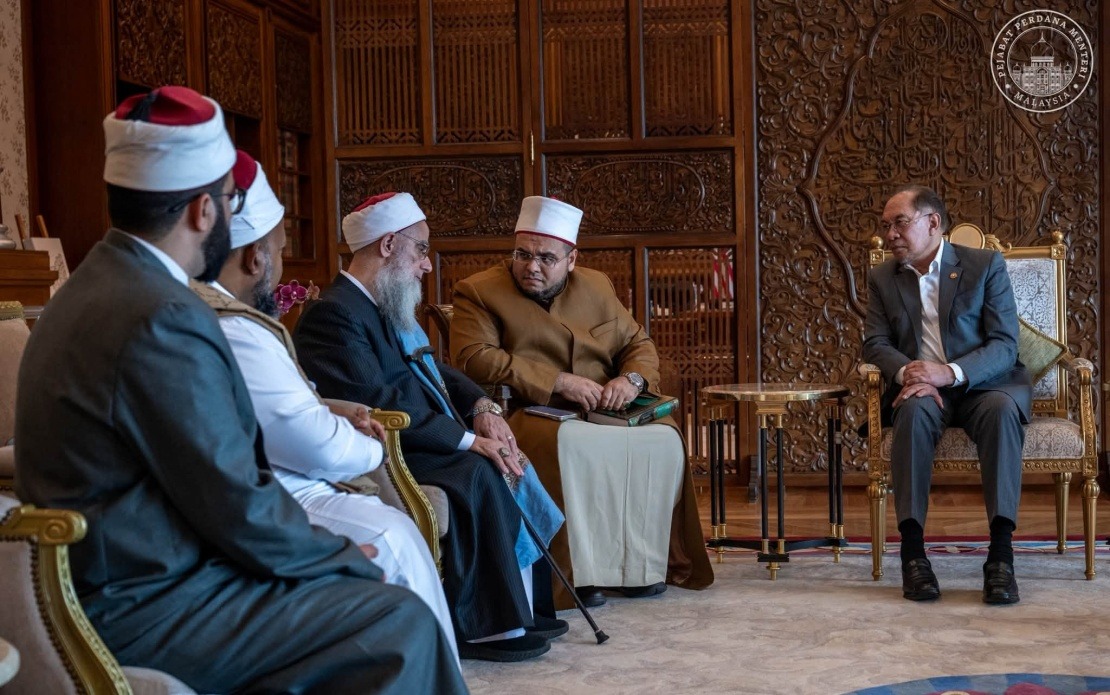
Prime Minister Datuk Seri Anwar Ibrahim received a courtesy call from Sheikh Dr Mustafa An-Nadwi Al-Hasani Mansurah, a prominent Egyptian scholar, at his Putrajaya office on July 20. The meeting underscores Malaysia's continued engagement with leading Islamic intellectual figures from across the Muslim world, particularly those emphasising scholarly rigour and ethical governance.
Through a Facebook post, Anwar characterised Sheikh Dr Mustafa as an influential authority whose academic work centres on the cultivation of moral values, scholarly wisdom, and deep specialisation in hadith studies—the collected traditions and teachings of Prophet Muhammad. The Prime Minister's public acknowledgement of the visitor reflects Malaysia's positioning as a hub for Islamic learning and dialogue, a role the nation has cultivated through hosting scholars and facilitating intellectual exchange.
Sheikh Dr Mustafa counts himself among the distinguished disciples of Sheikh Abul Hasan Ali al-Nadwi, a universally respected Islamic scholar and orator whose influence spans generations across the Muslim-majority world. This lineage matters considerably: it situates Sheikh Dr Mustafa within a particular intellectual tradition emphasising balanced interpretation, cultural refinement, and constructive engagement with contemporary challenges. His visit to Malaysia this week incorporated knowledge sessions aimed at broader audiences, suggesting a programmatic approach to scholarly outreach beyond governmental circles.
Anwar's messaging during the encounter pivoted on a broader cultural observation: that in an age where sensationalism and superficial spectacle dominate public discourse, figures embodying genuine scholarship and contemplative depth offer a corrective counterbalance. The Prime Minister's poetic framing—comparing knowledge and wisdom to morning dew, "quiet, gentle, yet capable of bringing life"—articulates a vision of intellectual engagement as something transformative yet understated, drawing implicit contrast with increasingly polarised public debates and media environments.
The two officials discussed Malaysia's current situation alongside broader themes, though the precise substance of their policy discussions remained undisclosed. Such bilateral conversations between Malaysian leadership and international Islamic scholars typically address multiple layers: formal governance matters, the state of Islamic thought globally, educational approaches, and community cohesion strategies. Given Malaysia's internal religious diversity and periodic tensions surrounding Islamic administration, visiting scholars' perspectives on integrating Islamic principles with plural governance hold particular resonance.
Anwar extended formal gratitude to Sheikh Dr Mustafa for counsel and spiritual intercession directed toward Malaysia's sustained national unity and prosperity. This formulaic courtesty also carries substantive weight within Islamic diplomatic practice, where blessings and prayers function as expressions of mutual respect and goodwill. The gesture signals Malaysian openness to receiving guidance from respected international Islamic voices, positioning the nation as both practitioner and beneficiary of cross-border scholarly networks.
The Prime Minister reciprocated with prayers for Sheikh Dr Mustafa's wellbeing, the flourishing of his scholarly endeavours, and his continued capacity to provide community guidance characterised by wisdom, moderation, and compassion. The emphasis on "moderation" reflects a deliberate positioning: Malaysia has long promoted itself as exemplifying moderate Islam, a framework distinguishing contemporary governance from more rigid or contentious interpretations. By highlighting these values in connection with Sheikh Dr Mustafa, Anwar reinforces the narrative that contemporary Islamic scholarship can embrace progressive community engagement without sacrificing theological rigor.
From a regional perspective, Malaysia's reception of prominent Muslim intellectuals functions as soft diplomatic capital, enhancing the nation's standing within broader Islamic networks while signalling receptiveness to international Islamic discourse. Such engagements also provide platforms for addressing regional concerns—from sectarian tensions to questions about Islam's compatibility with democratic pluralism—through conversations with respected intellectual authorities.
Sheikh Dr Mustafa's Malaysian visit encompassed structured knowledge sessions beyond his governmental audience, suggesting a teaching mission aimed at enriching local Islamic intellectual life. Malaysian Islamic institutions, civil society organisations, and student communities benefit from exposure to international scholars, broadening interpretive frameworks and connecting local discourse to global Islamic thought. For audiences increasingly engaging with Islamic teaching through digital platforms and diverse sources, scholarly validation from internationally recognised figures carries particular weight.
The encounter also reflects persistent Malaysian interest in deepening ties with Egypt, the Arab world's most populous nation and a traditional centre of Islamic learning. Egypt's Al-Azhar institution remains among Islam's most influential scholarly bodies, and visiting Egyptian intellectuals often carry Al-Azhar's intellectual imprint or network connections. Such engagements implicitly position Malaysia within a broader Arabic-Islamic intellectual sphere, maintaining cultural and spiritual connections that complement Malaysia's regional political identity.
Looking forward, the visit illustrates how Malaysia continues leveraging international scholarly engagement to reinforce domestic narratives around Islam's compatibility with ethical governance, intellectual advancement, and plural coexistence. As regional and global Islamic discourse grows more contested, such platforms—bringing respected international voices into productive conversation with Malaysian leadership—serve strategic purposes beyond ceremonial courtesy, contributing to Malaysia's evolving positioning within contemporary Islamic thought and practice.

