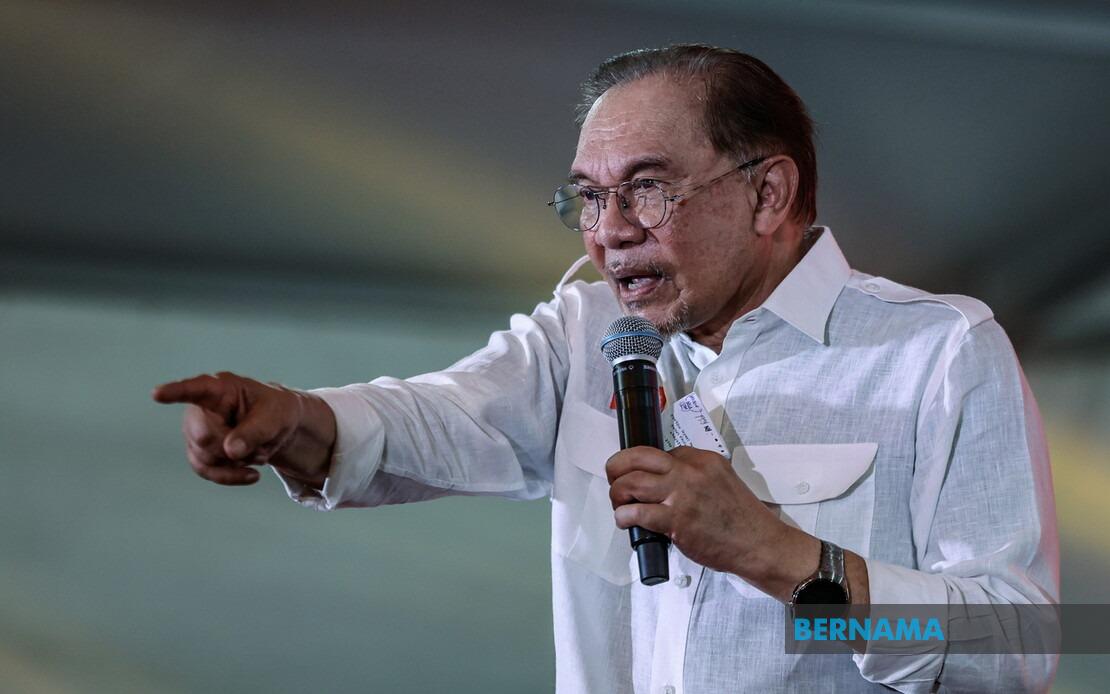
Prime Minister Datuk Seri Anwar Ibrahim has pushed back against accusations from Kedah Menteri Besar Datuk Seri Muhammad Sanusi Md Nor that the Federal Government neglects opposition-ruled states, insisting that developmental efforts across all territories remain a core priority regardless of their political complexion. Speaking at a campaign rally in Simpang Renggam on July 10, Anwar expressed frustration at what he characterised as unwarranted political broadsides, noting that his government has invested considerably in Kedah's advancement whilst the state leadership has abstained from collaborative engagement.
The friction between the two figures centres on differing narratives about federal support for Kedah, a state governed by the Islamist PAS party rather than Anwar's Pakatan Harapan coalition. Sanusi had reportedly mocked the Prime Minister's approach, suggesting that Anwar treated all states as dependent entities requiring federal benevolence—a framing Anwar rejected as mischaracterising both his intentions and track record. The timing of these remarks, coinciding with Anwar's visit to the northern border region, appears designed to underscore perceptions among opposition supporters that the government privileges allied territories in resource allocation.
Central to Anwar's defence was his recounting of the day's diplomatic venture to Bukit Kayu Hitam, where he and Thai Prime Minister Anutin Charnvirakul jointly inaugurated a new road corridor connecting Malaysia's Immigration, Customs, Quarantine and Security complex with Thailand's corresponding facility at Sadao. This infrastructure project, aimed at facilitating cross-border trade and movement whilst strengthening bilateral economic ties, directly benefits both Kedah and neighbouring Perlis—yet Sanusi notably absented himself from the ceremony despite its significance for the state's prosperity.
The absence carried obvious political messaging. By declining to participate in an event championing Kedah's border development, Sanusi signalled dissatisfaction with federal priorities and possibly sought to reinforce claims that the state receives inadequate attention. Anwar interpreted the snub differently, using it as evidence that the menteri besar's grievances stem from political positioning rather than substantive policy disagreement. His decision to bring a foreign leader to Bukit Kayu Hitam rather than the federal capital underscored Anwar's reasoning that this infrastructure initiative was tailored specifically to northern Malaysia's needs.
Despite Kedah's governance by an opposition party, Anwar maintained that his constitutional duty extends universally to all Malaysian citizens and all territorial jurisdictions. This rhetorical stance aligns with federal systems in which prime ministers must theoretically govern for the entire nation rather than exclusively for regions controlled by their political allies. However, the reality of Malaysian governance frequently complicates such pronouncements. Distribution of federal funding, allocation of development projects, and political attention often reflect coalition arithmetic, making claims of impartiality inherently subject to scrutiny.
The broader context involves a delicate equilibrium in Malaysian politics since the 2022 general election fundamentally reshaped parliamentary coalitions. Anwar's Pakatan Harapan governs several states whilst various opposition blocs—particularly PAS and Perikatan Nasional—control others. The tension between Anwar and Sanusi mirrors similar friction that federal governments have historically experienced with opposition state administrations. Managing this dynamic without appearing to punish dissenting territories becomes crucial for maintaining public confidence in institutional neutrality.
Anwar also seized the opportunity to promote the government's broader social welfare agenda, announcing intentions to expand the Sumbangan Asas Rahmah assistance programme pending continued political stability and electoral endorsement. He attributed the potential expansion to disciplined fiscal management, framing enhanced welfare provision as achievable through prudent stewardship rather than profligate spending. This messaging attempts to establish a narrative wherein the government merits continued public support because its economic competence creates room for expanded social benefits—a proposition closely watched as Malaysia navigates post-pandemic economic pressures.
The Layang-Layang rally represented one of five campaign events Anwar attended in Johor that day, underscoring the intensity of electoral mobilisation ahead of state elections. Such concentrated scheduling reflects both the competitive nature of contemporary Malaysian politics and the personal engagement Anwar now brings to campaign activities, a departure from earlier patterns of executive remoteness. His presence at grassroots gatherings demonstrates accessibility whilst simultaneously allowing him to address controversies and shape local narratives in real time.
Sanusi's earlier remarks, suggesting that Anwar behaves as if all states fundamentally depend on federal patronage, touch a genuine tension within Malaysian federalism. The Federal Constitution establishes a system wherein states retain significant autonomy over certain domains, yet financial dependence on federal allocations creates asymmetrical relationships. Opposition-ruled states sometimes struggle with funding constraints, partly because federal development budgets tend toward political alignment. Sanusi's criticism, whether tactically motivated or substantively grounded, resonates with constituencies skeptical of Putrajaya's evenhandedness.
The infrastructure investment at Bukit Kayu Hitam carries genuine economic significance beyond immediate political theatre. Enhanced border connectivity generates commercial opportunities for both Malaysians and Thai nationals, reduces transaction costs for cross-border commerce, and potentially attracts investment to hitherto marginalised northern regions. Such projects theoretically benefit Kedah regardless of whether state leadership receives political credit, though electoral politics inevitably entangles infrastructure narrative within broader governance disputes.
Moving forward, the relationship between Anwar's federal administration and Sanusi's state government will likely remain transactional and occasionally contentious. Both figures operate within political ecosystems requiring periodic displays of strength and autonomy. Anwar cannot appear indifferent to opposition criticism without risking perception of arrogance, whilst Sanusi must demonstrate that state interests supersede coalition loyalty. The challenge for Malaysia involves ensuring that such political competition does not genuinely compromise developmental equity across all territories, a principle increasingly difficult to maintain as electoral cycles intensify partisan positioning.

