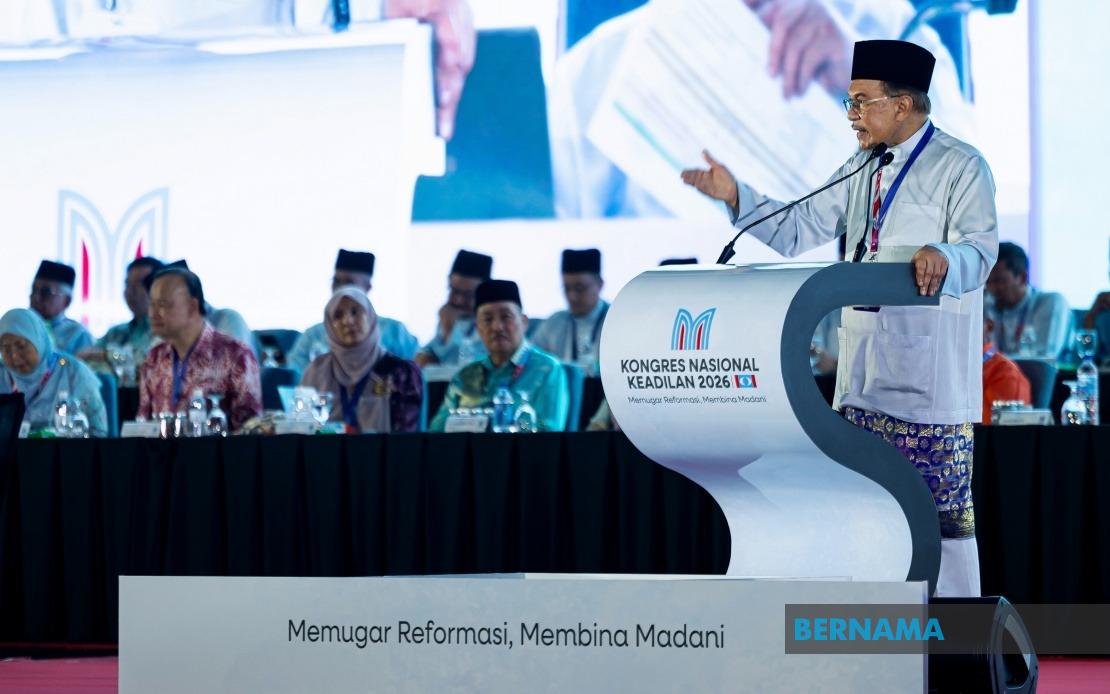
Prime Minister Datuk Seri Anwar Ibrahim has firmly rejected suggestions that his working relationship with Deputy Prime Minister Datuk Seri Dr Ahmad Zahid Hamidi has soured, insisting instead that their partnership remains functional and cordial despite mounting pressures on Malaysia's Unity Government coalition. Speaking in Melaka on August 15 during his presidential address at the 2026 PKR National Congress, Anwar characterised recent claims of deteriorating ties as a reflection of the critic's own worldview rather than reality on the ground.
The Prime Minister was responding directly to allegations by former UMNO Youth chief Khairy Jamaluddin, who contended that trust levels between the two leaders had reached their lowest ebb since the Unity Government's formation following the 15th General Election in 2022. Khairy's assertion came amid observable friction between the Barisan Nasional and Pakatan Harapan coalition partners, particularly after BN opted to collaborate with Perikatan Nasional during the recent Negeri Sembilan state election campaign. Rather than engage defensively, Anwar framed the disagreement as symptomatic of differing political philosophies rather than an indictment of his actual rapport with his deputy.
In his characteristically philosophical response, Anwar drew a distinction between those who interpret political differences through a lens of confrontation and those who pursue resolution through dialogue. He positioned himself squarely in the latter camp, suggesting that his approach prioritises consensus-building and peaceful negotiation over the zero-sum calculations that sometimes dominate Malaysian political discourse. This framing implicitly critiques Khairy's tendency to view coalition mechanics as inherently adversarial, a perspective that Anwar suggested distorts the reality of pragmatic governance among partners with divergent interests.
The Prime Minister took care during his congress speech to publicly acknowledge Ahmad Zahid's instrumental role in facilitating the Unity Government's establishment, a symbolic gesture that underscores their continued collaborative relationship despite policy disagreements. This public recognition carries significance beyond mere ceremonial courtesy; it signals to both the PKR grassroots and broader political observers that Anwar views the BN chairman's contributions as substantial and worthy of appreciation. By articulating this gratitude before a party audience that might otherwise interpret coalition dynamics as purely transactional, Anwar sent a signal of stability to financial markets and investor communities already anxious about Malaysia's political trajectory.
The tension underlying this exchange reflects deeper structural challenges facing Malaysia's ruling coalition, which has governed since the 2022 post-election period when no single bloc secured an outright parliamentary majority. The Unity Government, comprising PKR, UMNO, and various other parties, has proven resourceful in maintaining legislative coherence yet remains vulnerable to the kind of public friction that Khairy's comments have now amplified. The Negeri Sembilan situation, where BN diverged from its coalition partners to cooperate with PN, illustrates the centrifugal pressures that constantly threaten to fragment this delicate arrangement.
From a Malaysian governance perspective, Anwar's insistence on attributing critical commentary to personality differences rather than substantive policy divisions may obscure genuine sources of tension. The choice by BN to work with PN in Negeri Sembilan was not merely a localised electoral calculation but reflected strategic repositioning by UMNO as it contemplates its medium-term political options. Such moves invite legitimate scrutiny about whether the coalition partners share sufficiently aligned interests to sustain their arrangement through a full parliamentary term, or whether they are merely managing a temporary marriage of convenience.
The timing of Khairy's intervention deserves consideration as well. As a former UMNO insider relegated to opposition benches following internal party dynamics, Khairy maintains considerable influence among certain UMNO constituencies and retains media access. His public questioning of Anwar-Zahid relations may reflect genuine internal UMNO concerns about the party's strategic positioning, particularly given UMNO's historical dominance in Malaysian politics and its apparent diminishment within a coalition where PKR holds the prime minister's post. Rather than dismissing these concerns as merely reflective of Khairy's personal negativity bias, seasoned political analysts might recognise them as early warning signals of potential coalition strain.
The philosophical distinction Anwar drew between peaceful and confrontational approaches, while rhetorically appealing, also sidesteps the substance of Khairy's claims. Whether relationship quality has genuinely declined depends less on the attitudes of observers than on the frequency and severity of policy disagreements and the difficulty encountered in resolving them. Recent months have witnessed multiple instances where BN and PH positions have diverged on matters ranging from Negeri Sembilan electoral cooperation to broader macroeconomic policy orientations, suggesting that structural differences, not merely interpretive frameworks, are at play.
For Malaysian voters and Southeast Asian observers, the significance of Anwar's response lies in what it reveals about the sustainability of consensus-based governance under Malaysia's current electoral arithmetic. The Prime Minister's characterisation of disagreements as resolvable through peaceful discussion presumes sufficient goodwill and shared interest among coalition partners, assumptions that historical Malaysian politics suggests warrant careful scrutiny. The Unity Government's continued functioning remains important for regional stability, given Malaysia's economic significance and its role within ASEAN, yet its resilience cannot be taken as guaranteed regardless of leadership rhetoric about relationship quality.
Moving forward, the ability of Anwar and Zahid to maintain effective collaboration will likely depend less on public assurances and more on their capacity to deliver tangible benefits to their respective constituencies while managing the inevitable divergences that emerge between coalition partners with distinct ideological traditions. Whether the current emphasis on peaceful dialogue translates into practical mechanisms for resolving future disputes remains an open question that will shape Malaysian politics for the remainder of this parliamentary term.

