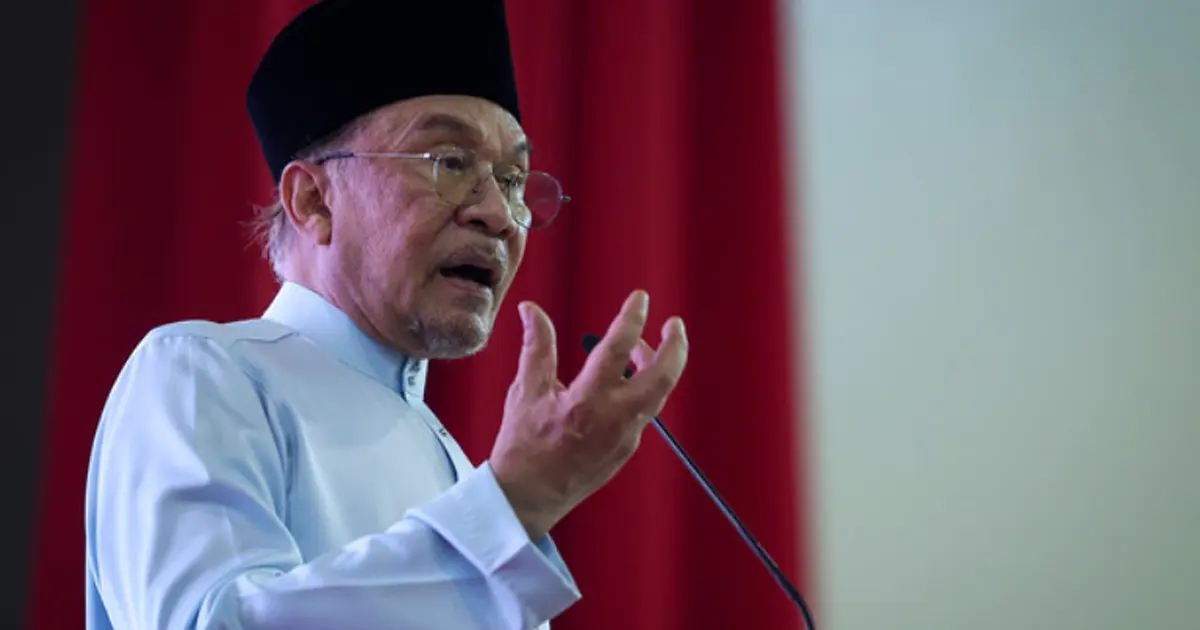
A PKR Youth leader has launched a stinging rebuke at Umno, claiming that Prime Minister Anwar Ibrahim extended a lifeline to the party when it faced existential challenges following the 2023 general election, only to face ingratitude and political disloyalty in return. Huraimi Husri, representing the Federal Territories chapter of PKR Youth, articulated the grievance in pointed terms, portraying the PKR president as a statesman who prioritised national stability over partisan advantage during a turbulent period of Malaysian politics.
The remarks emerge from an ongoing narrative within PKR circles regarding the fragility of the current political coalition and shifting alliances within Malaysia's governing structure. Following GE15 in November 2023, Umno found itself in a precarious position after the general election produced a hung parliament, with no single coalition commanding a decisive majority. The situation threatened to plunge the nation into prolonged political uncertainty, raising concerns about governmental effectiveness and investor confidence. Within this context, the role played by Anwar and PKR in facilitating a workable parliamentary arithmetic became central to Malaysia's immediate political settlement.
The formation of the unity government (Perpaduan Nasional) represented an attempt to transcend the deep partisan divides that have characterised Malaysian politics in recent years. Umno's participation in this broader coalition framework, despite historical antagonism with PKR and its predecessor organisations, required compromise and negotiation. According to PKR's perspective, Anwar's willingness to accommodate Umno within this arrangement—rather than seeking to exclude or punish the party for its electoral performance—demonstrated magnanimity and a commitment to constructive governance over vengeful politics.
However, the stability of such multi-party arrangements in Malaysia has proven notoriously difficult to maintain. The very tensions that necessitated a unity government in the first place—ideological differences, competition for resources and influence, and divergent policy priorities—continue to simmer beneath the surface of ostensible cooperation. Umno's position within the government has remained complex; the party must balance its role as a governing coalition partner while maintaining its separate organisational interests and those of its political base.
The accusation of betrayal lodged by Huraimi Husri likely references specific recent political manoeuvres or statements by Umno that PKR members perceive as disloyal or opportunistic. In Malaysian politics, where coalition governments depend on fragile consensus, even rhetorical signals from major partners can be interpreted as preparatory moves toward realignment or withdrawal. The language of "betrayal" suggests not merely policy disagreement but a sense of violated obligation and trust.
For Malaysian observers, this dispute reflects a deeper structural challenge facing the country's political system. Majority governments secured through single-party dominance or stable two-coalition competition have become increasingly rare. Instead, the landscape requires constant negotiation among multiple power centres, each with distinct constituencies and interests. Unity governments, while sometimes necessary for stability, create conditions where all parties feel simultaneously dependent and vulnerable, generating constant friction and mutual suspicion.
The PKR Youth leader's intervention also speaks to generational dynamics within Malaysian politics. Younger party members and activists often display less patience with the compromises and ambiguities that senior leaders must navigate. Their rhetoric tends toward greater clarity of principle and less tolerance for what they view as unprincipled alliance-making. By articulating this critique, Huraimi may be channelling frustrations among PKR's younger cadres who question whether pragmatic coalition politics serves their party's long-term interests and values.
Umno's perspective on its relationship with PKR and the unity government would necessarily differ markedly. The party, having governed for decades before its 2018 electoral loss, likely views its current position as one requiring careful management to preserve influence and rebuild its political fortunes. From this vantage point, protecting Umno's interests against potential PKR advantage may appear not as betrayal but as prudent stewardship of the party's future, particularly given historical enmity between the two organisations.
The implications of such internal coalition tensions extend beyond narrow partisan concerns. Investor sentiment, policy coherence, and public confidence in government all depend partly on the perception that the administration possesses sufficient internal cohesion to implement decisions and sustain direction. Repeated public quarrels between major coalition partners risk undermining these perceptions, even if the government technically maintains parliamentary majority. For Malaysia's economy and international standing, excessive internal political turbulence during critical periods of post-pandemic recovery and regional strategic competition carries real costs.
Looking forward, the sustainability of Malaysia's current political arrangement will likely depend on whether the coalition partners can develop mechanisms for managing disagreement more constructively. The evident frustration expressed by PKR Youth suggests that current informal arrangements are inadequate. Whether senior leaders in both Umno and PKR possess both the will and capability to establish clearer expectations and processes for coalition decision-making remains an open question that will substantially shape Malaysian politics in coming years.
The public nature of this critique also serves instrumental purposes within PKR's internal dynamics. By articulating grievances through official party channels, leaders can manage member expectations and demonstrate responsiveness to concerns about the partnership. This performative dimension of coalition politics, while sometimes dismissed as mere theatrics, actually serves important functions in maintaining party cohesion and legitimacy among activists and supporters who scrutinise leadership decisions closely.

