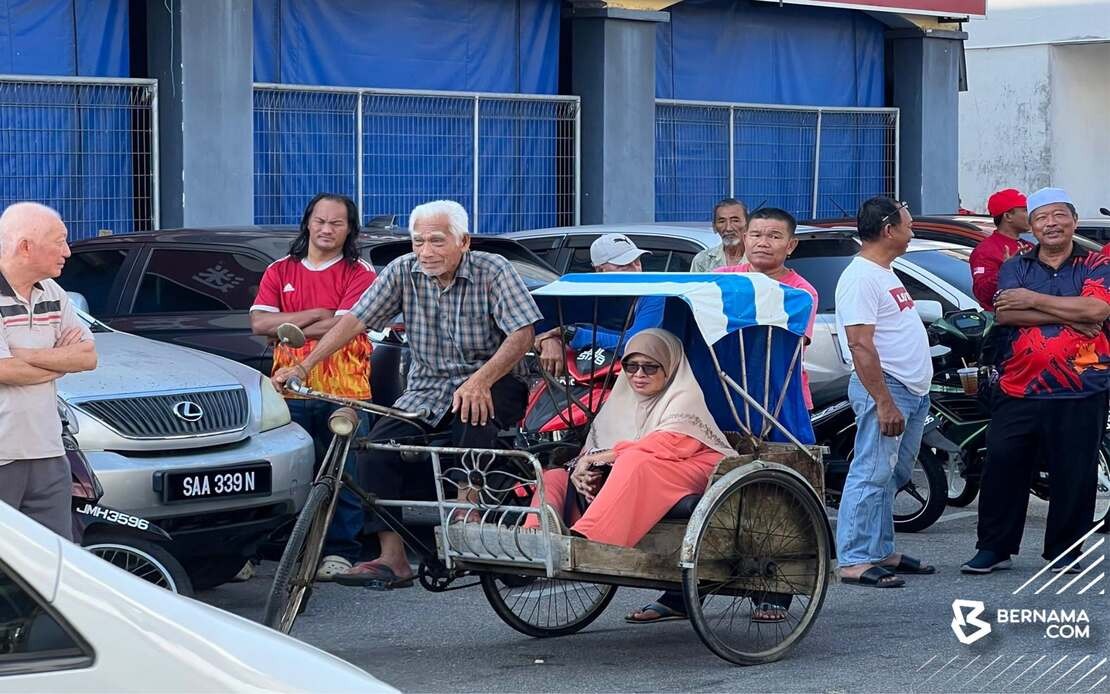
Prime Minister Datuk Seri Anwar Ibrahim has expressed deep appreciation for an elderly Johor resident's determination to meet him, after learning that the man had pedalled his trishaw nearly a kilometre through the town to catch a glimpse of the nation's leader. The gesture moved Anwar enough to publicly acknowledge it on social media, though scheduling constraints prevented a face-to-face encounter during the visit.
Abdul Razak Pelangga, 86, made the journey from his home in Kampung Parit Bugis to Kedai Kopi Hailam Sri Medan in Senggarang with his wife Jamilah Samsudin, 64, after learning the previous day that Anwar would be stopping for breakfast at the eatery as part of his campaign activities. The couple's decision to travel by trishaw rather than using motorised transport reflects a considered choice rooted in practical concerns about urban congestion, despite having access to alternative means of transport.
According to the imam of Masjid Raudhatul Jannah Parit Bugis, Abdul Razak deliberately opted for the trishaw to navigate around the parking difficulties that typically accompany political visits and large public gatherings. This decision underscores how routine infrastructure challenges in smaller Malaysian towns can shape the everyday choices of residents, even when they are attempting to participate in significant national moments.
Despite the couple's efforts, the Prime Minister's tight schedule during his breakfast engagement at the eatery meant he was unable to interact directly with them. Anwar spent approximately 50 minutes at the location for the meet-and-greet programme, which was organised in conjunction with the Johor State Election campaign in the Senggarang state constituency. The demands of campaigning inevitably limit a leader's ability to connect with every well-wisher, a reality that underscores the often-fleeting nature of political engagement at the grassroots level.
Anwar subsequently used his Facebook platform to acknowledge the couple's gesture, apologising for the missed opportunity while expressing his gratitude for their encouragement and support. His response reflects an understanding that such moments, even when they do not culminate in direct interaction, hold symbolic weight in the relationship between political leaders and ordinary Malaysians. The public nature of his acknowledgment also serves to recognise the couple's commitment and their emotional investment in witnessing their country's leadership.
The Prime Minister's message, which invoked Islamic blessings, conveyed a wish for Abdul Razak and Jamilah's continued good health and prosperity. Such warm sentiment, articulated through his personal social media account, demonstrates how modern political communication allows leaders to maintain a degree of intimacy with constituents even when physical meetings prove impractical. The exchange illustrates the evolving nature of political engagement in the digital age, where a public message can serve as a bridge across missed in-person opportunities.
This incident from Batu Pahat also reflects broader themes within Malaysian political culture, where grassroots enthusiasm and respect for national leadership remain significant forces. The willingness of an 86-year-old man to undertake such an effort to be present at a moment when his nation's leader passes through speaks to the deep civic engagement that characterises many Malaysian communities, particularly in smaller towns and villages where such visits remain relatively infrequent and thus carry heightened significance.
The campaign visit to Senggarang was part of Anwar's wider engagement with Johor voters during the state election cycle. Such constituency-level visits form the backbone of electoral campaigns in Malaysia, allowing leaders to maintain visible presence and direct contact with voters in different regions. The Prime Minister's participation in these activities, despite the demands on his time, underscores the traditional importance of local engagement in Malaysian electoral politics.
The story of Abdul Razak and Jamilah also subtly highlights the experiences of Malaysia's elderly population, many of whom continue to engage actively with community and national affairs despite advancing age. Their journey to see Anwar reflects not only respect for the office but also the desire to remain connected to national developments and to participate in civic moments, even when physical mobility presents challenges. Such narratives are important reminders of the diverse age groups that comprise the Malaysian electorate and their varying capacities and motivations.

