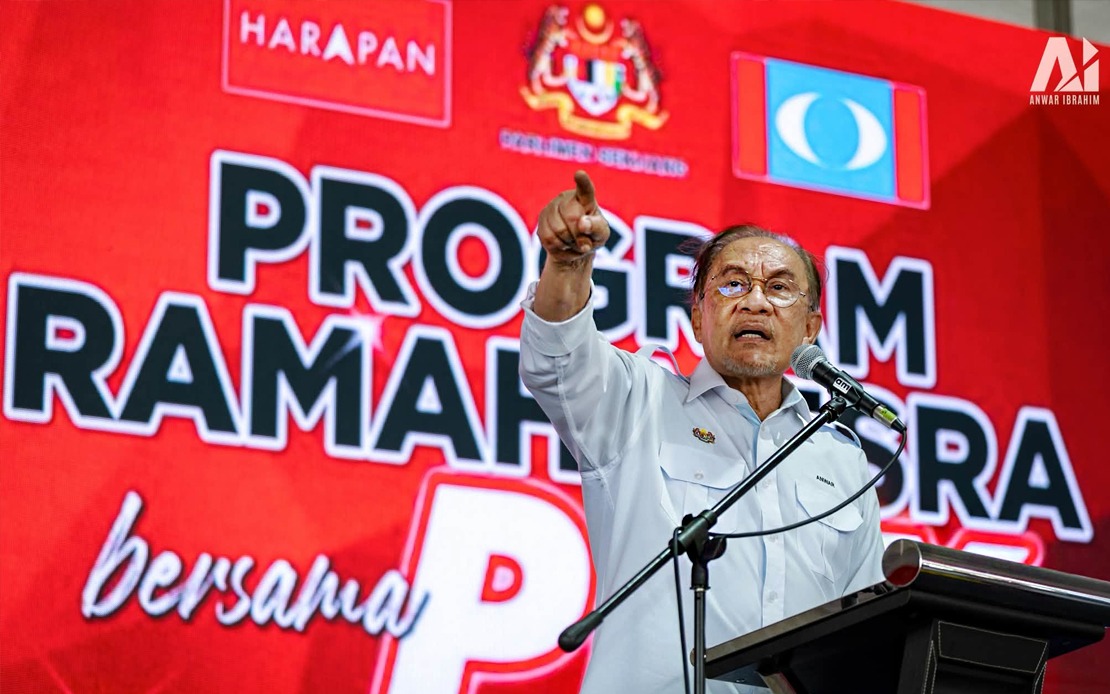
Prime Minister Datuk Seri Anwar Ibrahim has committed to championing Malaysian durian farmers at the highest diplomatic level, pledging to broach the issue of declining prices during an upcoming meeting with Chinese Premier Li Qiang. Speaking during a meet-the-people session in the Gambir state constituency in Tangkak, Anwar acknowledged the mounting financial pressure facing durian growers following a convergence of harvest peaks across Peninsular Malaysia that has precipitated a dramatic contraction in market prices and, consequently, farmer revenues.
The Prime Minister framed his intervention as part of a broader strategy to leverage bilateral relations between Malaysia and China for economic gain. By positioning durian access discussions within the context of Malaysia-China commercial ties, Anwar signalled that agricultural trade expansion represents a strategic priority capable of addressing seasonal oversupply challenges that periodically destabilise the sector. He emphasised that opening additional market channels during periods of abundance would provide farmers with alternative outlets, thereby insulating them against domestic price collapses driven by supply gluts.
Anwar's candid acknowledgement of the difficulty inherent in negotiating with Beijing underscored the complexity of the undertaking. China maintains rigorous phytosanitary and quality standards for imported agricultural products, creating formidable barriers to market entry. Nevertheless, Anwar framed his personal relationship with Li Qiang as an asset that might facilitate breakthrough discussions, suggesting that high-level political engagement offers pathways that conventional trade negotiations might not. The timing of his planned China visit in August positions the durian discussion as part of a comprehensive bilateral engagement rather than a narrow sectoral complaint.
For Malaysian durian producers, particularly those concentrated in Johor, Pahang, and Terengganu, access to Chinese consumers represents the holy grail of market expansion. China's rapidly expanding middle class has developed an insatiable appetite for premium tropical fruits, with durian commanding particularly high prices owing to its exotic status and limited cultivation capacity outside Southeast Asia. A successful expansion of quota allocations or a relaxation of import restrictions would fundamentally alter the economics of Malaysian durian farming, potentially shifting the sector from cyclical feast-or-famine dynamics toward more stable revenue streams.
The political dimension of Anwar's pledge cannot be overlooked. His appearance in Gambir alongside Pakatan Harapan's Johor leadership—including election director Datuk Seri Amirudin Shari and PH's state candidate Mohd Nor Mohd Yusof—situated the durian initiative within the coalition's electoral calculus for the forthcoming Johor state election. Demonstrating responsiveness to farmer grievances through high-level diplomatic action serves to reinforce PH's positioning as an administration capable of translating grassroots concerns into governmental priority, a messaging strategy essential to coalition performance in rural constituencies where agricultural livelihoods predominate.
Beyond durian, Anwar used the platform to underscore his administration's commitment to shielding Malaysian consumers from global commodity price volatility. Referencing geopolitical tensions centred on Iran and United States relations, he attributed contemporary oil price pressures to supply disruptions rooted in Middle Eastern instability. The government's deliberate choice to absorb these costs through fuel subsidisation rather than pass them to consumers represents, in his framing, a principled rejection of orthodox economic management in favour of protecting household purchasing power.
Malaysia's fuel subsidy regime has become a defining feature of the current administration's social contract with voters. Current retail prices as of July 1 stood at RM3.37 per litre for RON95 petrol and RM3.97 per litre for diesel; however, the BUDI MADANI programme caps end-user prices at RM1.99 and RM2.10 per litre respectively, representing substantial government underwriting of the differential. Anwar's assertion that Malaysia maintains the world's lowest fuel prices through sustained government intervention positions this subsidy framework as both economically anomalous and politically courageous.
The comparative claim warrants scrutiny within regional and global context. While several oil-exporting nations—notably Brunei and Bahrain—maintain fuel price regimes comparable to or lower than Malaysia's, Anwar's rhetorical positioning reflects a domestically oriented political narrative prioritising consumer protection over fiscal orthodoxy. The divergence between retail market prices and administered prices creates implicit budgetary commitments that constrain fiscal flexibility, a trade-off Anwar signals his government consciously accepts on grounds of social equity.
From a macroeconomic standpoint, Malaysia's dual-track fuel pricing system generates ongoing policy tensions. Subsidisation insulates consumers from price signals that typically incentivise conservation and efficiency, potentially contributing to elevated petroleum demand. Conversely, rapid price liberalisation risks triggering inflationary pressures that cascade through transportation and production costs, ultimately eroding real household incomes. Anwar's public declaration that he personally finds price increases unconscionable suggests ideological resistance to market-based adjustments, embedding fuel pricing within a political economy of social protection rather than allocative efficiency.
The political economy of durian and fuel pricing converge in revealing the premium this administration places on protecting rural and working-class constituencies from commodity market volatility. Both interventions—diplomatic market access expansion and subsidised fuel pricing—represent governmental attempts to intermediate between farmers and consumers, respectively, and global market forces beyond individual national control. Anwar's willingness to personally champion these causes at international and domestic levels reflects a governing philosophy that interprets state power, in part, through the lens of protecting vulnerable populations from unmediated market forces.
As Malaysia navigates evolving trade dynamics with China and confronts persistent fiscal pressures from commodity price fluctuations, the effectiveness of Anwar's durian diplomacy and fuel subsidy commitments will substantially shape both the government's credibility among agricultural constituencies and its long-term fiscal sustainability. The forthcoming engagement with Premier Li Qiang will test whether high-level political capital can overcome structural barriers to Chinese market access, whilst the fuel subsidy regime remains vulnerable to eventual adjustment pressures should global oil prices spike dramatically.

