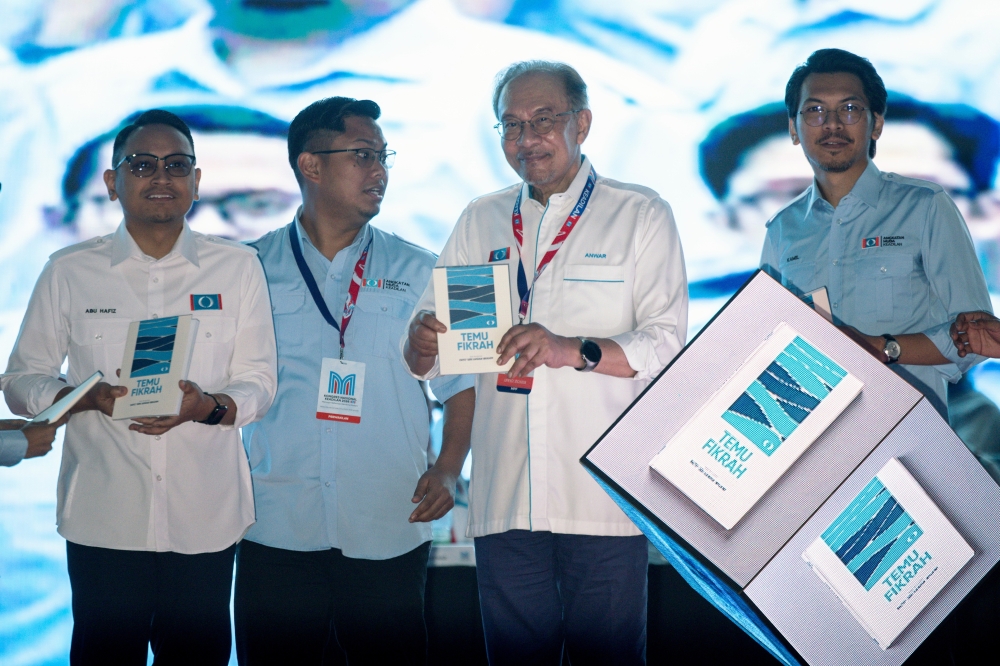
Prime Minister Datuk Seri Anwar Ibrahim introduced Temu Fikrah in Melaka on Friday, positioning the document as a foundational guide for PKR Youth that merges ideological principles with operational direction. The initiative reflects the ruling coalition's effort to embed its Madani governance framework—centring on shared prosperity and inclusive development—into the grassroots machinery of the country's largest opposition-turned-government party. The launch signals PKR's strategy of strengthening youth engagement through structured ideological and practical guidance, a move particularly significant given the party's pivotal role in maintaining coalitional stability in Parliament.
The Temu Fikrah framework emphasises three core pillars that the party leadership believes will shape the next generation of PKR activists and office-holders. Courage, positioned as the willingness to challenge injustice and advance transformative ideas, forms the moral foundation. Creativity speaks to the party's ambition to innovate governance solutions responsive to Malaysia's evolving economic and social needs. The third element—explicit alignment with Madani principles—anchors PKR Youth within the broader federal agenda, ensuring that local party activism complements national policy direction rather than operating in isolation. This three-pronged approach reflects a maturation in how ruling parties in Southeast Asia attempt to institutionalise both ideological commitment and practical governance competence within youth structures.
The document functions simultaneously as manifesto and operational manual, a hybrid format uncommon in Malaysian political practice. Traditional party manifestos typically articulate values and electoral promises; operational manuals prescribe administrative and institutional procedures. By fusing these, the Temu Fikrah seeks to ensure that PKR Youth members understand not only what the party stands for but how to translate those principles into tangible programmes and policy advocacy. This approach carries implications for how political parties across the region engage younger constituencies, potentially establishing a template that balances ideological clarity with pragmatic governance capability.
For Malaysian observers, the launch underscores the internal consolidation efforts within PKR as it navigates its transformation from an opposition party to a government coalition anchor. Since assuming federal power in 2022, PKR has faced the dual challenge of maintaining its reform credentials while delivering concrete governance outcomes. Youth wings represent critical constituencies for this balance—they can mobilise grassroots support and provide ideological energy, but without proper channeling can become sources of intra-party friction or unrealistic demands. Temu Fikrah appears designed to address this tension by establishing clear expectations and shared reference points.
The emphasis on courage within the manifesto carries particular weight in Malaysia's contemporary political environment. Rising inflation, employment uncertainties for fresh graduates, and concerns about institutional reform have created an articulate youth demographic increasingly willing to engage directly with policy. By explicitly valorising courage as a party virtue, PKR signals openness to internal debate and constructive challenge, though the document's specifics will determine whether this translates into genuine space for dissent or represents rhetorical positioning. The framing distinguishes PKR's self-image from competitor narratives in Malaysian politics, though whether this distinction resonates with voters or merely among party cadres remains an open question.
Creativity in governance carries particular relevance for Southeast Asian governments grappling with fiscal pressures and structural economic transitions. The Madani framework, launched by the current administration, emphasises targeted social support, green economic transition, and institutional strengthening. PKR Youth engagement with creative governance solutions could translate into policy experimentation at state and local levels, where the party holds significant positions. However, creativity without adequate resourcing or institutional support risks producing ambitious plans disconnected from implementation capacity—a common challenge in developing democracies where aspirational governance frameworks encounter budgetary constraints.
The Madani governance integration within Temu Fikrah reflects the broader effort to establish consistent messaging across coalition partners and government institutions. Malaysia's political system features significant power diffusion—state governments, federal territories, and diverse coalition parties all operate with considerable autonomy. Documents like Temu Fikrah serve as alignment mechanisms, attempting to ensure that local initiatives reinforce rather than contradict central policy directions. This is particularly important for PKR, which governs Selangor, the country's most economically productive state, and therefore can either amplify or dilute federal governance agendas depending on internal coherence.
For regional political analysts, the launch illustrates evolving approaches to youth mobilisation in Southeast Asian democracies. Rather than purely oppositional engagement or purely ceremonial incorporation, the manifesto-manual model attempts to channel youth energy toward institutional contribution. Singapore and Vietnam employ more directive approaches; Thailand's various regimes have alternated between co-optation and suppression. Malaysia's approach, reflected in Temu Fikrah, suggests a confidence in institutional capacity to absorb and direct youthful idealism toward productive purposes, though this requires sustained credible governance delivery to avoid disillusionment.
The document's reception among PKR Youth membership will provide important signals about the party's internal health and the broader appeal of Madani governance among younger constituencies. Strong uptake suggests successful messaging and genuine resonance with youth priorities; weak adoption might indicate generational disconnection or doubts about the sincerity of institutional openness. Subsequent months will reveal whether Temu Fikrah remains a ceremonial launch point or becomes an active reference in party training, candidate selection, and youth-led policy initiatives.
Looking ahead, the success of initiatives like Temu Fikrah will partially determine PKR's capacity to remain a coalition anchor and sustain government stability. Malaysian governance depends significantly on ruling coalition cohesion, and parties with engaged, coherent youth wings historically demonstrate greater organisational resilience. By providing structural guidance to its youth wing aligned with national governance priorities, PKR attempts to strengthen both its internal institutional capacity and its contribution to federal stability. Whether this translates into tangible governance improvements and sustained youth engagement will be measured in coming years as the party faces electoral cycles and governance challenges.

