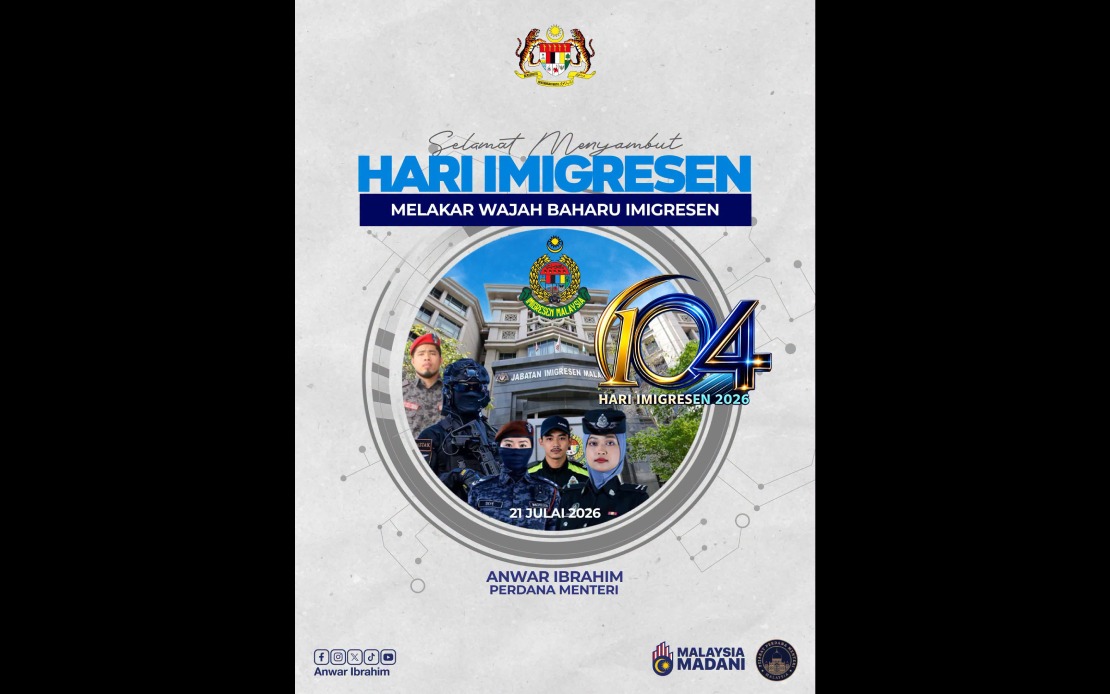
Prime Minister Datuk Seri Anwar Ibrahim has issued a direct appeal to all staff within the Immigration Department to discharge their duties with unwavering integrity whilst firmly rejecting any manifestation of corrupt practices or irregularities. The appeal came during the national observance of Immigration Day, a significant occasion that underscores the critical role immigration authorities play in protecting Malaysia's borders and sovereignty. Through a public statement on social media, Anwar articulated the expectation that every officer, from frontline personnel to senior management, must embody the highest ethical standards in their daily operations.
The Prime Minister's message extends beyond mere compliance with anti-corruption regulations, instead framing integrity as a foundational value that should guide decision-making at every level within the department. In the Malaysian context, where issues of institutional reform and public sector accountability remain subjects of intense national discussion, this pronouncement carries particular weight. The timing of the address during Immigration Day ceremonies reflects the government's commitment to signalling that no institution is exempt from the broader push toward greater transparency and ethical governance that has characterised recent political developments.
Acknowledging that enforcement of immigration rules represents a position of significant authority and trust, Anwar emphasised that compassion must complement rigour in how officers interact with the public. This dual emphasis on professionalism and empathy recognises that immigration administration involves numerous sensitive human situations—from visa processing that affects families and livelihoods to border management that requires judgement and discretion. By urging officers to balance firmness in upholding regulations with courtesy and understanding, the Prime Minister outlined a vision of an immigration authority that remains both effective and humane.
The 2026 Immigration Day theme of "Charting a New Face for Immigration" suggests that the department is undergoing or planning significant transformation. This repositioning may involve modernisation of systems, training initiatives, or structural reforms designed to enhance service delivery and institutional credibility. For Malaysia, a nation that processes millions of travellers annually and hosts a substantial migrant workforce, the efficiency and integrity of immigration services directly impact both economic vitality and public confidence in government institutions. An immigration authority perceived as professional and fair facilitates business operations and tourism; one beset by corruption and inefficiency imposes costs on commerce and damages Malaysia's international reputation.
Corruption within immigration agencies represents a particularly acute governance challenge across Southeast Asia. Opportunities for bribery arise at multiple checkpoints—visa issuance, entry clearance, documentation processing—and the financial incentives can be substantial. When officers succumb to such pressures, the consequences ripple outward. Travellers may face arbitrary delays or demands for payments, foreign investors encounter unpredictability in visa processing, and the nation's ability to control borders and security threats diminishes. Anwar's explicit call to reject irregularities thus addresses a practical institutional vulnerability that requires sustained attention and cultural change.
The Prime Minister's invocation of serving the people alongside safeguarding sovereignty reflects the dual mandate that immigration authorities navigate. While these objectives often align, tensions can emerge when balancing openness to visitors and migrant workers against security imperatives. By emphasising both dimensions, Anwar signals that efficiency and facilitation—what the department describes as professional and courteous service—must never be sacrificed for security, nor security compromised for convenience. This balanced framing appeals to diverse stakeholders: businesses and tourism operators who benefit from streamlined processes, security agencies concerned with threat management, and international partners evaluating Malaysia's institutional standards.
The appeal to elevate Malaysia's standing on the global stage attaches immigration administration to the broader national project of enhancing the country's competitiveness and reputation. In an era of heightened scrutiny of institutional quality, ease of doing business rankings, and travel security assessments, how Malaysia manages its borders and processes travellers contributes to international perception. Nations renowned for efficient, corruption-free immigration systems attract investment and talent more readily than those with reputations for bureaucratic friction and malfeasance. By grounding his message in this international dimension, Anwar connects departmental ethics to national economic and diplomatic interests.
The statement also implicitly acknowledges that integrity must be actively cultivated rather than assumed. Immigration personnel operate in environments where opportunities for misconduct exist and where the pressure to supplement modest salaries through informal means can be intense. Anwar's public articulation of expectations, combined presumably with institutional mechanisms for training, accountability, and whistleblower protections, represents a multifaceted approach to embedding integrity. Without sustained commitment from leadership, clear communication of values, and systems that make wrongdoing costly, exhortations alone ring hollow.
For Malaysian citizens, the quality of immigration administration affects experiences ranging from passport renewal to spousal sponsorship to workplace visas for foreign employers. A department functioning with integrity and professionalism reduces frustration, eliminates arbitrary treatment, and builds confidence that rules are applied consistently. For Malaysia's position as a regional economic hub and tourism destination, immigration performance directly influences competitiveness. Investment decisions by foreign firms often factor in the ease and predictability of visa and work permit processes; tourism marketing depends on perceptions of welcoming yet secure entry procedures.
The broader context of Anwar's message reflects ongoing efforts to rebuild institutional credibility following periods of political turbulence and corruption scandals that affected various government agencies. By publicly reaffirming anti-corruption expectations during a ceremonial occasion, the Prime Minister underscores that administrative professionalism and ethical conduct represent non-negotiable requirements, not aspirational ideals. This messaging must translate into concrete accountability mechanisms, training programmes, and incentive structures within the Immigration Department to demonstrate that the appeal represents genuine commitment rather than performative rhetoric.
Moving forward, the effectiveness of such calls will be measured not in words but in outcomes: reduced corruption complaints, improved processing times, enhanced staff morale and retention, and positive feedback from businesses, travellers, and international observers. The department's challenge involves sustaining momentum toward institutional renewal whilst managing the operational pressures inherent in processing millions of traveller movements annually and administering complex visa regimes. Success requires leadership committed to change, sufficient resources for training and systems development, and a departmental culture that celebrates and rewards integrity rather than tolerating it as a constraint on efficiency.

