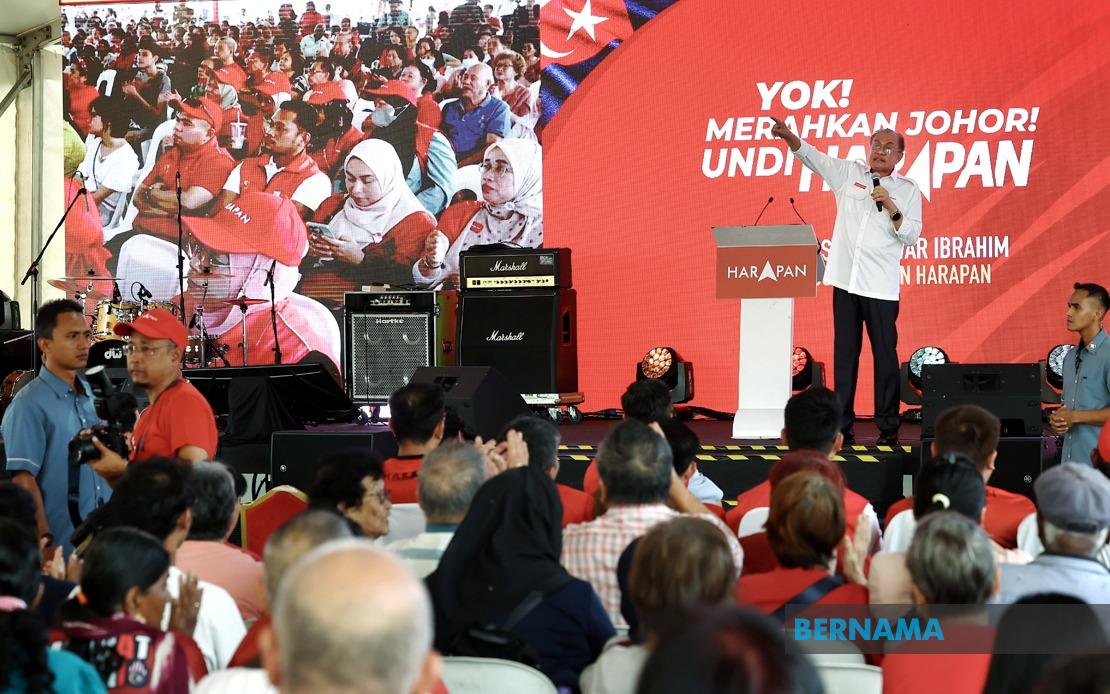
Prime Minister Datuk Seri Anwar Ibrahim has made a direct appeal to all political parties contesting the Johor state election, urging them to refrain from leveraging the incarceration of former Prime Minister Datuk Seri Najib Razak as a tool for electoral gain. Speaking at a campaign event in Kulai, Anwar stressed that the time has come to move beyond the contentious issue of Najib's imprisonment and instead redirect political discourse towards substantive matters affecting the people's livelihoods.
Anwar's intervention reflects a broader strategic shift within the ruling coalition, which seeks to pivot away from the divisive legacies of the previous regime and concentrate campaign messaging on the government's economic management agenda. By explicitly calling for an end to politicising Najib's situation, Anwar is attempting to set the tone for a campaign focused on forward-looking policies rather than backward-looking recriminations about past governance failures.
The former prime minister, who was convicted in connection with the 1Malaysia Development Berhad scandal, continues to serve his sentence despite various legal proceedings. Anwar's acknowledgement that Najib is "now in prison" and his statement that "enough is enough" suggest a desire to treat the matter as settled within the judicial system rather than as an ongoing political battleground.
However, Anwar did not shy away from highlighting the massive financial legacy left by the 1MDB scandal, which continues to constrain the government's capacity to deliver public services. The Prime Minister pointed to the RM51 billion debt burden inherited from the misappropriation scheme, underscoring that this astronomical sum represents money that could have been invested in critical infrastructure such as schools, hospitals, and road networks, or directed towards poverty alleviation programmes.
This framing is strategically significant for the Pakatan Harapan coalition's campaign in Johor. Rather than attacking political opponents for their historical associations with the previous administration or their connections to Najib, Anwar is attempting to reframe the 1MDB issue in terms of its ongoing economic impact on Malaysians. The implication is that voters should focus their concerns not on Najib as an individual imprisoned in the past, but on the real-world consequences of financial mismanagement that continue to affect public service delivery today.
The gathering where Anwar made these remarks brought together several senior coalition figures, including Youth and Sports Minister Mohammed Taufiq Johari and Deputy Investment, Trade and Industry Minister Sim Tze Tzin, indicating that this message represents a coordinated position across the government rather than a personal editorial by the Prime Minister. The presence of the Pakatan Harapan candidate for Bukit Batu, Arthur Chiong Sen Sern, underscores that this campaign directive is being transmitted to individual candidates across the state.
For Malaysian observers and particularly those in Johor, Anwar's remarks signal that the ruling coalition intends to contest the state election on the basis of economic competence and social service delivery rather than moral judgments about the prior regime. This approach carries both advantages and risks: it allows the coalition to occupy higher ground on policy substance, but it may also be perceived as insufficient accountability for the 1MDB scandal by those who believe the issue remains politically relevant.
The Johor state election represents an important electoral test for Pakatan Harapan, and the coalition's campaign strategy will likely influence political messaging in other constituencies across Malaysia. Anwar's intervention suggests that senior leadership believes the party's best chance of electoral success lies in demonstrating effective governance rather than relitigating past failures.
Nonetheless, Anwar's explicit invocation of the 1MDB debt burden indicates that the government believes the issue cannot be entirely divorced from campaign narratives. By reframing it as an ongoing economic problem rather than a historical political scandal, Anwar appears to be seeking a middle ground: acknowledging the severity of past financial crimes while redirecting public attention towards their present-day consequences and the government's efforts to manage the resulting fiscal constraints.
For Southeast Asian observers, Anwar's approach reflects a maturing political environment in Malaysia where electoral competition increasingly centers on economic performance and administrative effectiveness rather than personality-driven attacks or relentless focus on individual accountability. This shift, if sustained, could reshape the tenor of Malaysian politics towards greater emphasis on policy differentiation and comparative performance metrics.
The Prime Minister's remarks also underscore the extent to which the 1MDB scandal continues to define Malaysia's fiscal landscape and political discourse, even years after initial prosecutions and convictions. The fact that a sitting Prime Minister must publicly address the ongoing burden of inherited debt in the course of a state election campaign speaks to the magnitude of the financial damage inflicted and its persistent relevance to governance challenges.

