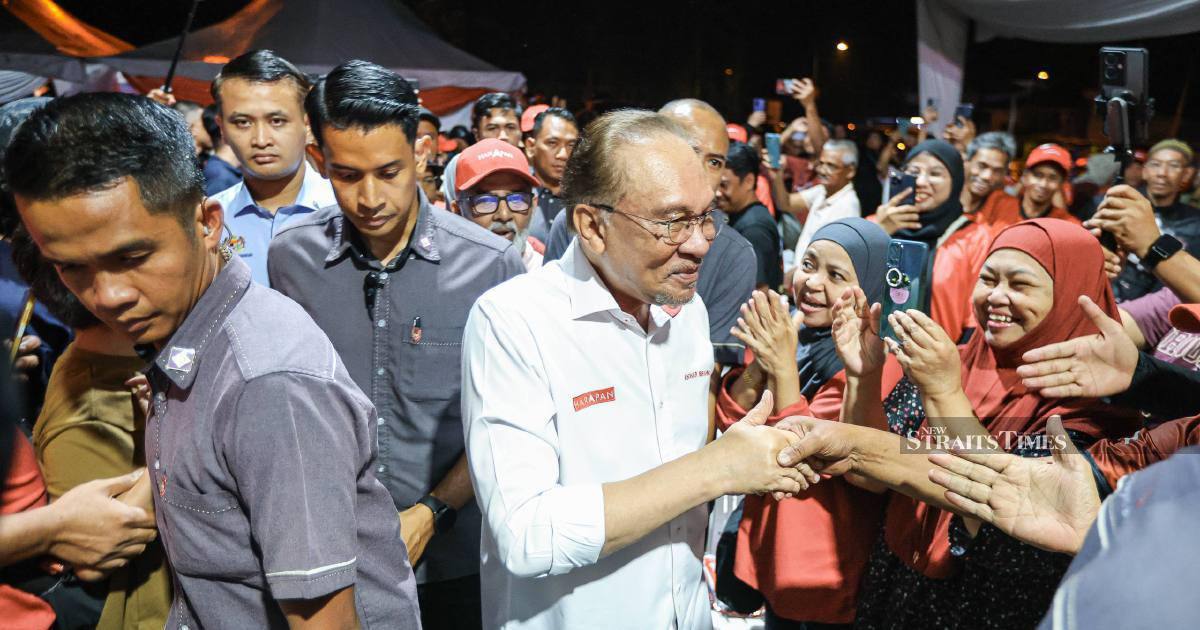
The Prime Minister and Pakatan Harapan chairman Datuk Seri Anwar Ibrahim has made a direct appeal to Johorean voters living beyond their home state, calling on them to travel back specifically to participate in the forthcoming state election scheduled for Saturday. The exhortation underscores the coalition's recognition that voter turnout, particularly among the diaspora, could prove decisive in determining electoral outcomes in a state where marginal victories have become increasingly common.
Johor, Malaysia's second-largest state by population, has historically witnessed significant internal migration as residents seek employment opportunities in neighbouring Kuala Lumpur and across the causeway in Singapore. This demographic pattern has created a substantial pool of registered voters who maintain electoral rights in their home constituencies despite residing elsewhere. The appeal targets not merely those who have relocated to neighbouring Kuala Lumpur, where many commute daily for work, but extends to the more distant Johorean communities established in Singapore, where tens of thousands have made their home over decades.
The timing of Anwar's appeal carries strategic weight. State elections in Malaysia frequently hinge on voter participation, with differential turnout between urban and rural constituencies sometimes determining which coalition controls state government. Johor, having emerged as a critical political battleground following the 2022 general election redistribution, represents a prize both coalitions view as essential to controlling state-level resources and positioning for future federal contests.
For many Johoreans working in Singapore, participating in state elections requires making a deliberate journey across the causeway, navigating border procedures, and potentially taking time away from employment. The convenience factor acts as a natural depressant on voter participation, historically favouring those with more flexible schedules or stronger emotional attachments to constituency politics. By explicitly invoking civic responsibility, Anwar's statement attempts to reframe voting not merely as a political choice but as an obligation to one's home community.
The call reflects broader patterns in Malaysian electoral politics where coalition leaders increasingly recognize that mobilizing diaspora voters demands explicit messaging and logistical consideration. Unlike national elections, where absentee voting mechanisms remain underdeveloped despite repeated proposals, state elections still require physical presence at polling stations. This structural constraint disproportionately affects workers in high-income employment who face greater opportunity costs in taking time off.
Kuala Lumpur holds particular significance in Anwar's appeal. The capital city hosts not merely Johorean commuters but substantial permanent settlements of Johor-origin residents, including retirees and families who have built their lives in the federal territory. The two-hour travel distance between Kuala Lumpur and Johor makes same-day voting feasible for committed voters, yet many may deprioritize state elections in favour of federal contests that garner greater media attention and perceived national importance.
Singapore-based Johoreans represent a more complicated constituency. Cross-border workers who maintain Malaysian citizenship and electoral registration have historically shown lower participation rates in state elections, a pattern attributable to practical challenges including employment constraints and the complexity of international travel. The shift toward cross-border residence has accelerated following successive lockdowns and the normalization of work-from-office arrangements, potentially making this election cycle slightly different from recent precedent.
The Pakatan Harapan coalition's emphasis on this diaspora mobilization hints at confidence calculations about base support in rural and semi-rural areas. If internal polling suggested commanding majorities in core constituencies, such appeals would prove less strategically important. The fact that Anwar, as Prime Minister, made this call personally rather than delegating to state-level party officials suggests the coalition views the election as competitive and resource-dependent on maximizing every possible vote.
The appeal also carries implications for how Malaysian political messaging operates across state lines. Anwar's invocation of civic duty tacitly acknowledges that electoral politics remains fundamentally localized in Malaysian federalism, with state-level outcomes mattering independently from national government composition. This contrasts with some voters' tendency to treat state elections as second-order contests where national partisan alignments matter more than local issues.
For Johor's electoral dynamics specifically, the participation of diaspora voters could significantly influence outcomes in marginal constituencies, particularly those in suburban areas between Kuala Lumpur and Johor Bahru where demographic composition includes substantial numbers of economic migrants. These constituencies frequently feature among the closest races, with victory margins measured in hundreds rather than thousands of votes. A coordinated diaspora turnout operation could theoretically shift multiple seats.
Beyond immediate electoral calculations, the appeal illuminates how modern Malaysian state politics intersects with labour mobility and urbanization patterns. As more young Malaysians pursue opportunities away from their home constituencies, maintaining political engagement across geographic distance has become a structural challenge. Political parties increasingly recognize that assuming voter loyalty based on birth state alone proves insufficient; active mobilization becomes necessary even among the party's presumed base.
The coming Saturday's election will reveal whether such appeals translate into measurable voting behaviour changes among diaspora populations. If participation rates among Johoreans in Singapore and Kuala Lumpur exceed historical averages, it would suggest that explicit mobilization appeals, particularly from national leadership, successfully overcome the practical barriers that typically suppress non-resident voter turnout. Conversely, modest participation would indicate that structural incentives—employment obligations, travel costs, logistical inconvenience—outweigh emotional appeals to civic duty, even when delivered by the nation's Prime Minister.

