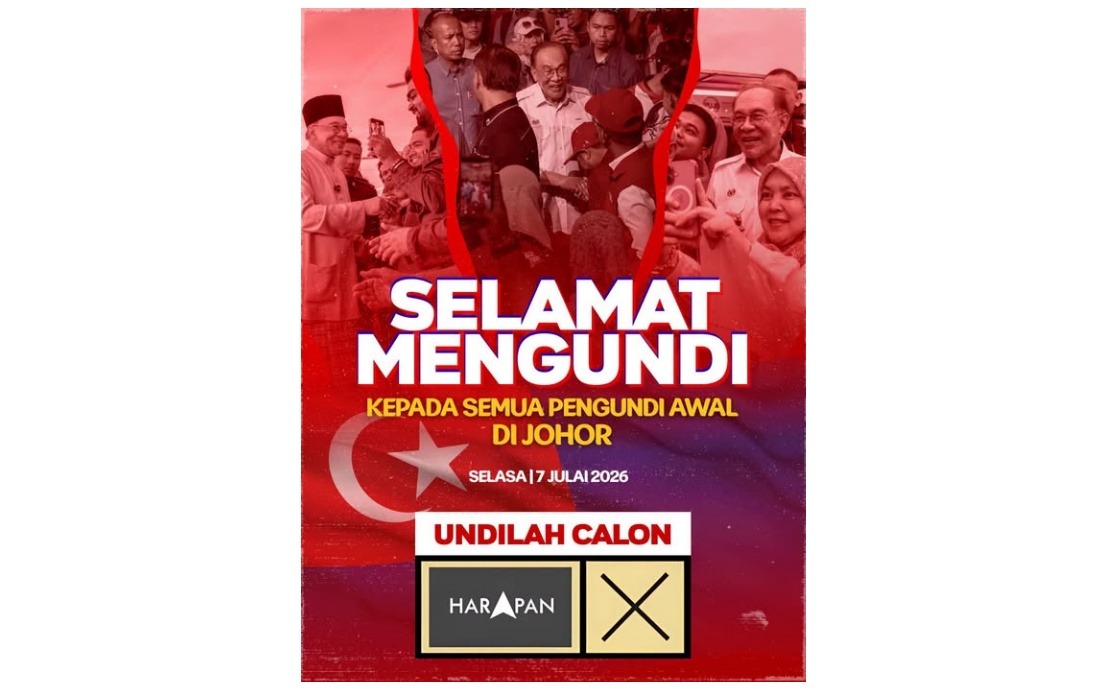
Prime Minister Datuk Seri Anwar Ibrahim has publicly encouraged the nearly 25,000 early voters participating in the 16th Johor state election to cast their ballots for Pakatan Harapan candidates, framing the contest as a crucial opportunity to shape the state's future. Speaking through a Facebook post on July 7, Anwar, who leads the opposition coalition, directly appealed to eligible early voters to support the coalition's candidates across all contested seats, emphasising that their participation would help deliver positive change to Johor.
The early voting phase brought together security personnel and their spouses from Malaysia's armed and law enforcement agencies, reflecting standard electoral procedures that allow such personnel to vote before the general polling date. In total, 24,751 eligible voters participated across 64 designated polling centres throughout the state, a significant proportion representing the country's commitment to ensuring comprehensive suffrage even among those with demanding public service schedules.
The composition of early voters reflected the security sector's substantial presence in the electoral process. The Malaysian Armed Forces contingent, including both active personnel and their spouses, accounted for 12,041 of the early votes cast, while the Royal Malaysia Police and General Operations Force, along with their respective family members, provided the remaining 12,710 voters. This breakdown underscores the logistical complexity of accommodating multiple security agencies within a coordinated voting framework.
Polling arrangements were structured to accommodate the large number of early voters while maintaining operational efficiency across the security forces. Fifty-three polling centres dedicated to Royal Malaysia Police personnel opened simultaneously at 8 am, whilst eleven centres served Malaysian Armed Forces voters, with staggered closing times between noon and 6 pm depending on the particular location and registered voter numbers. This phased approach reflected careful electoral planning to prevent congestion whilst ensuring all eligible personnel could exercise their democratic rights without compromising security operations.
Pakatan Harapan's participation in this election demonstrates the coalition's continued engagement in state-level contests following its return to national prominence in recent years. The coalition fielded a full slate of 56 candidates across all available state seats, with representation distributed among its three constituent parties: PKR putting forward 20 candidates, Amanah contributing 19, and DAP providing 17 candidates. This distribution reflects the coalition's internal power-sharing arrangements and organisational strengths in different constituencies.
The broader electoral context reveals the substantial competition taking shape ahead of the main polling day scheduled for Saturday. A total of 172 candidates across all political parties were competing for positions representing the diverse political landscape in Johor, Malaysia's southernmost state and home to over 2.7 million registered voters. This candidate pool reflected both established parties and emerging political movements seeking representation in the state assembly.
For Malaysian observers and voters in other states, the Johor election carries implications extending beyond the state's boundaries. As one of Malaysia's largest and most economically significant states, political outcomes in Johor often influence broader national political calculations and coalition dynamics. The state's electorate comprises diverse demographic groups spanning urban, semi-urban, and rural areas, making it a barometer for voter sentiment across different community segments.
Anwar's personal appeal to early voters represented a strategic engagement by the prime minister in state-level politics, blending his national leadership platform with direct advocacy for coalition candidates. By framing the election as offering voters a choice between continuity and change, and explicitly encouraging support for Pakatan Harapan, Anwar sought to mobilise support among the security personnel voting early—a constituency traditionally viewed as disciplined and organised.
The emphasis on early voting reflects modern electoral management practices adopted across Southeast Asian democracies, particularly where large institutional populations require accommodation within the voting framework. Malaysia's approach of permitting advance polling for security forces recognises both democratic principles and practical governance requirements, ensuring participation from those whose professional duties might otherwise complicate their ability to vote on the designated date.
Looking forward to Saturday's main polling day, the early voting results would provide preliminary insights into voter turnout levels and perhaps early indicators of electoral momentum. Political analysts would scrutinise whether the security sector's voting patterns reflected particular preferences or aligned with broader state sentiment, using early results as a proxy for understanding larger electoral dynamics as results from general polling sites began arriving throughout the weekend.

