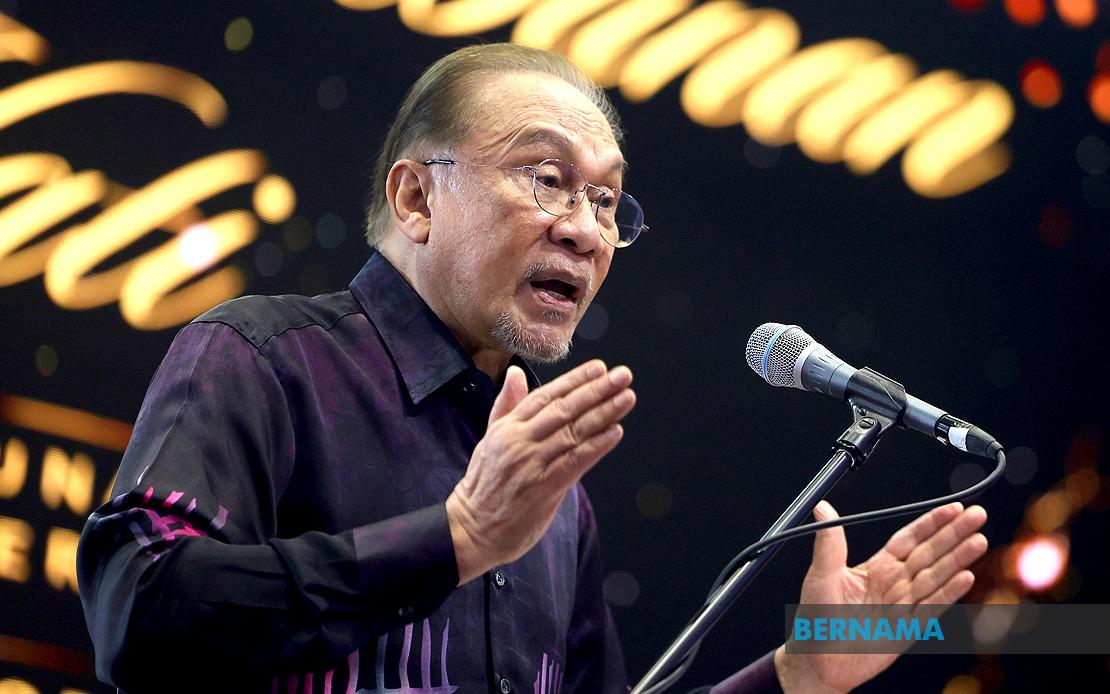
Prime Minister Datuk Seri Anwar Ibrahim has issued a forceful appeal to Malaysians to safeguard the nation's foundational commitment to unity, warning that deliberate efforts by certain leaders to amplify ethnic tensions pose a fundamental threat to the country's cohesion and prosperity. Speaking at a dinner event in Seremban organised by Pertubuhan Lima Generasi Malaysia, Anwar articulated a vision of the nation transcending manufactured divisions that pit communities against one another, addressing what he characterised as a coordinated campaign to undermine Malaysia's multiethnic fabric.
The prime minister framed ethnic diversity not as a liability to be managed but as a distinctive competitive advantage that underpins Malaysia's regional standing and economic dynamism. This positioning reflects a deliberate rhetorical strategy: by redefining plurality as national strength rather than a source of conflict, Anwar seeks to reorient public discourse away from zero-sum calculations about communal interests. He emphasised that this advantage can only materialise when grounded in substantive mutual understanding rather than merely rhetorical appeals for coexistence. The distinction matters because it places responsibility on political and civil leaders to actively construct the institutional and social foundations for cross-community engagement rather than assuming harmony flows automatically from demographic heterogeneity.
Anwar's remarks directly challenged what he depicted as a deliberate strategy by certain political actors to artificially weaponise ethnic identities. His specific framing—"some leaders want us to hate one another"—identifies the problem not as inherent intercommunal tension but as cynical political manipulation. By naming this tactic, he positioned rational self-interest on the side of unity; Malaysians recognising the manipulation can theoretically inoculate themselves against it. The formulation also carries implicit criticism of rival political formations and leaders within his own coalition who may be perceived as engaging in such tactics, though he avoided personalising these attacks.
The enumeration of Malaysia's constituent ethnic groups—Malays, Chinese, Indians, Kadazans and others—served multiple functions in Anwar's address. It acknowledged the demographic reality beyond the simplified Malay-Chinese binary that dominates much political discourse, particularly including East Malaysian perspectives through explicit mention of the Kadazans. This rhetorical inclusivity signals recognition that a unity agenda must encompass the full spectrum of Malaysian society rather than privileging certain communities in its framework. The invocation of these groups working together "as one strong force" translates abstract principles into a concrete vision of collective power.
The venue and audience composition carried significance for how the message would be received and amplified. The Pertubuhan Lima Generasi Malaysia, with over 1,000 members in attendance at the Seremban event, represents what appears to be a civil society or community-focused organisation, distinguishing it from a narrowly partisan gathering. By delivering this message through such a forum rather than exclusively through formal governmental channels, Anwar reached an audience likely to include civic leaders, community organisers, and grassroots influencers who shape opinion within their networks. The presence of Negeri Sembilan Menteri Besar Datuk Seri Aminuddin Harun underscored state-level alignment with the prime minister's agenda.
The timing of these remarks reflects broader currents in Malaysian politics, where communal messaging and identity-based appeals have intensified in recent electoral cycles. Regional observers have noted the prevalence of ethnically coded political strategies across Southeast Asia, with Malaysia representing a particular case where constitutional protections for certain communities intersect with competitive democratic politics. Anwar's intervention attempts to establish a countervailing narrative that positions unity-building and cross-community cooperation as politically advantageous rather than mere moral imperatives. Whether such framing can gain sufficient traction against more mobilising ethnic appeals remains an open question for Malaysian democratic development.
The implicit stakes in Anwar's appeal extend beyond immediate political competition to fundamental questions about Malaysia's trajectory as a plural society. Sustained erosion of interethnic cooperation threatens institutional capacity, as governmental effectiveness often depends on cross-community consensus on policy direction. Economic performance also suffers when business confidence declines due to perceptions of communal instability. International investment considerations similarly hinge on assessments of political stability and social cohesion. These structural imperatives provide Anwar with substantive arguments beyond appeals to moral principle, even if they require longer-term framing to gain resonance.
The prime minister's call also reflects attempts to distinguish his administration's approach from predecessors and rival formations. By emphasising unity and mutual understanding, Anwar positions his government as the custodian of Malaysia's founding compact—the constitutional settlement that balanced various communal interests within a singular framework. This narrative positions opposition to unity-building as implicitly hostile to constitutional arrangements and national foundations, creating a patriotic dimension to the unity agenda. Such framing has proven effective in Malaysian politics when deployed by leaders with sufficient credibility to sustain it.
Moving forward, the effectiveness of Anwar's appeal will likely depend less on rhetorical force than on whether his administration and political allies demonstrate sustained commitment to translating unity rhetoric into concrete governance outcomes. Policies affecting economic distribution, representation in public institutions, and resource allocation across communities will signal whether unity represents genuine commitment or merely electoral positioning. Malaysian citizens across communities remain attentive to such indicators, having experienced various pledges to communal harmony that proved incompletely implemented.