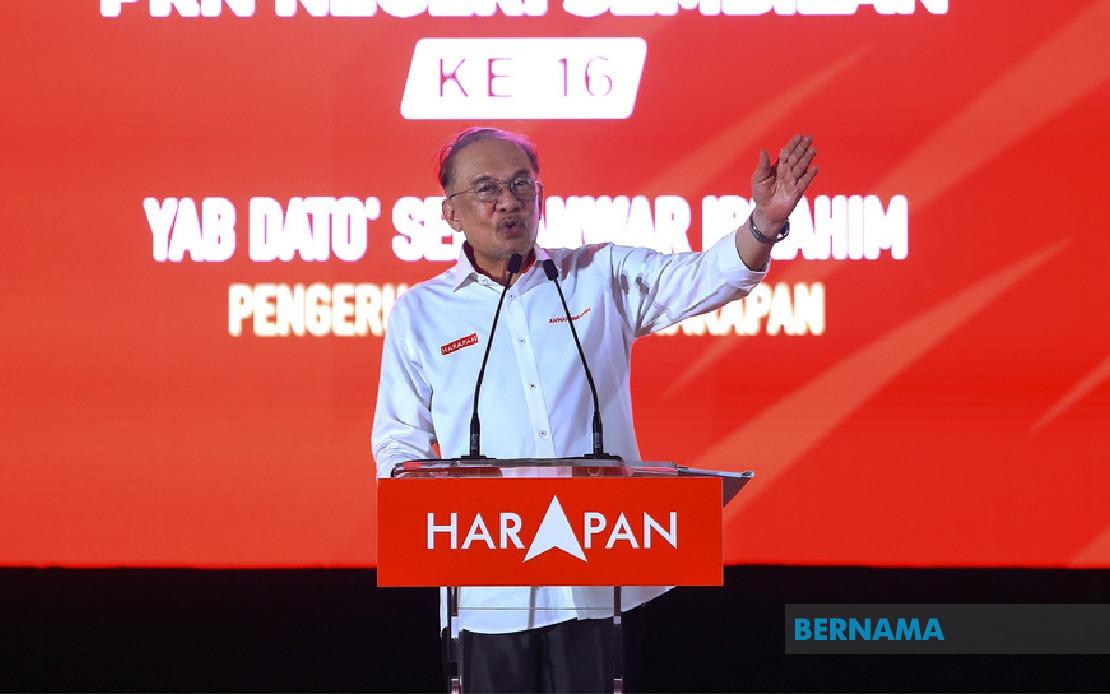
Prime Minister Datuk Seri Anwar Ibrahim has made a direct appeal to voters in Negeri Sembilan to maintain their backing for Pakatan Harapan (PH) in the state election scheduled for August 1, arguing that continuity of the coalition's leadership is vital for completing ongoing development initiatives across the state. Speaking through a Facebook post, Anwar—who holds the dual roles of Prime Minister and PH chairman—framed the upcoming ballot as a choice between progress and stagnation, emphasizing that halting the current trajectory would undermine efforts to improve living standards for the 1.1 million residents of the state.
The messaging reflects a carefully calibrated campaign strategy that seeks to position PH's six-year tenure in Negeri Sembilan as a success story requiring validation. Since 2018, when Menteri Besar Datuk Seri Aminuddin Harun first took office under the PH banner following the historic defeat of Barisan Nasional in the 14th general election, the state government has launched infrastructure projects, welfare programmes, and business development initiatives. Anwar's invocation of these achievements suggests PH recognises that voter confidence hinges on demonstrable results rather than abstract political narratives, a lesson the coalition learned painfully from its 2023 general election performance when it captured only 82 parliamentary seats despite entering the contest as the incumbent.
Anwar's emphasis on the collaborative relationship between state and federal governments deserves particular attention for Malaysian readers. The statement reveals an implicit acknowledgment that modern governance requires synchronisation between different levels of administration. When state and federal authorities are aligned politically—both serving the same coalition—bureaucratic obstacles diminish and funding flows more readily. This arrangement has enabled Negeri Sembilan to access federal development allocations and technical support that might otherwise face delays or complications. The contrast with states ruled by opposition parties, where PH federal governments have occasionally withheld or redirected resources on grounds of administrative disputes, underscores the practical advantages of political alignment.
The Prime Minister's praise of Menteri Besar Aminuddin Harun as a leader who embodies "integrity, humility and a strong sense of responsibility" serves multiple strategic purposes. First, it personalises the campaign around a familiar local figure whose performance can be directly assessed by voters. Second, it implicitly distances Aminuddin from the internal PH tensions that have periodically erupted since the coalition's 2022 reunification, including squabbles over ministerial portfolios and succession planning. Third, by highlighting character traits rather than policy specifics, Anwar appeals to voter sentiment beyond partisan ideology—many citizens across the political spectrum value honest administration and responsive governance regardless of party affiliation.
The election calendar outlined in the original announcement—nominations on July 16, early voting on July 28, and polling on August 1—compresses the campaign period into a remarkably tight two-week window. This compressed schedule presents both advantages and disadvantages for the incumbent PH administration. On one hand, brevity limits opposition parties' time to mount sustained attacks and build alternative narratives. On the other hand, it restricts PH's own capacity to conduct grassroots mobilisation and reach voters in rural areas where personal contact remains decisive. Given Negeri Sembilan's mixed urban-rural composition, with significant populations in Seremban, Nilai, and Port Dickson alongside agricultural communities in districts like Jelebu and Kuala Pilah, the condensed timeline could determine which party better mobilises its ground machinery.
For Southeast Asian context, this election matters beyond Negeri Sembilan's borders. Malaysia's federal system means that state governments control significant portfolios including land, agriculture, local government, and education curriculum implementation. If PH retains Negeri Sembilan, it would consolidate control over seven of Malaysia's 13 states—a commanding position that shapes national policy implementation. Conversely, a loss would represent a significant retreat, raising questions about PH's capacity to maintain electoral momentum heading toward the 15th general election expected between mid-2024 and mid-2025. Regional observers in Indonesia, Thailand, and the Philippines watch Malaysian electoral contests carefully as bellwethers for opposition performance against entrenched incumbents, making the Negeri Sembilan result instructive for democratic movements across Southeast Asia.
Anwar's invocation of religious language—"Alhamdulillah" (praise be to God) and "Insya-Allah" (God willing)—reflects the cultural and religious sensibilities of Negeri Sembilan's predominantly Muslim electorate. This rhetorical choice connects political messaging to Islamic values, subtly suggesting that supporting PH represents a morally correct choice aligned with broader principles of accountability and trustworthiness. Such language, commonplace in Malaysian political discourse, carries particular resonance in Negeri Sembilan given the state's historical role as a centre of Islamic learning and its significant Islamic institutional presence.
The promise that PH will continue upholding voter trust to "build a more prosperous and progressive future" represents a forward-looking vision designed to overcome potential voter fatigue or disappointment. After six years in office, incumbent administrations often face "time for change" sentiment, particularly if citizens perceive that promised improvements have not materialised at expected pace. PH's strategy appears to acknowledge this challenge by framing the election not as a referendum on past performance alone, but as a choice about future direction and the possibility of accelerated progress with renewed popular mandate.
Critically, Anwar's appeal for continued support implicitly recognises that Negeri Sembilan voters retain real choice. Unlike one-party dominant systems, Malaysian democracy functions through competitive elections where outcomes remain genuinely uncertain. The narrowness of some recent electoral results—including PH's precarious margins in several 2022 by-elections—suggests that support for the coalition cannot be taken for granted. By actively campaigning and appealing to voters on substantive grounds, Anwar demonstrates respect for democratic accountability while simultaneously mobilising his coalition's supporters ahead of a contest that will significantly influence Malaysia's political trajectory through 2025.

