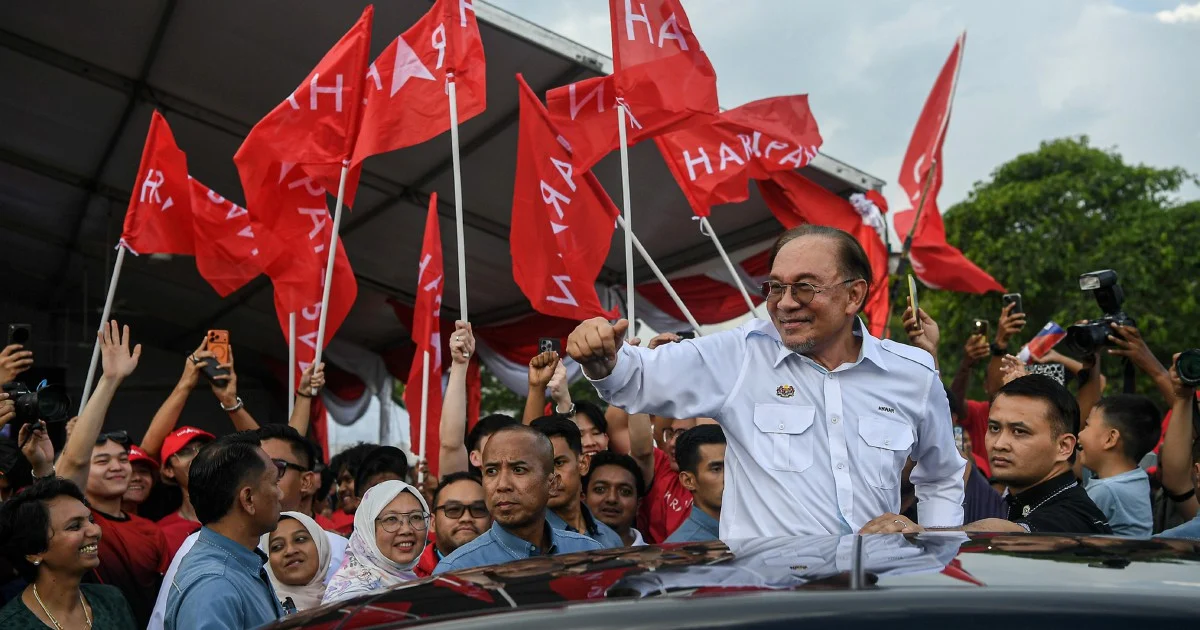
At a gathering in Segamat, Pakatan Harapan chairman Datuk Seri Anwar Ibrahim delivered a pointed rebuke to rival politicians who distance themselves from the Democratic Action Party, characterising their reluctance to share platforms or collaborate with the party as fundamentally inappropriate conduct within Malaysia's democratic framework.
Anwar's intervention signals renewed tension within the broader political landscape, where the presence of DAP—Malaysia's predominant Chinese-led party and core Pakatan component—continues to generate friction among competing coalitions. The Prime Minister's remarks underscore the coalition's determination to normalise DAP's role as a legitimate political force that has secured electoral endorsement from Malaysian voters across multiple election cycles.
The timing of Anwar's comments reflects mounting frustration within Pakatan regarding what it perceives as persistent stigmatisation of DAP by opposing camps. Despite the party's parliamentary presence following successive general elections, some political actors maintain what the coalition characterises as unnecessarily hostile stances, either refusing formal associations or deploying rhetorical attacks that Pakatan argues distort public understanding of DAP's policy positions and governance record.
This dispute carries particular significance for Malaysia's political stability and institutional health. Coalition dynamics depend fundamentally on accepting the legitimacy of electoral outcomes—a principle that extends beyond simple procedural compliance to encompassing genuine recognition of voters' explicit choices. When substantial political figures publicly reject partnerships with democratically elected representatives, they implicitly challenge the validity of the mandate those voters conferred, creating friction that weakens institutional confidence.
For Malaysian observers, the broader context involves decades of fraught communal politics where Chinese-based parties have frequently encountered structural disadvantages and prejudicial framing. DAP specifically has weathered accusations, some substantive but others manifestly exaggerated, that have circulated through opposition networks and segments of the traditional media. Anwar's intervention represents a direct counter to what Pakatan perceives as this ongoing delegitimisation campaign, reasserting that such tactics contradict democratic norms.
The coalition chairman's position carries weight given his historical prominence in Malaysia's reform movements and his previous advocacy for inclusive governance frameworks. Anwar has positioned himself as an advocate for transcending racial and religious polarisation, rendering his defence of DAP's legitimate place in governing coalitions consistent with his broader political philosophy, though clearly contentious among constituencies that oppose Chinese-led representation in senior decision-making structures.
Regionally, Malaysia's experience with managing multiethnic coalition politics holds instructive implications for other Southeast Asian democracies wrestling with analogous tensions. The underlying question—whether mature democracies should accept electoral outcomes that distribute power across ethnically and religiously diverse coalitions—resonates across the region, particularly in states with comparable demographic compositions and historical patterns of communal contest.
Anwar's comments also illuminate the precarious equilibrium that Pakatan has maintained since 2018. The coalition spans ideologically diverse partners, from the Islamic-oriented Amanah and PKR to DAP's secular-progressive orientation, alongside internal tensions regarding representation and policy priorities. Public defence of DAP partnership, therefore, signals Anwar's determination to preserve coalition cohesion against centrifugal pressures that periodically threaten to unravel the alliance.
Opposition parties, particularly those advocating greater emphasis on Islamic governance frameworks and Bumiputera-centric economic policies, have historically presented themselves as alternatives to Pakatan specifically by positioning themselves against DAP participation in government. These formations argue they represent values and constituencies inadequately protected by Pakatan's model. Anwar's challenge to politicians adopting this stance constitutes a direct confrontation with competing visions of Malaysia's political future, not merely a procedural disagreement about coalition etiquette.
The practical implications extend to legislative dynamics and governance effectiveness. Coalitions that lack confidence in their partners' legitimacy struggle to coordinate policy implementation, negotiate resource allocation, and present unified positions on major national questions. By insisting that all coalition participants deserve respect grounded in electoral validation, Anwar advocates for the pragmatic conditions necessary for functional governance rather than merely abstract democratic principles.
Moving forward, how Malaysian political actors respond to Anwar's reproach will signal whether the country is consolidating toward acceptance of genuine multiethnic power-sharing arrangements or gravitating back toward strategies that marginalise non-Bumiputera communities from substantive governance roles. The trajectory of this dispute carries implications extending well beyond immediate electoral calculations, touching on fundamental questions about what form Malaysia's democracy will take across the medium-to-long term.

