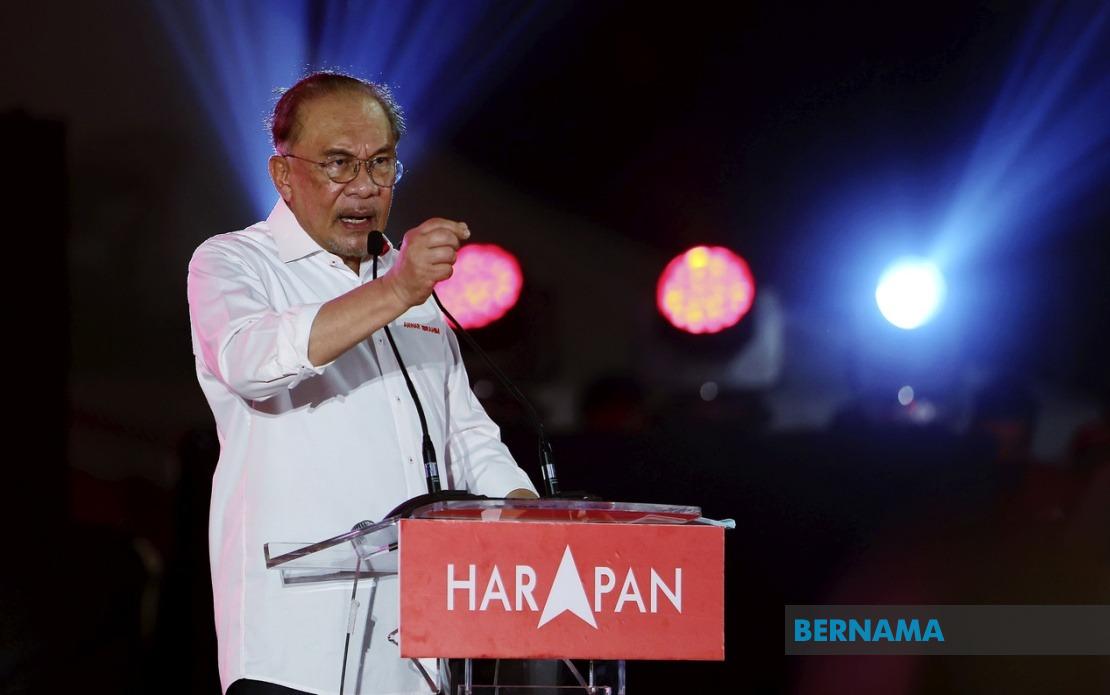
Prime Minister Anwar Ibrahim has issued a pointed reminder to all political contestants in the forthcoming 16th Negeri Sembilan State Election to steer clear of contentious matters involving the monarchy and constitutional affairs, underscoring the importance of safeguarding national institutions even amid fierce electoral battles.
Sppeaking at a candidate announcement ceremony in Kuala Pilah on July 14, the Pakatan Harapan chairman outlined his vision for how political competition ought to function in a mature democracy. While acknowledging that electoral contests represent a natural and essential component of democratic governance, Anwar stressed that such competitions must be conducted with integrity and restraint, avoiding the weaponisation of sensitive institutional and constitutional matters that could fracture social cohesion.
The Prime Minister articulated a careful distinction between robust political disagreement and irresponsible discourse. He made clear that parties may vigorously contest policy positions and leadership credentials without resorting to defamatory tactics or attacks that undermine the foundational structures upon which Malaysian governance rests. This framing suggests growing concern within the ruling coalition about campaign rhetoric that might breach established political norms in the state contest.
Anwar emphasised that Negeri Sembilan's electorate deserves leadership characterised by moral integrity and demonstrable competence in advancing the state's development agenda. The statement reflected broader PH messaging that frames the election not merely as a competition between parties but as a choice between governance philosophies centred on clean administration and public accountability.
The Pakatan Harapan machinery was marshalled fully for the announcement, with senior figures from the coalition's three component parties present. DAP secretary-general Anthony Loke, Amanah president Datuk Seri Mohamad Sabu, and key federal officials Datuk Seri Fahmi Fadzil and Datuk Seri Amirudin Shari all attended, signalling the coalition's commitment to retaining control of the state legislature.
Anwar expressed explicit confidence in the performance of incumbent Menteri Besar Datuk Seri Aminuddin Harun, characterising him as a collaborative leader whose pragmatic approach has facilitated productive engagement with the federal government. This endorsement effectively positioned the state administration as an extension of broader federal development initiatives, a strategic messaging approach intended to convince voters that state-level continuity serves the larger national interest.
The Prime Minister articulated a specific aspiration for Negeri Sembilan's trajectory, cautioning against scenarios where the state might lose momentum in development or fall behind peer states in economic progress or infrastructure advancement. This language subtly framed a PH loss as potentially damaging to the state's prospects, linking electoral outcomes directly to developmental outcomes in ways designed to motivate party loyalists and persuade swing voters concerned about their state's future.
Pakatan Harapan's candidate slate comprises 36 individuals drawn from PKR, DAP, and Amanah, mixing seasoned political operators with newly recruited contenders. The inclusion of sitting Menteri Besar Aminuddin for the Linggi state seat and DAP's Anthony Loke for the Chennah state seat reflected the coalition's confidence in these senior figures' electoral appeal, with their prominent placement intended to anchor the broader ticket and project organisational stability.
The electoral context in Negeri Sembilan carries implications extending beyond the state level. As a PH-governed state that has remained within the coalition's orbit since the 2018 general election, retention here would reinforce the ruling coalition's narrative of sustained popular support despite navigating the complex terrain of Malaysian multi-ethnic politics. Conversely, any significant erosion of PH support or a change of state administration would complicate Anwar's positioning ahead of the next federal general election, potentially due around 2025.
Anwar's specific warnings about constitutional and royal issues appear calibrated to forestall opposition parties, particularly UMNO-led Barisan Nasional, from deploying such matters as campaign wedges. Historically, such issues have proven potent in Malaysian electoral contexts, particularly in rural and traditionally-minded constituencies where institutional loyalty commands deep respect. By establishing a normative framework discouraging such tactics, the Prime Minister sought to constrain opposition campaign options while positioning PH as the responsible guardian of national institutions.
The Negeri Sembilan contest also occurs within Malaysia's broader political recalibration. The state's 36 seats represent a relatively modest electoral prize compared to larger states, yet every state election victory matters in the cumulative contest for control of state governments and the overall political narrative. PH's performance here will be interpreted as either validation of its governance model or evidence of waning popular confidence, making each seat contested and each vote strategically significant.

