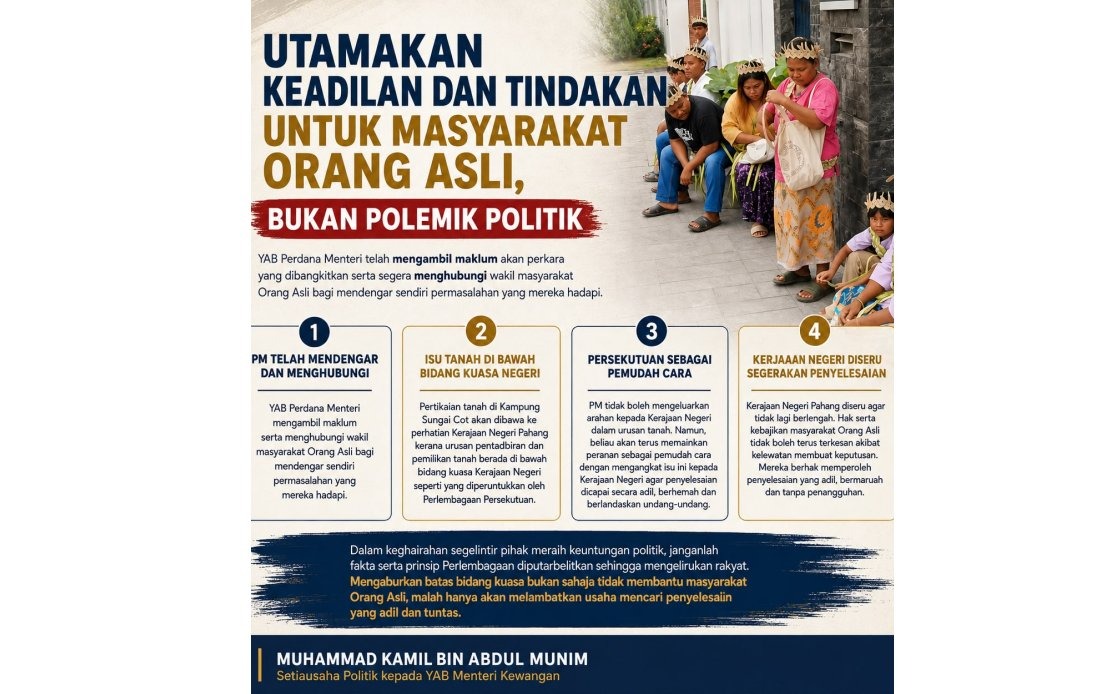
Prime Minister Datuk Seri Anwar Ibrahim has committed to playing an active facilitating role in resolving the contested land ownership issue affecting the Orang Asli community in Kampung Sungai Cot, Maran, Pahang. According to Muhammad Kamil Abdul Munim, political secretary to the Finance Minister, the Prime Minister intends to escalate the matter to the Pahang State Government with the aim of securing a resolution that protects indigenous rights while adhering to legal frameworks and constitutional principles.
The intervention signals growing pressure on the federal government to address grievances within indigenous settlements, where questions of ancestral land rights frequently collide with state-level administrative systems. Orang Asli land disputes remain among the most intractable issues in Malaysian federalism, with communities often caught between customary claims and formal legal titling systems that historically failed to recognise pre-colonial occupation. The Kampung Sungai Cot case exemplifies this broader tension, which has periodically attracted media attention and activism from civil society groups advocating for indigenous welfare.
Muhammad Kamil's statement emphasised that the Prime Minister had personally engaged with affected community representatives to understand their circumstances directly, rather than relying solely on official briefings. This approach underscores an acknowledgment that Orang Asli grievances demand high-level political attention and that dismissing such concerns risks further alienating marginalised populations from confidence in federal institutions. The direct outreach also reflects an attempt to demonstrate responsiveness to indigenous communities ahead of electoral cycles, particularly in states like Pahang where Orang Asli populations constitute meaningful constituencies.
However, the political secretary simultaneously sought to clarify the constitutional boundaries limiting federal intervention. Under Malaysia's federal structure, land administration and ownership remain constitutionally vested in state governments, a principle enshrined in the Federal Constitution. This jurisdictional reality means that while the Prime Minister can advocate, negotiate, and pressure state authorities, he cannot unilaterally mandate land transfers or policy changes affecting state-controlled territory. The clarification appeared defensive, potentially responding to criticism that the federal government lacked genuine leverage to resolve such disputes.
Muhammad Kamil's remarks also contained an oblique rebuke of political actors he characterised as exploiting the issue for partisan advantage while distorting constitutional facts. He warned that such behaviour not only failed to serve Orang Asli interests but potentially complicated resolution efforts by introducing antagonistic political dimensions into what should remain a matter of administrative coordination and legal remedy. This framing suggests internal federal-state tensions regarding how to handle the dispute, with the Prime Minister's office keen to position itself as a problem-solver rather than a bystander.
The statement urged the Pahang State Government to expedite decision-making on the matter, emphasising that prolonged inaction perpetuated suffering for an already marginalised community. This pressure tactic attempted to shift accountability toward state-level actors, implicitly suggesting that delays reflected state government negligence rather than federal limitation. For Pahang's administration, the public nudge from the Prime Minister's office likely generated domestic political pressure to demonstrably progress the issue or risk accusations of indifference toward indigenous welfare.
The Orang Asli land question carries particular significance across Southeast Asia, where indigenous communities across Thailand, Laos, Cambodia, and Indonesia face analogous pressures from land commercialisation, agricultural expansion, and state development priorities that marginalise customary rights. Malaysia's experience offers a cautionary reference point: despite constitutional protections theoretically recognising indigenous interests, implementation gaps and jurisdictional fragmentation have allowed disputes to languish for decades. The Kampung Sungai Cot case therefore resonates beyond Pahang, highlighting systemic vulnerabilities in how federal systems protect minority land claims against majoritarian or commercial pressures.
For Malaysian readers, the dispute exemplifies recurring tensions within the federation between protecting indigenous rights and respecting state autonomy—a constitutional balance that frequently privileges state control over federal obligation. The Prime Minister's facilitation role essentially amounts to diplomatic engagement and moral persuasion rather than enforceable federal mandate, a limitation that civil society groups have critiqued as insufficient for addressing historical injustices. This constraints reflects deeper questions about whether Malaysia's constitutional architecture, designed in 1957, adequately safeguards indigenous interests against contemporary pressures.
The timing of the statement, following the Prime Minister's public Facebook announcement of engagement with Pahang authorities, suggests coordinated communication strategy designed to demonstrate visible federal responsiveness. Such public commitments increase reputational costs for non-compliance, though they do not necessarily accelerate actual resolution timelines. State governments operating under fiscal constraints and competing development priorities may struggle to prioritise lengthy legal procedures for land disputes when facing immediate demands for infrastructure, services, and economic growth.
Moving forward, the resolution's trajectory will depend substantially on whether Pahang authorities prioritise the issue internally and whether federal resources or incentives can be marshalled to support state-level action. Options potentially range from legal proceedings clarifying indigenous land rights, negotiated settlements involving compensation or alternative land allocation, or formal recognition of customary ownership—each carrying different fiscal and political implications for the state. The Prime Minister's facilitation role will ultimately prove meaningful only if it translates into sustained federal engagement and concrete mechanisms supporting state-level resolution efforts.
For the Orang Asli community in Kampung Sungai Cot, the Prime Minister's public commitment provides advocacy leverage and raises political salience of their grievance. However, history suggests that federal assurances, while welcome, frequently fail to generate durable outcomes without complementary legal remedies, sustained activism, or structural reforms addressing systemic vulnerabilities in indigenous land protection. The coming months will test whether this particular intervention transcends familiar patterns of sympathetic rhetoric disconnected from substantive institutional change.

