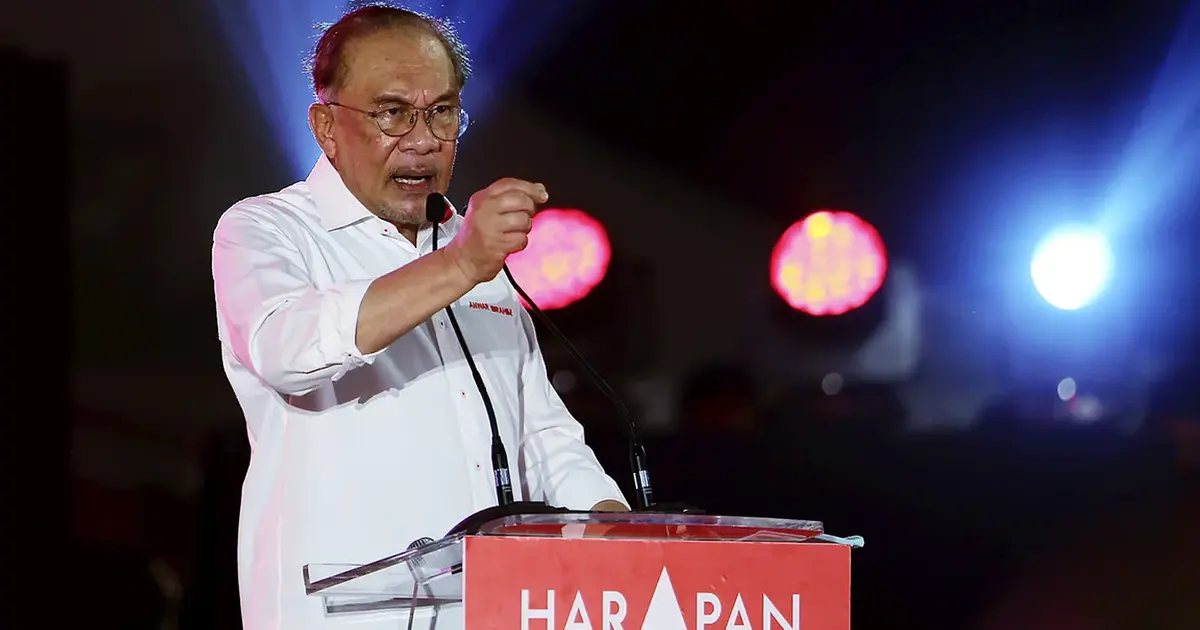
Prime Minister Anwar Ibrahim has made a direct appeal to political parties contesting the Negeri Sembilan state election, urging them to refrain from entangling the state's royal institution in their electoral campaigns. The Pakatan Harapan chairman's warning reflects growing concerns within Malaysia's political establishment about maintaining the sanctity of constitutional monarchy during periods of intense partisan competition, a principle that has long underpinned the nation's political stability.
Anwar's intervention signals the governing coalition's determination to establish clear boundaries around what should remain beyond the reach of ordinary political contestation. The issue touches on a fundamental aspect of Malaysia's constitutional framework, where the institution of royalty occupies a space deliberately insulated from day-to-day partisan conflicts. In Negeri Sembilan, which operates under a unique system where the Yang di-Pertuan Besar is elected from among the nine Undangs rather than inherited through primogeniture, the political sensitivities surrounding the institution are particularly acute.
The timing of Anwar's statement underscores anxiety within Pakatan Harapan about how campaign rhetoric might inadvertently or deliberately blur the lines between legitimate political debate and inappropriate commentary on matters affecting the royal household. Previous Malaysian elections have occasionally witnessed attempts by various parties to invoke royal concerns as a means of garnering support, often with inflammatory consequences for national unity. Such precedents make preemptive messaging essential for a prime minister mindful of the delicate equilibrium required to maintain constitutional stability.
For Malaysian voters, particularly those in Negeri Sembilan, this intervention carries implicit reassurance that the government will actively monitor campaign conduct and discourage any party—whether within the ruling coalition or the opposition—from crossing established lines of propriety. The federal leadership's willingness to speak plainly about such matters suggests confidence in the ability to maintain discipline within their own ranks while also setting expectations for competitors. This approach differs markedly from periods when such concerns were left unspoken or ambiguous, potentially creating space for misinterpretation.
The Negeri Sembilan political context deserves particular attention, given the state's distinctive governance structures. Unlike other Malaysian states where the ruler's role is largely ceremonial in electoral contexts, Negeri Sembilan's arrangement creates a direct connection between electoral outcomes and the selection of its highest office holder. This unique constitutional position means that state-level campaigns can more readily brush up against questions affecting the institution itself, making Anwar's caution both timely and substantive rather than merely protocol.
Opposition parties and other political actors must now contend with clear expectations laid down by the federal government, though the absence of enforcement mechanisms beyond political pressure raises questions about how seriously such admonitions will be taken. In Malaysian political culture, where respect for the throne commands broad support across ideological divides, open defiance of a prime ministerial warning about the institution would invite significant reputational costs. Nonetheless, the line between criticising specific policies or government decisions versus targeting the institution itself can prove difficult to police in the heat of campaigns.
For the international dimension, Malaysia's ability to keep its royal institutions above the fray of electoral politics distinguishes it from many democracies where executive heads face direct and sometimes brutal partisan scrutiny. This distinction reflects a historical bargain embedded in the Federal Constitution, where acceptance of constitutional monarchy in exchange for limited but genuinely secure sovereignty over religious and cultural affairs has formed a key element of Malaysia's multicommunal political settlement. Any erosion of this understanding through campaign politicking would threaten the broader equilibrium.
Anwar's leadership of Pakatan Harapan places particular responsibility on the coalition to model the restraint he is demanding from others. The government's own communications machinery, state-level officials, and party machinery must scrupulously avoid language or actions that might be interpreted as dragging the Negeri Sembilan royal institution into factional disputes. Any appearance of double standards would severely undermine the credibility of the message and invite accusations of hypocrisy from political opponents.
Regional observers will note that Malaysia's approach to protecting royal institutions from electoral politics stands in notable contrast to some neighbouring democracies where such matters remain subject to vigorous and occasionally acrimonious public debate. The Malaysian model reflects the particular historical circumstances and constitutional design of the federation, where the monarchy serves not merely ceremonial functions but also embodies important dimensions of sovereignty and cultural identity that transcend ordinary partisan divisions.
Looking forward, the effectiveness of Anwar's warning will depend on whether campaign conduct in Negeri Sembilan remains within established boundaries. Political parties will be scrutinised by media, civil society observers, and the public for any breaches of the principles the prime minister has articulated. The stakes extend beyond Negeri Sembilan itself, as conduct during this campaign may set precedents affecting how future state and federal elections unfold, particularly regarding the intersection of legitimate political competition and protected constitutional institutions.
The prime minister's statement ultimately reflects a government conscious of its responsibility to preserve Malaysia's constitutional order while allowing robust electoral competition. In an era when political polarisation has intensified across the region and globally, maintaining this balance requires constant attention and periodic reinforcement through statements such as Anwar's. How parties respond to this guidance will reveal much about the health of Malaysia's democratic institutions and the continued viability of the constitutional bargains that have historically sustained national stability.

