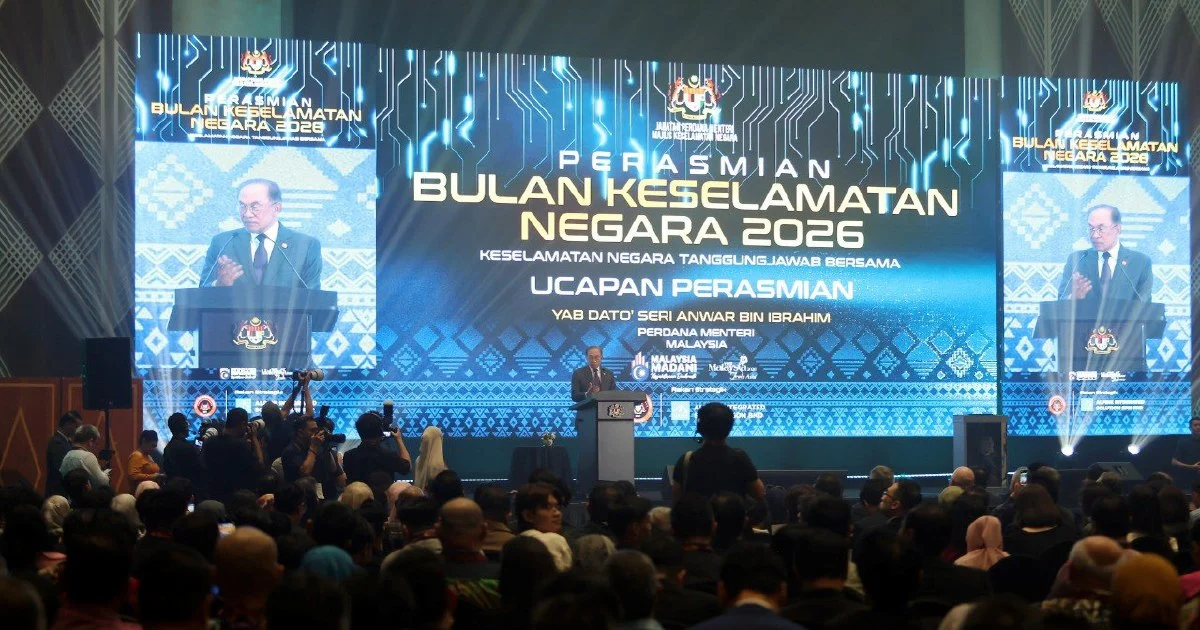
Prime Minister Datuk Seri Anwar Ibrahim has issued a pointed warning about the persistence of racial and regional divisions in Malaysian politics, expressing particular concern as Johor prepares for its upcoming state elections. Speaking from Putrajaya, the premier stressed that the nation risks remaining ensnared in outdated frameworks that prioritise communal identity over broader national interests, a pattern he suggested continues to undermine productive political discourse.
Anwar's remarks reflect broader anxieties within the government about the trajectory of state-level electoral campaigns, particularly in Johor, a state whose political composition carries significant implications for federal stability. The caution appears directed at multiple constituencies within Malaysian politics—from opposition parties to elements within the ruling coalition that may be tempted to exploit communal sensitivities for electoral advantage. Johor's demographic diversity and its status as an economically crucial state make it a natural flashpoint for such narratives, amplifying the potential damage from divisive messaging.
The prime minister's intervention signals recognition that state elections have increasingly become vehicles for national-level political actors to project power and test messaging strategies. Johor holds particular strategic value given its geographical proximity to Singapore, its role as an industrial and commercial hub, and its substantial voting population. Elections there inevitably draw scrutiny from federal leadership, particularly when conducted under conditions that threaten to deepen communal polarisation.
Anwar's framing of racial and regional narratives as "old" carries deliberate weight. It positions such rhetoric as backward-looking and incompatible with Malaysia's aspirations for development and regional competitiveness. The implication is that campaigns fixated on ethnic grievances or regional rivalries distract from substantive issues—economic growth, cost of living, infrastructure, education—that affect all Malaysians regardless of background. This rhetorical move attempts to redefine what constitutes relevant political discourse.
The concerns Anwar raised also reflect a tension inherent in Malaysian democracy: how to acknowledge legitimate cultural and communal interests without enabling divisive rhetoric that fractures the social fabric. The challenge intensifies during state elections, where regional pride and local identity naturally feature in campaigns, but where such themes risk being weaponised along racial lines. Johor, with its significant Indian and Chinese communities alongside its Malay-Muslim majority, exemplifies this complexity.
Historically, state elections in Malaysia have served as testing grounds for new political narratives and coalition-building strategies. Johor's electoral history demonstrates this pattern, with results often foreshadowing shifts in federal politics. Any campaign that leans heavily on racial appeals not only risks immediate polarisation but also establishes precedents that influence subsequent electoral cycles, normalising divisive messaging across political competition.
The prime minister's intervention carries implicit criticism of political actors who may be tempted to exploit communal anxieties for short-term electoral gain. In a multiethnic democracy, such temptations are perennial, particularly when facing competitive electoral conditions. By raising these concerns publicly, Anwar attempts to establish a normative boundary around acceptable campaign rhetoric—one that emphasises unity and shared interests over communal differentiation.
For Malaysian business and civil society stakeholders, the prime minister's statement represents a reassurance that the federal government remains committed to maintaining social cohesion during electoral processes. Racial and regional tensions can have real economic consequences, affecting investment confidence, consumer sentiment, and labour market stability. Johor's role as a major manufacturing and logistics hub makes it particularly sensitive to disruptions stemming from heightened communal tensions.
The timing of Anwar's remarks also reflects strategic political calculation. By addressing racial and regional narratives ahead of polling, he positions the federal government on the side of unity and moderation—a posture designed to appeal to centrist and multi-communal constituencies. Simultaneously, it places pressure on political opponents and coalition partners to moderate their own rhetoric, raising the political cost of divisive campaigns.
Southeast Asian observers have long noted Malaysia's capacity to manage diversity while acknowledging the recurring risks of communal fragmentation. Anwar's warning reflects this ongoing tension within the Malaysian political system. The state's institutions and constitutional framework have generally proven resilient to periodic bouts of racial or regional polarisation, yet such episodes extract real costs in terms of social trust and political effectiveness.
The Johor elections thus become a test not merely of which party or coalition secures electoral victory, but of whether Malaysian politics can progressively transcend the racial and regional framings that have historically dominated campaigns. Success in moderating such rhetoric would signal maturation in the political system; failure would suggest that despite repeated warnings from national leadership, communal divisions remain the dominant currency of electoral competition.
Ultimately, Anwar's intervention underscores a fundamental challenge facing Malaysian democracy: creating political competition that remains vibrant and responsive to voters while constraining the most divisive manifestations of that competition. Whether subsequent election campaigns in Johor heed such warnings will reveal whether such restraint can be sustained in practice, or whether the structural incentives of electoral politics continue to override appeals to unity.

