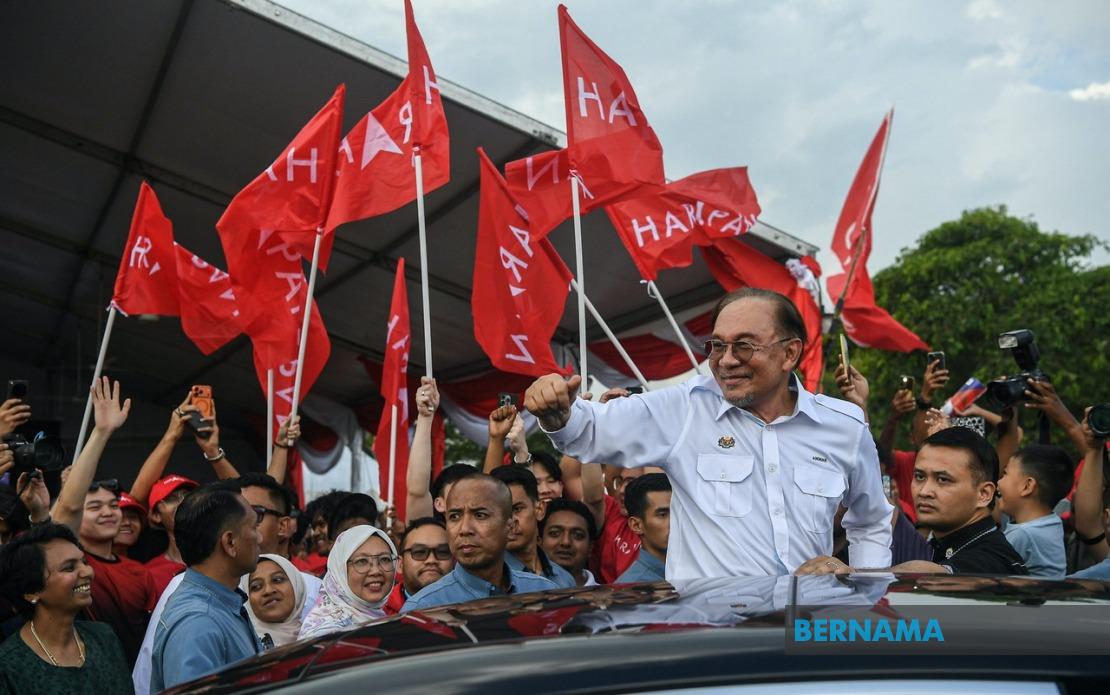
Prime Minister Datuk Seri Anwar Ibrahim's involvement in Pakatan Harapan's campaign for the 16th Johor State Election has catalysed considerable momentum among voters, with party officials reporting an exceptionally encouraging reception across multiple districts. Communications Minister Datuk Fahmi Fadzil characterised the public response to the Prime Minister's presence at campaign events as extraordinary, reflecting genuine community engagement with the coalition's electoral narrative.
Fahmi, who accompanied Anwar during recent campaign stops in the Batu Pahat district, witnessed firsthand the depth of public interest in the Prime Minister's participation. He recounted an emblematic moment in Senggarang, where an elderly man transported his wife by trishaw specifically to meet Anwar, illustrating the pull that the Prime Minister's campaigning exercises over voters across demographic lines. Such anecdotes, while individual instances, reportedly mirror broader patterns of turnout and enthusiasm observed throughout the coalition's campaign schedule.
The Communications Minister's observations carry particular weight given his dual role as both PH's communications director and cabinet representative. His assessment that community responses translate into tangible support for the coalition's policy positions and candidates suggests that Anwar's campaign efforts are achieving their intended strategic objective of mobilising the electoral base. Fahmi noted that beyond formal applause and staged interactions, the spontaneous nature of voter enthusiasm—people deliberately positioning themselves to encounter the Prime Minister—indicates genuine, unprompted interest rather than manufactured political theatre.
Anwar's campaign schedule in the lead-up to polling day has been intensive by any measure. Over a 48-hour period spanning Saturday, July 4, and Sunday, July 5, the Prime Minister attended 15 separate campaign programmes distributed across Johor's various constituencies. This exhaustive itinerary underscores PH's strategic prioritisation of the Johor contest, where the coalition is mounting a comprehensive challenge by fielding candidates across all 56 State Legislative Assembly seats. The density of Anwar's personal involvement signals that party leadership regards this election as crucial to demonstrating electoral viability and consolidating support in Malaysia's second-largest state by population.
The Johor election itself represents a significant political moment for the coalition. With 172 candidates contesting the 56 available seats, the race presents a competitive environment where the margin between victory and setback could reshape perceptions of PH's political fortunes heading into future national contests. The decision to field full-slate candidacies indicates confidence, though success is far from predetermined, and the competitive density of the race ensures that each individual constituency battle carries implications for the overall outcome.
Fahmi emphasised that the community's receptiveness to Anwar's campaigning reflects broader acceptance of PH's electoral messaging and policy platform. He interpreted the spontaneous gatherings and deliberate efforts by voters to meet the Prime Minister as evidence that the coalition's campaign narrative has resonated across diverse voter segments throughout the state election period. This characterisation suggests that PH views the campaign as not merely a struggle for individual seats but as a referendum on the coalition's governance record and vision, with Anwar's personal appeal serving as a vehicle for communicating that broader message.
The timing of the election cycle also contextualises the intensity of campaign activity and the strategic importance assigned to Johor. State elections serve as barometers of shifting political sentiment between national polls, and victory or defeat in Johor carries disproportionate symbolic weight given the state's demographic and economic significance. For a coalition government still consolidating its position and addressing legacies of political instability, demonstrating electoral competitiveness in major state contests proves essential for maintaining momentum and validating its claim to represent the electorate's preferred direction.
Pollster activity and media coverage have intensified correspondingly, with the Malaysian National News Agency (Bernama) maintaining dedicated coverage of the election cycle through its operations centre in Johor Bahru. This institutional attention reflects the election's perceived national importance, ensuring that outcomes will be subject to close scrutiny and interpretation by political analysts, media commentators, and opposition figures seeking to assess the government's electoral standing.
The logistics of Anwar's campaign participation also merit consideration. Coordinating a 15-event campaign blitz across a geographically dispersed state requires substantial organisational infrastructure and resource allocation, demonstrating both the financial commitment that PH has made to this contest and the operational capacity of the party machinery. The scale of this effort distinguishes the Johor campaign from routine electoral activity and signals to party activists and rank-and-file supporters that senior leadership is invested in the outcome.
Fahmi's public articulation of optimism regarding the campaign's reception likely serves multiple audiences simultaneously. To PH supporters and party machinery, such statements provide morale reinforcement and justify continued campaign exertion. To undecided voters, the narrative of mounting grassroots support may itself generate momentum through demonstration effects, encouraging participation and support. To political observers and media analysts, the communications minister's confident tone communicates party leadership's conviction in their electoral prospects, setting expectations for performance evaluation following the July 11 polling day.
The Johor state election thus occupies a position of considerable strategic importance within Malaysia's broader political landscape. The intensity of Prime Minister Anwar Ibrahim's personal engagement, the breadth of PH's candidate slate, and the palpable energy characterising campaign events collectively suggest that all major stakeholders regard this contest as consequential for trajectories extending well beyond the state legislature itself. Whether the reported community enthusiasm translates into voting support and seat gains will become apparent once the electorate delivers its verdict on Saturday.

