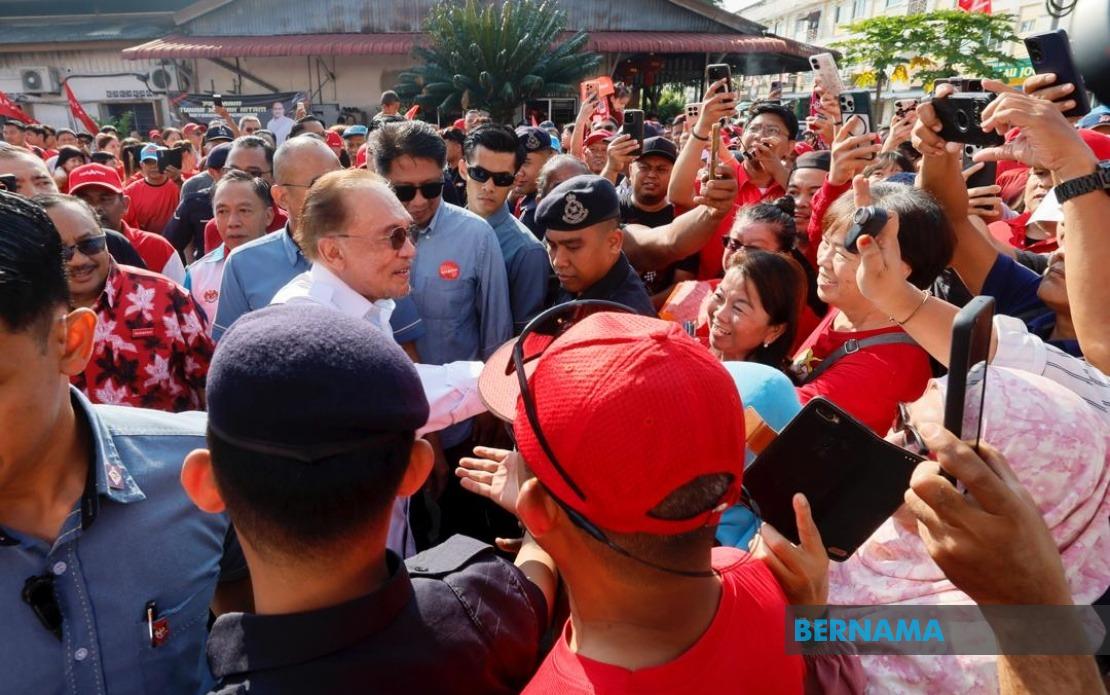
Prime Minister Datuk Seri Anwar Ibrahim's intervention in the Johor state election campaign has injected fresh momentum into Pakatan Harapan's electoral machinery, particularly in the competitive Machap and Layang-Layang constituencies as the coalition intensifies its ground game in the final stretch before polling day on July 11. The high-profile visit during the ninth day of campaigning underscored the national leadership's commitment to a state widely viewed as strategically important for PH's ability to sustain its federal coalition.
Nur Hafiz Roslan, contesting for the Machap seat under the PH banner, highlighted the psychological lift that accompanied the Prime Minister's presence at the grassroots engagement. Beyond the immediate morale boost for campaign volunteers and candidates themselves, Anwar's appearance transmitted a substantive message about the philosophical underpinnings of PH's electoral pitch. The PKR president seized the occasion to reinforce to his team that campaign activities must remain anchored in genuine public service rather than the cultivation of political antagonism or sectarian advantage.
During his interaction with the campaign personnel, Anwar explicitly referenced the Islamic concept of amal soleh, or virtuous conduct, as the guiding principle for their mobilisation efforts. This rhetorical framing reflected PH's broader strategy to position itself as the custodian of ethical governance and communal welfare at a moment when Malaysian voters continue to grapple with concerns about institutional integrity and equitable resource distribution. The emphasis on service without prejudice took on particular resonance in Simpang Renggam parliamentary constituency, where the interaction between federal and state-level contests adds layers of complexity to voter calculations.
Nur Hafiz's characterisation of the PH presence as fundamentally about serving the community rather than seeking dominance suggested an awareness that the coalition must navigate sensitivities around power dynamics and representation. His assertion that services would be delivered impartially pointed to a calculated effort to address potential voter apprehensions about partisan favouritism or the subordination of minority interests to majoritarian preferences. For constituencies with mixed demographics like those in the Simpang Renggam area, such assurances can meaningfully influence swing voters who harbour residual doubts about PH's inclusivity.
Guna Balakrishnan, the PH candidate for Layang-Layang, echoed the narrative of intensified community engagement catalysed by Anwar's visit. His comments indicated that despite encouraging preliminary signals from local residents, the campaign faced an ongoing imperative to broaden its reach across different population segments and to avoid complacency in the critical days before the ballot. Anwar's specific charge to Guna—that electoral success must translate into concrete developmental benefits for the area—reflected a pragmatic acknowledgement that rural and semi-rural constituencies increasingly demand tangible deliverables rather than symbolic gestures of political attention.
The 'PMX Santai Sarapan Bersama Masyarakat' programme, which brought together more than 1,000 residents in Simpang Renggam, exemplified a deliberate shift in campaign choreography toward informal, accessible interactions. The casual breakfast setting and relaxed demeanour cultivated an impression of approachability that contrasts sharply with the formality and distance sometimes associated with prime ministerial engagements. This style of politics, which emphasises personal connection and unscripted moments, has become increasingly valued by Malaysian voters seeking authenticity and evidence of genuine concern rather than performative politicking.
Attendees who spoke to observers provided anecdotal testimony to the effectiveness of this approach. Chuan Chee Mei, a 48-year-old resident, attributed her strengthened resolve to support PH candidates directly to witnessing Anwar's personal engagement with the grassroots operation and his visible alignment with local aspirants. This observation highlights the persistent importance of leadership visibility and symbolic endorsement in Malaysian electoral dynamics, where the perceived blessing of senior figures can validate candidate viability for voters still forming their preferences.
Noor Takiyudin Salleh's account similarly emphasised the distinction between formal, top-down campaign messaging and the felt experience of encountering political leadership in an informal setting. His observation about the scale of attendance and the informal tone suggested that the event succeeded in generating the kind of organic enthusiasm that translates more reliably into campaign energy than centrally orchestrated messaging. For PH strategists monitoring the campaign's effectiveness across constituencies, such first-hand reports provide crucial feedback about whether their ground organisation is successfully bridging the gap between party machinery and ordinary voter engagement.
The Johor state election itself commands attention well beyond the state's borders because it tests PH's capacity to consolidate electoral support in a region where the coalition has faced historical challenges and where traditional power brokers retain considerable influence. With 172 candidates competing for 56 state seats, the electoral battleground encompasses fierce inter-party competition and, in some constituencies, internal tensions within the broader opposition coalition. Polling on July 11, preceded by early voting on July 7, represents a crucial opportunity for PH to demonstrate that its federal-level coalition arrangements can translate into coherent state-level governance and electoral appeal.
For Malaysian observers tracking coalition stability and PH's trajectory ahead of the next federal election, the Johor campaign offers an early indicator of whether the alliance can effectively mobilise grassroots support and whether its messaging—centred on service, ethical conduct, and communal welfare—resonates with voters beyond urban centres where PH traditionally commands stronger support. Anwar's hands-on campaigning suggests confidence in the coalition's prospects while also underlining the personal political stakes riding on electoral outcomes in a state whose composition and demographic profile present both opportunities and constraints for a federal coalition seeking to strengthen its position.

