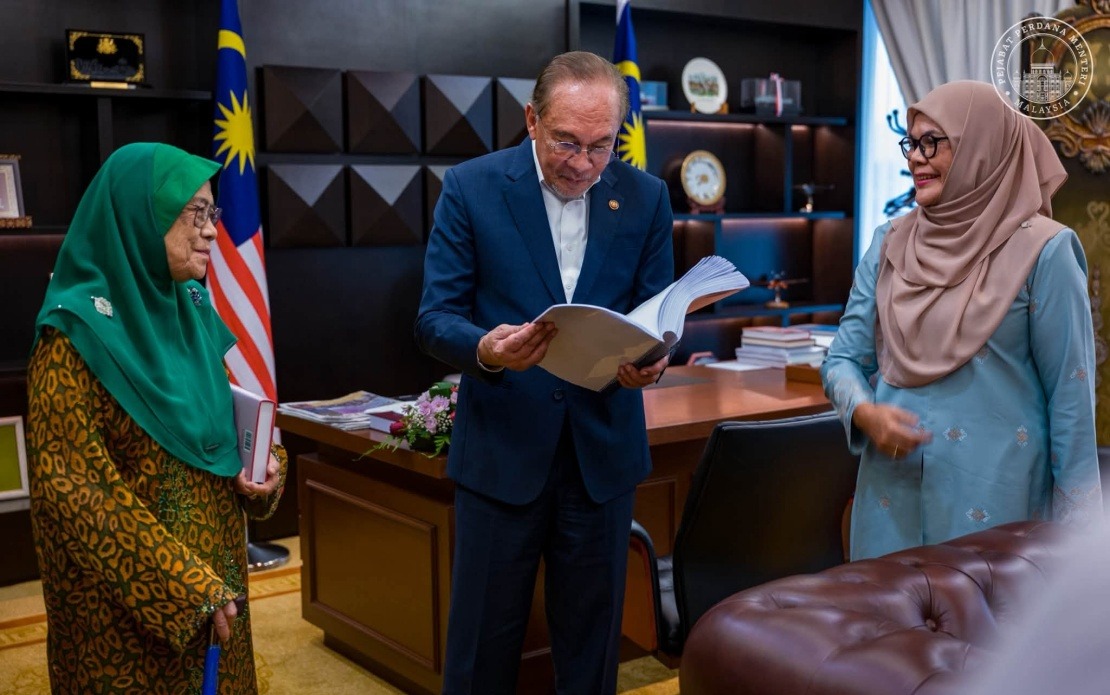
Prime Minister Datuk Seri Anwar Ibrahim has endorsed a new book documenting his political philosophy and worldview, expressing optimism that the publication will become a foundational reference for Malaysia's future leaders and citizens. In remarks shared on social media, Anwar indicated that the manuscript, authored by Professor Dr Salinah Ja'afar from the Academy of Malay Studies at Universiti Malaya, represents a deliberate effort to preserve his intellectual contributions and vision for the country beyond his tenure in office.
The book project reflects a growing trend among senior political figures globally to codify their ideological positions and governance philosophy in permanent written form. For Malaysia, where political transitions can be abrupt and institutional memory sometimes fragmentary, such documentation carries particular significance. By working with established academics, Anwar is positioning his ideas within scholarly discourse rather than merely as political messaging, lending them potential longevity and intellectual credibility across ideological divides.
Anwar's involvement in the book's development went beyond passive approval. He reviewed the manuscript and provided detailed feedback during its preparation, ensuring that his core convictions and the reasoning behind them received accurate representation. Additionally, he sat for exclusive interviews with both Professor Ja'afar and the book's academic adviser, Professor Emeritus Datuk Dr Nik Safiah Abdul Karim, to ensure comprehensive coverage of the intended themes. This collaborative approach signals that the final product aims for scholarly rigor rather than hagiography.
The appointment of Professor Emeritus Nik Safiah Abdul Karim as academic adviser adds institutional weight to the project. Her distinguished career as a language scholar and contributions to Malaysian academia lend credibility to the enterprise. Her involvement suggests that the book will address not merely Anwar's political positions but perhaps the intellectual architecture underlying them—how his ideas evolved, the influences that shaped them, and their potential application to contemporary and future challenges.
Anwar's stated hope that the book will guide future generations particularly on nation-building reflects his understanding that Malaysia faces persistent challenges requiring coherent long-term vision. The emphasis on "personal values" development alongside state-building indicates that Anwar views leadership ethics and individual integrity as foundational to effective governance. This framing resonates with his historical positioning as a leader concerned with institutional reform and moral governance, themes that have featured prominently in his political discourse across multiple decades and political parties.
For Malaysian readers and policymakers, the book's potential utility depends partly on how it handles Anwar's considerable political evolution. His trajectory from Islamic activist to reformer within UMNO to opposition firebrand to eventual architect of the Pakatan Harapan coalition represents significant ideological recalibration. How the authors navigate these shifts—whether presenting them as principled evolution or strategic repositioning—will substantially affect the book's credibility as an intellectual guide. A sophisticated treatment might explore how consistent underlying values produced different policy prescriptions in different political contexts.
The timing of such a project during Anwar's tenure as Prime Minister carries tactical implications. By establishing an authoritative written record of his ideas now, he shapes how his premiership and legacy will be interpreted. For academics and researchers, the book may become the primary source for understanding his worldview, potentially influencing how historians and analysts assess his leadership and the Pakatan Harapan government's direction. This is particularly relevant given Malaysia's ongoing democratic transitions and the intense contestation over the nation's ideological orientation.
The involvement of Universiti Malaya scholars rather than partisan figures or ghostwriters suggests an attempt to position the work within the intellectual mainstream. Universities carry institutional credibility that partisan think tanks or political foundations might lack. This choice may reflect confidence that Anwar's ideas can withstand academic scrutiny, or alternatively, a strategic calculation that academic framing will enhance the work's perceived objectivity and shelf life beyond current political cycles.
For the Southeast Asian region, this project illustrates how established political figures are increasingly investing in intellectual legacy-building. As democratic institutions mature across the region, leaders recognize that their policy influence extends beyond their immediate terms through documented thought and written philosophy. A well-received book positioning Anwar's governance philosophy could influence policymaking conversations across ASEAN, particularly among leaders grappling with similar questions about institutional reform, corruption, and developmental state management.
The book's potential reach extends to civil society organizations and educational institutions. If adopted in Malaysian universities or promoted through institutional channels, the work could shape how new generations of administrators and citizens understand their government's foundational principles. Educational use would substantially amplify its impact relative to a volume aimed solely at general readership or political elites.
Regarding concrete outcomes, success will depend on the book's accessibility and resonance with its intended audiences. Academic rigor and scholarly credibility must be balanced with readable prose that engages non-specialist readers. Too technical an approach might confine the work to university libraries; too popular a treatment could undermine its scholarly credibility. The authors face the substantial challenge of honoring both the Prime Minister's stature and genuine intellectual inquiry.
Anwar's emphasis on documenting ideas shaped by "life experiences and reading" acknowledges that political philosophy rarely emerges from abstract theorizing alone. This grounding in lived experience and intellectual engagement could render the book valuable beyond partisan audiences. Citizens interested in understanding how Malaysia's leaders approach governance questions, regardless of their political affiliation, might find utility in a serious examination of Anwar's foundational thinking and values.

