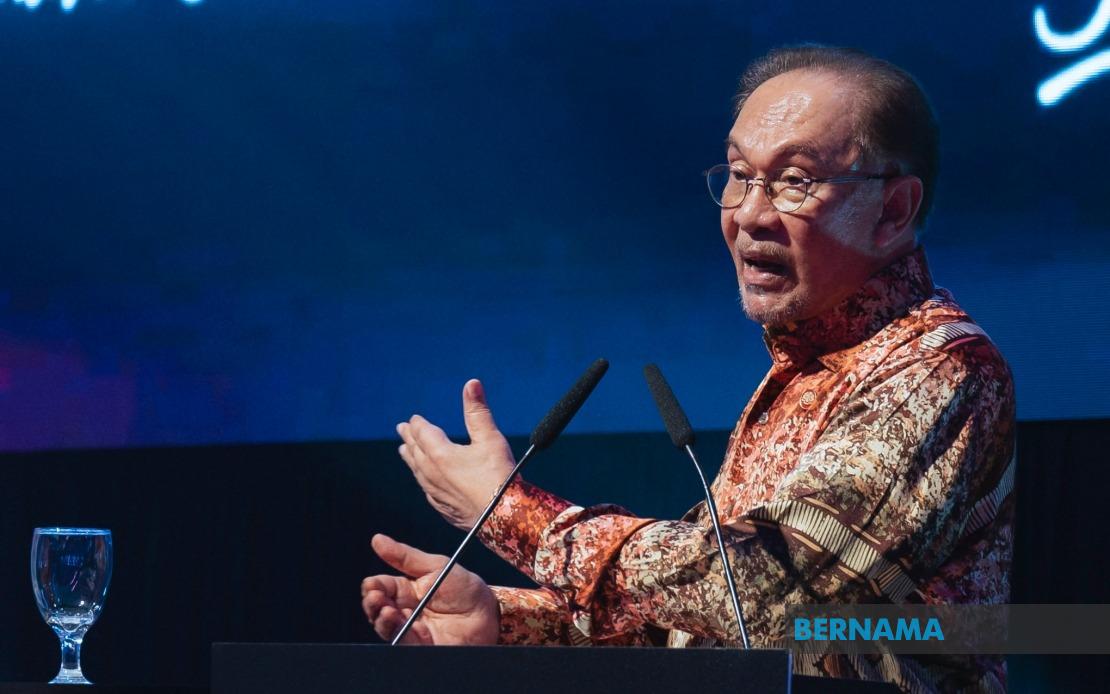
Prime Minister Datuk Seri Anwar Ibrahim's recent comments on Taiwan sparked considerable controversy across regional and international media, yet the substance of his argument has been widely misunderstood. Rather than endorsing military conflict, the premier articulated a position grounded in classical deterrence theory—the idea that states maintain the capability to respond forcefully to territorial threats precisely so they may never need to exercise that capacity. This distinction between possessing defensive capability and actively seeking confrontation remains crucial to understanding Malaysia's diplomatic balancing act in one of the world's most volatile regions.
At the heart of Anwar's remarks lies a deceptively simple proposition: no functioning state voluntarily accepts its own disintegration without resistance. The Prime Minister employed Malaysia itself as the relevant analogy, noting that no government in Kuala Lumpur would passively submit to the dissolution of the Malaysian federation merely because international opinion counselled restraint. Applied to China's perspective on Taiwan, this logic suggests that Beijing's insistence on territorial integrity reflects standard statecraft rather than aggressive expansionism. The reasoning operates on the principle that credibility matters—if a government renounces force entirely and unambiguously, it invites precisely the kind of pressure and coercion it seeks to prevent.
Yet Anwar's framework explicitly prioritises peaceful resolution and negotiated settlement. Deterrence theory does not presume that force represents a preferred instrument; rather, it functions as an ultimate backstop, employed only when all diplomatic, legal, and political channels have been exhausted. The reserve capacity to respond militarily exists not as an endpoint but as insurance—a mechanism designed to discourage adversaries from testing resolve in the first place. In this formulation, the explicit or implicit threat of serious consequences serves to prevent the very confrontation that deterrence theorists wish to avoid.
The relationship between Malaysia's declared One China policy and Anwar's deterrence argument requires careful unpacking. Kuala Lumpur officially recognises the People's Republic of China as the sole legitimate government of China, declining to grant Taiwan separate diplomatic status. Simultaneously, Malaysia maintains robust economic relationships and people-to-people connections with Taipei without acknowledging it as a sovereign state. Within this diplomatic configuration, Anwar suggests that Malaysia cannot simultaneously accept the premise of One China while dismissing Beijing's legitimate concern over Taiwan's political status. The symmetry he draws—Malaysia would resist dismemberment, therefore China's concern over reunification carries inherent legitimacy—presents a framework for understanding Beijing's position even if one disagrees with its methods or ultimate objectives.
Taiwan itself, however, explicitly rejects this entire analytical framework. From Taipei's perspective, Taiwan constitutes a functioning democracy that has governed itself successfully for more than seven decades, and any reference to force—however theoretically grounded—legitimises coercion against a sovereign people who never voted to become part of the People's Republic. This Taiwanese position commands substantial international sympathy, particularly among democracies that view forced political integration as antithetical to self-determination. The tension between Malaysia's One China recognition and international sentiment favouring Taiwan's democratic autonomy reflects a genuine dilemma that no rhetorical flourish can neatly resolve.
What distinguishes Anwar's position from actual warmongering lies in the distinction between acknowledging Beijing's deterrent logic and actively supporting military intervention. The Prime Minister has not called for force; he has explained why states rationally maintain the option of force even while preferring peaceful resolution. This explanation does not constitute endorsement. Rather, it reflects sophisticated realist analysis—the recognition that international relations operate according to certain immutable patterns that policymakers ignore at their peril. Deterrence depends fundamentally on credibility, and credibility dissolves the moment a state signals irreversible commitment to accepting whatever demands others impose.
Malaysia's regional interests, however, demand consistent emphasis on restraint and dialogue regardless of how one philosophically evaluates deterrence logic. A military confrontation across the Taiwan Strait would inflict catastrophic damage on the regional economy, destroying supply chains, disrupting trade flows, and destabilising the entire ASEAN architecture that Malaysia helped construct. The semiconductor industry, electronics manufacturing, and countless other sectors depend on uninterrupted cross-strait commerce and the stable expectations that underpin it. From a purely Malaysian perspective, therefore, advocating for restraint, negotiated settlement, and respect for international law remains the paramount priority, even while acknowledging that other states may evaluate their strategic interests differently.
The Prime Minister's remarks should therefore be interpreted within their proper analytical context: as an explanation of deterrence doctrine rather than a manifesto for military action. Sophisticated statecraft requires understanding why adversaries or competitors hold the positions they occupy, even when one disagrees fundamentally with those positions. By explaining the logic underlying Beijing's stance, Anwar engaged in exactly the kind of strategic empathy that underpins productive diplomacy. Understanding does not equal agreement, and explaining another state's rational calculus does not constitute endorsement of its preferred outcomes.
Looking forward, Malaysia's diplomatic posture must remain carefully balanced across multiple competing imperatives. The country must continue honouring its One China policy, as it has for decades, while simultaneously avoiding any appearance of endorsing coercive methods or supporting military solutions to political disputes. Malaysia should remain steadfast in promoting dialogue, restraint, and peaceful dispute settlement—both in rhetoric and in concrete diplomatic action. At the same time, Malaysian leaders need not apologise for articulating realist analysis regarding how states actually behave, even when that analysis contradicts idealistic preferences for conflict-free international relations.
The fundamental principle underlying Malaysia's position rests on a simple but profound insight: states maintain defensive capacity not because they actively desire conflict but because responsibility to their citizens demands preparedness. Yet this same principle demands that Malaysia, as a regional power invested in stability, consistently advocate for the peaceful resolution of disputes, the respect for international law, and the pursuit of dialogue over confrontation. Anwar's remarks, properly understood, reflect exactly this balance—acknowledging the logic of deterrence while implicitly endorsing the pursuit of peaceful settlement that renders deterrence unnecessary.

