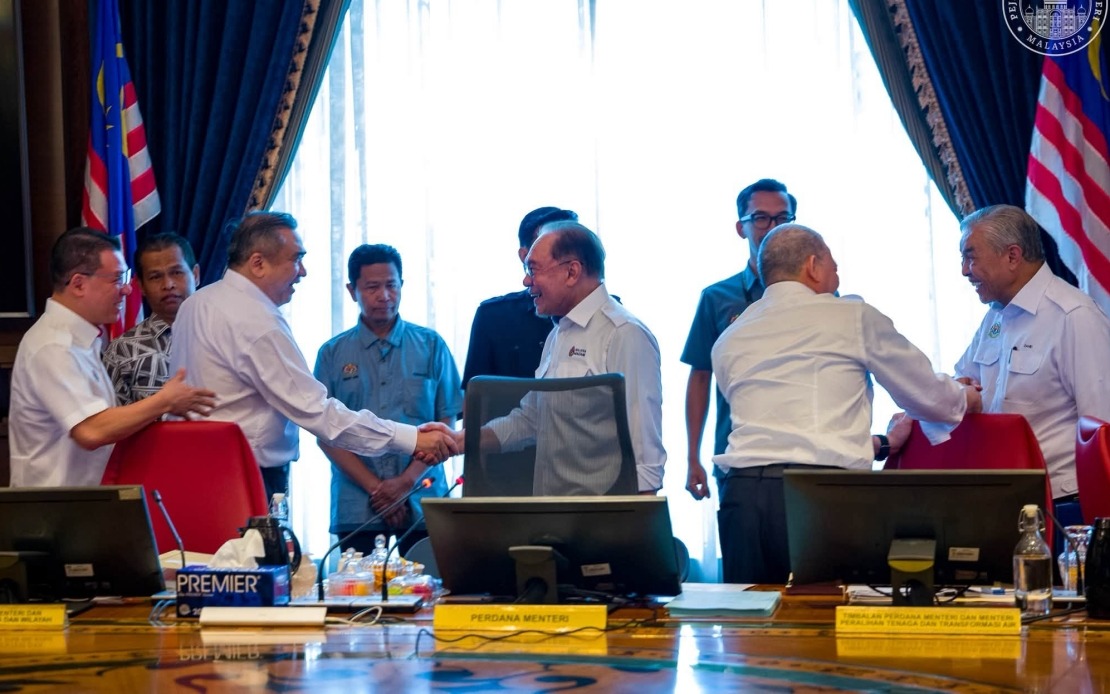
Prime Minister Datuk Seri Anwar Ibrahim has released a poetic message celebrating the virtues of national unity, discipline and mutual respect, sharing a traditional four-line Malay pantun through his official Facebook page that resonated strongly with digital audiences. The carefully crafted verse, which emphasises the strength derived from consensus and friendship, garnered over 11,500 likes within two hours of publication and sparked more than 1,700 comments, many of them composed in the classical pantun format itself, indicating the post's cultural resonance among Malaysians.
The Prime Minister accompanied his poetic offering with photographs from a recent Cabinet meeting, featuring Deputy Prime Minister Datuk Seri Dr Ahmad Zahid Hamidi and Transport Minister Anthony Loke among other senior government figures. The images conveyed a clear visual message of camaraderie and governmental harmony, with all ministers appearing relaxed and united in purpose. This calculated presentation of internal cohesion carries particular significance given the current political context in which Malaysia's federal administration is being tested by competing priorities.
Anwar's message arrives at a delicate moment for Malaysian politics, as the Federal Unity Government comprising Pakatan Harapan and Barisan Nasional faces a significant internal tension. The two coalitions, which together form the backbone of federal stability, are simultaneously competing fiercely against each other in the Negeri Sembilan state election. This paradox of being both governmental partners and electoral rivals creates a complex dynamic that requires careful navigation to prevent fractures in the federal arrangement.
The Negeri Sembilan contest represents a genuine battleground between the coalition partners. Pakatan Harapan, chaired by Anwar, is contesting all 36 state seats with full commitment, while Barisan Nasional, under Ahmad Zahid's leadership, is fielding candidates in 25 constituencies and has additionally forged an electoral alliance with Perikatan Nasional. This configuration means that the two pillars of federal governance are effectively working against each other's interests at the state level, even as they share ministerial responsibilities and policy-making authority at the national level.
The timing of Anwar's poetic intervention suggests a deliberate effort to reframe the political narrative around the Negeri Sembilan election. Rather than allowing the campaign to overshadow or destabilise the Federal Government, the Prime Minister's message serves as a public reminder that electoral competition, no matter how vigorous, should not compromise the underlying institutional stability and personal relationships that hold the federal arrangement together. The emphasis on friendship and consensus speaks directly to the need for restraint and statesmanship during this period of state-level contestation.
Online commentators and social media users interpreted Anwar's pantun as a statement of reassurance, with many noting its conciliatory undertone. The enthusiastic response, including numerous pantun-based replies from ordinary Malaysians, suggests that the message successfully communicated the desired sentiment of unity amidst healthy political competition. The cultural medium chosen—the traditional Malay pantun—proved particularly effective in conveying gravitas and authenticity, connecting with Malaysian audiences on both intellectual and emotional levels.
For observers of Malaysian politics, Anwar's initiative represents a sophisticated approach to managing coalition tensions. Rather than issuing stern warnings or formal statements, the Prime Minister chose to appeal to shared cultural values and the importance of maintaining social harmony. This rhetorical strategy avoids the appearance of weakness or loss of control while simultaneously signalling to Pakatan Harapan's own supporters that electoral ambition must be tempered by recognition of the Federal Government's broader stability requirements.
The Negeri Sembilan state election, set for August 1 following early voting on July 28, will serve as a crucial test of whether the Federal Unity Government can withstand serious electoral competition without internal rupture. The state assembly's dissolution on June 5 initiated a campaign period during which both coalitions are attempting to maximise their respective electoral prospects. Early voting and the full polling day will reveal whether voters in Negeri Sembilan reward or punish the coalition partners for their competing political positions.
For the wider Malaysian political landscape, the outcome in Negeri Sembilan holds implications beyond the state itself. A significant victory for either coalition could embolden that group within the Federal Government and potentially influence calculations about the future trajectory of the current arrangement. Conversely, a closely contested result might reinforce the message that cooperation remains necessary for political survival. The national audience is watching closely to see whether the federal stability that Anwar's pantun celebrates can be maintained when subjected to the pressures of genuine electoral competition.
The post also reflects broader challenges facing Prime Minister Anwar as he seeks to manage an inherently unstable political coalition. The Federal Unity Government emerged from necessity rather than ideological alignment, bringing together parties with distinct and sometimes competing interests. Maintaining this arrangement requires constant attention to symbolism, messaging and the careful cultivation of personal relationships among senior leaders. Anwar's poetic intervention demonstrates his understanding of these requirements and his willingness to invest political capital in preserving the federal arrangement even while his own coalition pursues aggressive electoral strategies.
Looking ahead, the success of Anwar's unity messaging will depend not only on the result in Negeri Sembilan but on how both coalitions conduct themselves during the remaining campaign period and after the election concludes. Whether the emphasis on friendship and consensus translates into concrete behavioural restraint, or whether it remains merely rhetorical flourish, will determine whether such appeals can effectively manage coalition tensions in future political challenges.

