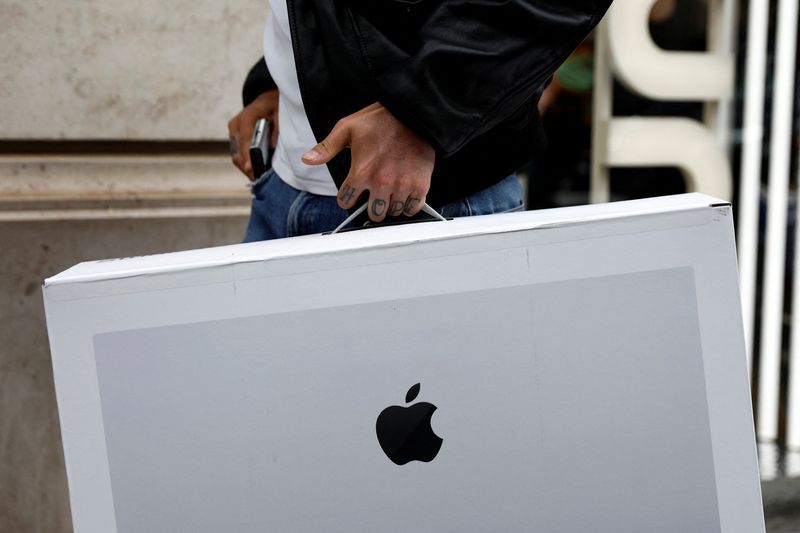
Apple has reclaimed its position as the world's most valuable company, displacing Nvidia from the top spot and signalling a notable shift in how investors view the trajectory of artificial intelligence development and profitability. The Cupertino technology giant reached a valuation of approximately $4.88 trillion on Friday, edging past Nvidia's $4.86 trillion following a 3.5 per cent decline in the chipmaker's shares. The swap represents Apple's return to the number one ranking for the first time since April of the previous year, underscoring the volatility and rapid evolution of sentiment within the technology sector.
The reshuffling of valuations reflects a broader recalibration among institutional investors who are stepping back from the singular focus on artificial intelligence infrastructure companies that dominated market conversation throughout much of the past year. Nvidia had held the top position for nearly twelve months, capitalising on insatiable demand for its graphics processors which power the generative AI systems that capture global attention. Yet the recent turnabout suggests that market participants are beginning to contemplate a more diverse set of beneficiaries from the artificial intelligence revolution, one that extends beyond the semiconductor manufacturers at the foundation of the technology stack.
Toni Meadows, head of investment at BRI Wealth Management, characterises the transformation as a fundamental shift in how the market perceives Apple's competitive positioning. Until recently, Apple faced criticism from some analysts for appearing to lag in the race to develop proprietary artificial intelligence models, having largely eschewed the massive capital expenditure commitments undertaken by rivals such as OpenAI, Google, and Meta. However, investor sentiment has pivoted decisively in favour of a different strategic calculus, one that privileges durability of earnings and efficient monetisation pathways over speculative artificial intelligence upside. Meadows observes that Apple's strength lies in its reduced exposure to the escalating capital intensity of model development and its superior positioning to extract value from artificial intelligence through services revenue, ecosystem lock-in effects, and hardware upgrade cycles.
The timing of Apple's ascent gains additional significance from the perspective of corporate succession planning at the company. Chief Executive Officer Tim Cook is preparing to hand over the reins to John Ternus, a hardware engineering veteran, in September. The achievement of becoming the world's most valuable company during Cook's final months provides a contrasting narrative to the early criticism that Apple had missed pivotal opportunities in the artificial intelligence landscape. The elevation in valuation could substantially influence how his tenure is ultimately remembered, shifting focus from perceived strategic gaps to recognition of long-term value creation.
Central to Apple's artificial intelligence strategy is the overhaul of Siri, the company's virtual assistant, which received its first major update in an extended period last month. The redesigned assistant represents Apple's deliberate attempt to narrow the capability gap with well-funded artificial intelligence competitors and emerging startups. Beyond the technical improvements to Siri itself, Apple possesses what some analysts describe as an untapped artificial intelligence asset of extraordinary potential: the vast reservoir of personal user data residing on billions of iPhones worldwide. This intimate knowledge of consumer behaviour, preferences, and activities could theoretically enable Siri to deliver substantially more contextualised and valuable responses compared to general-purpose competitors.
Yet extracting commercial value from this data goldmine presents an intricate challenge rooted in Apple's longstanding privacy commitments. The company has constructed its reputation partly on protecting user data through encryption and on-device processing, encrypting information within proprietary operating systems. Leveraging this data to enhance artificial intelligence capabilities without compromising the privacy guarantees that distinguish Apple in the marketplace requires innovation in both technical and policy domains. The company faces the delicate task of unlocking the commercial potential of user data whilst maintaining the privacy protections that form a core element of its brand promise to consumers.
Nvidia's displacement from the pinnacle should not be interpreted as signalling permanent diminishment of the chipmaker's importance to the unfolding artificial intelligence transformation. The company maintains formidable competitive advantages and continues to benefit directly from the enormous capital expenditure flowing into data centres and artificial intelligence infrastructure globally. Nvidia's graphics processors remain the dominant technology powering the generative artificial intelligence applications that have captured public imagination. Industry analysts caution that the rankings among these mega-cap technology companies remain fluid, and Nvidia could readily reclaim the top valuation if market sentiment swings back toward artificial intelligence infrastructure plays.
Apple itself occupies a precarious position that warrants careful monitoring by investors and analysts. The company has pursued a pricing strategy aimed at offsetting manufacturing cost pressures, a tactic that carries the inherent risk of constraining consumer demand, particularly in price-sensitive markets where purchasing power has been constrained by inflation. Benjamin Hall, vice president of alpha research at Segal Marco Advisors, suggests that the fundamental competitive dynamics between these two technology powerhouses are not substantially altered by the current valuation turnover, with Nvidia likely to remain a significant participant in the artificial intelligence economy regardless of which company commands the highest market capitalisation at any given moment.
Beyond the headline-grabbing battle between Apple and Nvidia, the artificial intelligence investment narrative is diffusing across a widened array of semiconductor and technology businesses. Memory chipmakers such as Micron have emerged as unexpected beneficiaries of the infrastructure build-out required to support artificial intelligence systems, with Micron crossing the $1 trillion market value threshold in May as investors recognised the critical importance of advanced memory architectures to artificial intelligence performance. South Korea's SK Hynix further diversified the competitive landscape by listing on the Nasdaq earlier in the month, bringing another formidable player into the arena for investor capital.
The broadening of investor focus away from the narrow concentration on "Magnificent Seven" companies toward a more distributed set of beneficiaries reflects maturation in how the market evaluates artificial intelligence opportunities. Hall notes that new entrants and expanded participation across the semiconductor value chain could effectively disperse attention and capital across a greater number of companies and investment theses, reducing the dominance of any single narrative or set of businesses.
The momentum in semiconductor stocks encountered significant turbulence in July as market participants initiated a comprehensive reassessment of the sustainability and pace of artificial intelligence-driven spending cycles. The Philadelphia SE Semiconductor index contracted by nearly nineteen per cent from all-time highs, reflecting broader anxiety about valuation excesses and the durability of the artificial intelligence investment thesis. Despite this substantial correction, the index has outperformed Nvidia's individual share price performance year-to-date, suggesting that diversification across the semiconductor landscape has provided some insulation against concentrated exposure to individual market leaders.

