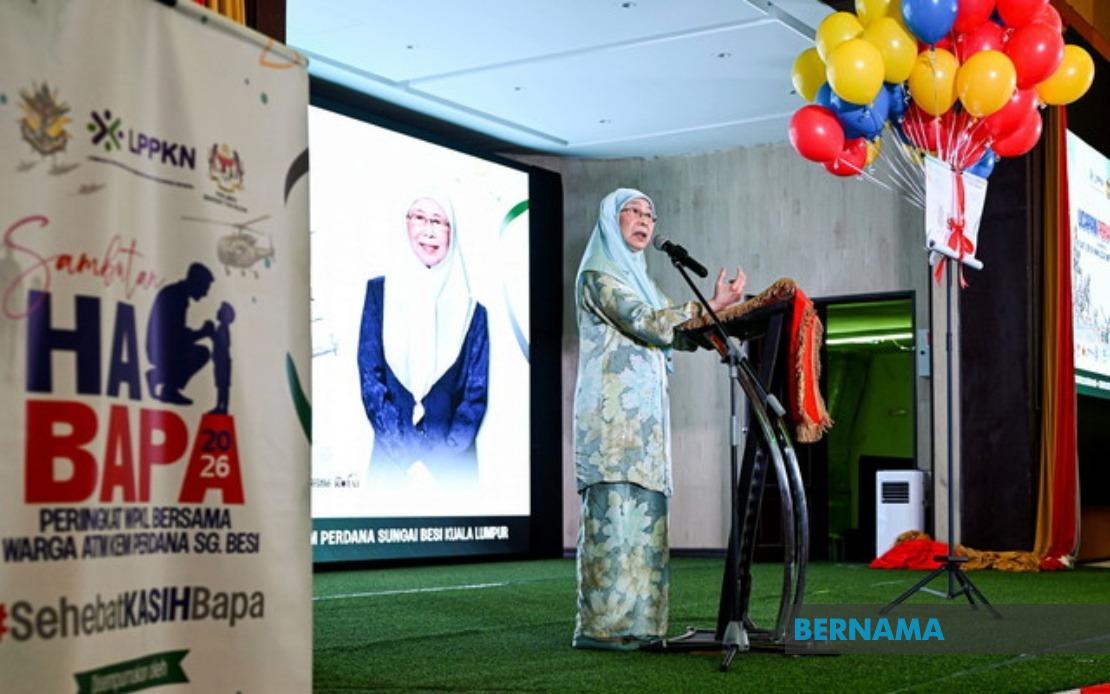
Dr Wan Azizah Wan Ismail, wife of the Prime Minister and Member of Parliament for Bandar Tun Razak, has renewed calls for comprehensive support systems to empower fathers serving within the Malaysian Armed Forces. Speaking at the 2026 Federal Territory of Kuala Lumpur Father's Day Celebration, she emphasised that military personnel juggling paternal responsibilities deserve sustained institutional backing given the unique sacrifices demanded by their service to the nation.
The event, which drew approximately 500 attendees including military families and government representatives, centred on recognising the dual burden shouldered by defence force fathers. These men often face prolonged separations from their children and spouses while fulfilling their constitutional duty to safeguard the country's sovereignty and territorial integrity. Dr Wan Azizah framed this recognition not as a charitable gesture but as a practical necessity for maintaining military effectiveness and personnel morale.
Central to her advocacy is the National Family Compassion Policy, known locally as DKKN. This initiative seeks to provide tangible assistance that acknowledges the particular pressures military fathers encounter when balancing deployment schedules with parental obligations. By normalising discussions around fatherhood within defence institutions, policymakers aim to create workplace environments where servicemen feel supported in their roles as family leaders, rather than viewing these responsibilities as secondary to military duties.
Dr Wan Azizah articulated a broader societal argument for strengthening fatherhood within the armed forces context. She contended that robust support for male military personnel directly contributes to family stability, which in turn strengthens the wider social fabric. This perspective aligns with growing international recognition that family-friendly military policies correlate with higher retention rates, improved mental health outcomes, and stronger unit cohesion. The connection between personal wellbeing and professional performance has become increasingly evident in contemporary defence force management.
The celebration itself was organised jointly by the National Population and Family Development Board, known as LPPKN, in collaboration with the Malaysian Armed Forces. This partnership reflects an acknowledgment that addressing the needs of military families requires coordination across civilian government agencies and defence institutions. The themed event, titled 'Sehebat KASIH Bapa'—roughly translating to "As Mighty as Father's Love"—sought to elevate fatherhood within military culture by making it a subject of institutional celebration rather than relegating it to private concern.
Among the concrete initiatives Dr Wan Azizah highlighted was LPPKN's Fatherhood Module, a structured programme designed to enhance parenting competencies among military fathers. This training component addresses specific skills related to child development, communication with children during deployments, and maintaining emotional connections across geographical distance. Such modules represent a shift from traditional military approaches that often compartmentalised personal and professional lives.
Equally significant is the Men Empowerment Network, referred to as MEN, which LPPKN has developed as a peer support mechanism. Rather than relying solely on formal counselling or top-down directives, this network leverages collective experience among military fathers to normalise conversations about parenting challenges, work-life integration, and emotional wellbeing. The peer-to-peer approach often proves more culturally acceptable and practically effective within hierarchical military structures.
The initiative carries particular relevance for Malaysia's defence sector at a time when recruitment and retention remain ongoing challenges. Personnel who feel their contributions as fathers are valued and supported are demonstrably more likely to remain in service and perform effectively. This dynamic becomes especially important as the armed forces compete for talent in a competitive regional labour market where skilled individuals have multiple career options.
Dr Wan Azizah's emphasis on fatherhood as a central pillar of family institutions also reflects shifting social attitudes across Malaysia and Southeast Asia more broadly. While traditional discourse often centred on motherhood and women's roles in family structures, contemporary policy increasingly recognises that meaningful paternal engagement produces measurable benefits for child development, family economic stability, and social cohesion. This reframing acknowledges that modern families function better when both parents are actively supported in their roles.
The broader implication of this advocacy extends beyond military personnel to civilian sectors where similar tensions between professional demands and family responsibilities exist. By elevating fatherhood support as a policy priority within one of Malaysia's most visible and respected institutions, the government sends a signal that balancing work and family life is not a personal problem to be managed individually, but a systemic issue requiring institutional solutions.
For Malaysian families with military connections, these initiatives translate into practical recognition that their sacrifices matter beyond abstract patriotic rhetoric. When service members know that policies exist to help their families during deployments, and that their roles as fathers are valued within institutional culture, it reinforces the dignity of both military service and family life. This integration of family-centred values into defence force operations represents an evolution in how modern militaries understand personnel welfare and institutional effectiveness.

