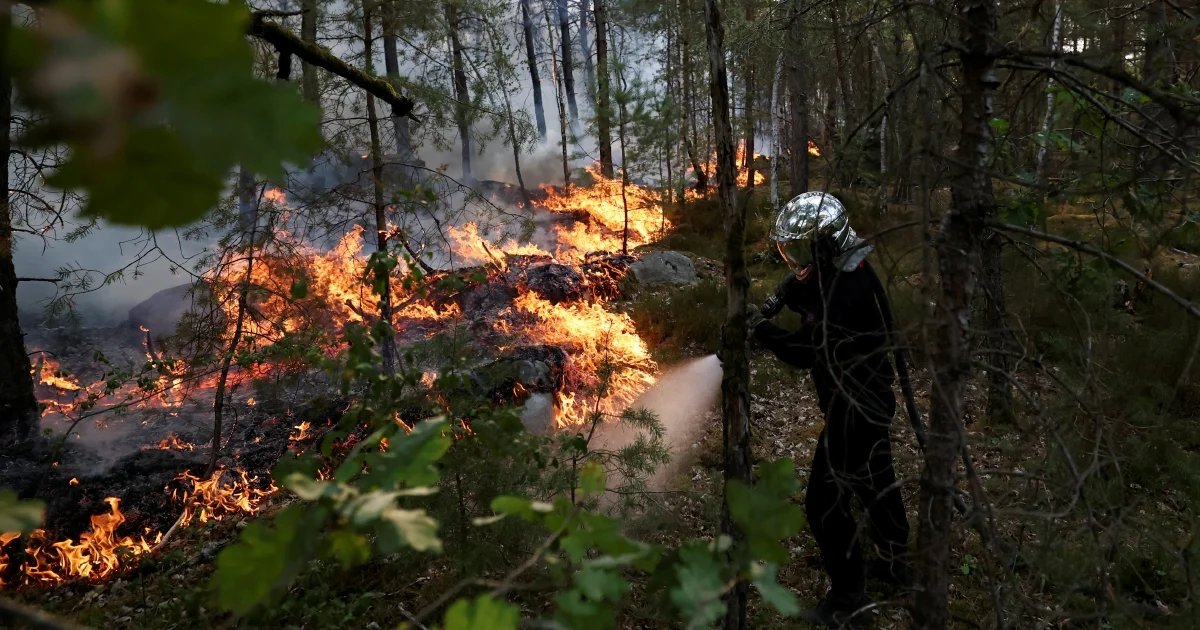
France mobilized extensive firefighting resources on Monday to contain two separate blazes that have destroyed over 1,300 hectares of woodland in a historically significant forest zone south of the French capital. The magnitude of the destruction underscores the vulnerability of even well-populated regions in western Europe to rapidly spreading wildfires, particularly during periods of dry weather. Investigators have moved swiftly, with police arresting two individuals suspected of deliberately setting the fires that tore through the region.
The fires erupted in the Arbonne-la-Foret area, a landscape characterized by dense forest cover that has long played an important ecological and cultural role for the surrounding communities. The speed at which the flames spread across such extensive territory demonstrates how quickly vegetation can ignite and advance under favorable weather conditions, turning small fires into regional catastrophes. Forest composition, accumulated leaf litter, and low humidity levels combine to create combustible conditions that can overwhelm even well-equipped emergency services.
The involvement of suspected arson adds a troubling dimension to the incident. While France does experience natural wildfire ignition through lightning strikes during thunderstorms, human negligence or deliberate acts account for a significant proportion of forest fires across Europe. The rapid arrest of two individuals suggests that investigators identified crucial evidence or witness accounts linking the suspects to the fire's origin. Arson charges in wildfire cases typically result in serious legal consequences, reflecting both the environmental damage and threat to human life that such actions create.
For Malaysian readers familiar with Southeast Asia's own wildfire challenges, the French situation offers instructive parallels and contrasts. While Indonesia and Malaysia contend with peatland and plantation fires driven largely by agricultural clearing and land development, European forests face distinct pressures. Climate change patterns are extending fire seasons and creating drier conditions across temperate zones, moving fire risk further north and westward than historical patterns would suggest. France's experience demonstrates that no developed nation, regardless of its firefighting infrastructure or forest management expertise, remains immune to catastrophic wildfire events.
The response by French authorities illustrates how national-level emergency services mobilize during major fires. Personnel and equipment are typically redirected from surrounding regions, neighboring countries may send assistance, and civilian populations in threatened zones receive evacuation orders. The coordination required to manage such operations tests logistical systems and inter-agency communication protocols. For a country accustomed to relatively lower wildfire frequencies compared to Mediterranean nations, a 1,300-hectare fire represents a serious incident demanding substantial resource commitment.
The historical and ecological significance of forests near major population centers adds another layer of concern. The Arbonne-la-Foret region represents part of France's natural heritage, and large-scale destruction carries implications for biodiversity, carbon sequestration, and recreational access. Regeneration of burned areas takes decades, while ecosystem recovery unfolds over even longer timescales. Charred forests also become susceptible to erosion, with consequences for water quality in downstream areas and increased landslide risk on slopes.
Arson as a cause of wildfires raises important questions about forest security and public awareness. Some individuals deliberately set fires for various motivations ranging from personal grievance to mental health crises. Others may underestimate fire risk when engaging in unsafe burning practices. France, like other European nations, has pursued public education campaigns emphasizing fire prevention and reporting suspicious activity. However, determined arsonists present challenges that extend beyond conventional prevention messaging.
The incident also highlights the role of meteorological conditions in fire behavior. Winds, humidity levels, and temperature determine how rapidly flames spread, their intensity, and whether containment becomes possible. Firefighters employ terrain features and strategic fuel removal to establish containment lines, but unfavorable conditions can overwhelm such efforts. Climate patterns are increasingly creating extended periods of elevated fire risk across regions traditionally considered low-fire environments.
For Southeast Asian nations and indeed globally, the French wildfires underscore the necessity of maintaining robust firefighting capacity and cross-border assistance mechanisms. Regional cooperation frameworks like ASEAN can facilitate equipment sharing, personnel exchange, and technical expertise dissemination. Investment in early warning systems, rapid response coordination, and forest management practices pays dividends across multiple types of fire scenarios, whether natural or human-caused.
The investigation into the suspected arson will likely proceed through French legal channels, with forensic analysis determining how the fires began and evidence linking the arrested individuals to the incidents. Such cases often involve scrutiny of mobile phone records, witness statements, and physical evidence collected from fire origins. Beyond legal proceedings, the fires will prompt reviews of forest management policies, emergency response effectiveness, and whether additional preventive measures warrant implementation across France's wooded regions.

