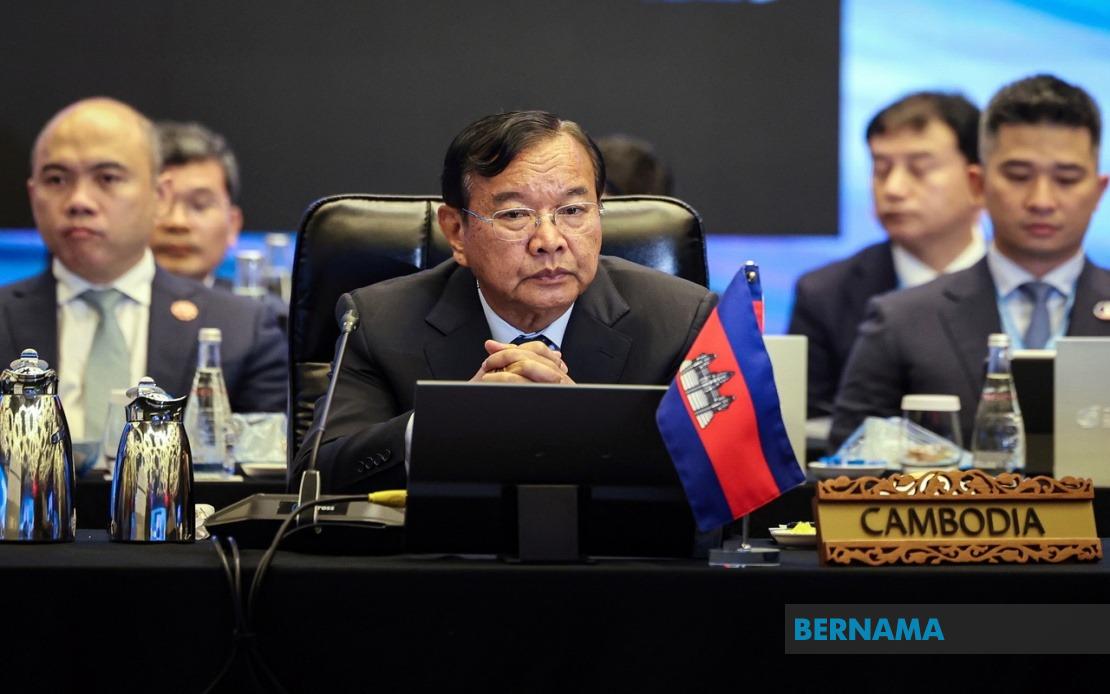
Cambodia's Foreign Minister and Deputy Prime Minister Prak Sokhonn has reaffirmed that the Association of Southeast Asian Nations remains an essential institutional framework for safeguarding regional peace and stability, particularly as the international environment grows increasingly turbulent. Speaking in an official message marking ASEAN's 59th anniversary on August 8, Sokhonn emphasized that the bloc's foundational instruments—its Charter and the Treaty of Amity and Cooperation—continue to provide crucial guidance for member states navigating an era marked by competing interests and strategic uncertainty.
The Cambodian minister's remarks underscore a fundamental reality about Southeast Asia's geopolitical standing: the region has undergone a remarkable transformation since ASEAN's establishment in 1967. What was once characterized by rivalry, mistrust, and the paralysis of Cold War divisions has evolved into a space where dialogue, collaborative frameworks, and economic interdependence have become defining features. This evolution did not occur spontaneously but resulted from deliberate institutional design and the commitment of member states to maintaining a rules-based regional order that transcends bilateral disputes.
However, Sokhonn's commentary also reflects growing anxiety within ASEAN capitals about the durability of this hard-won stability. The regional environment has deteriorated markedly in recent years, with multiple flashpoints threatening the consensus-building approach that has traditionally characterized ASEAN engagement. Armed conflicts in various corners of the global system have demonstrated that regional proximity to instability carries inherent risks, while intensifying great-power competition in areas adjacent to Southeast Asia—particularly in the South China Sea and beyond—creates pressure on ASEAN's unity and coherence.
The Foreign Minister articulated a crucial strategic imperative: that ASEAN cannot adopt a passive posture in response to external pressures and transformations. Instead, he argued that the bloc must position itself as an active agent capable of shaping regional outcomes rather than merely absorbing the consequences of decisions made elsewhere. This framing represents a significant shift from ASEAN's traditional modus operandi, which has emphasized restraint, non-interference, and careful consensus-building. Sokhonn's call for proactive engagement suggests that Cambodia and potentially other member states view the current international climate as demanding more assertive multilateral diplomacy.
The strain on international law and multilateralism that Sokhonn identified reflects broader anxieties about the liberal international order that has undergirded Southeast Asian development and relative stability. The resurgence of unilateral actions by major powers, the weakening of institutional constraints on state behavior, and the proliferation of competing visions for regional order all threaten the framework that ASEAN members have relied upon to protect their interests and maintain autonomy. For smaller Southeast Asian states in particular, a robust system of international law and functioning multilateral institutions represent crucial insurance policies against domination by larger neighbors or distant great powers.
Cambodia's own trajectory within ASEAN provides important context for understanding this emphasis on institutional preservation. Since joining the bloc in 1999—following the resolution of its devastating civil conflict—Cambodia has benefited substantially from ASEAN membership, which provided international legitimacy, economic integration opportunities, and a platform for diplomatic engagement with major powers. Sokhonn's reiteration of Cambodia's commitment to strengthening ASEAN unity and resilience thus reflects not merely rhetorical positioning but genuine national interest in maintaining the institutional architecture that has served the country's post-conflict recovery.
The current composition of ASEAN—comprising Brunei, Cambodia, Indonesia, Laos, Malaysia, Myanmar, the Philippines, Singapore, Thailand, Vietnam, and Timor-Leste—represents ten Southeast Asian nations and one Timorese member navigating an increasingly complex geopolitical landscape. The diversity of interests, political systems, economic development levels, and strategic partnerships among these members makes consensus-building challenging under any circumstances. Myanmar's ongoing political crisis, tensions between some members over maritime disputes, and divergent approaches toward major-power engagement all test ASEAN's institutional cohesion regularly.
The invocation of the Treaty of Amity and Cooperation—which enshrines principles of mutual respect for sovereignty, non-interference in internal affairs, peaceful settlement of disputes, and enhanced cooperation—represents a deliberate effort to ground regional engagement in established norms. These principles have enabled ASEAN to accommodate diverse members with incompatible interests without fragmenting, but their effectiveness depends entirely on voluntary compliance and commitment from member states. Recent years have witnessed occasional erosion of these principles, making Sokhonn's emphasis on upholding them both in principle and practice particularly significant.
For Malaysian readers and observers, Cambodia's perspective carries particular weight because it reflects the thinking of a Southeast Asian state with no permanent security alliance with external powers and limited capacity to balance geopolitical pressure independently. Cambodia's experience illustrates why smaller ASEAN members value bloc cohesion and institutional frameworks: such mechanisms provide collective leverage and protection that individual states cannot secure unilaterally. Malaysia's own strategic position as a middle-power with significant economic interests in regional stability aligns closely with this emphasis on ASEAN's indispensability.
The challenge confronting Sokhonn and other ASEAN leaders is translating rhetorical commitment to unity and centrality into concrete institutional capacity to influence outcomes in the region. ASEAN's traditional strength—its ability to serve as a forum where diverse states engage peacefully—becomes less impressive if the bloc cannot translate dialogue into effective responses to genuine security challenges. The question of whether ASEAN can move from passive accommodation of member interests toward active collective problem-solving will largely determine its relevance in coming decades, particularly as geopolitical competition intensifies in the Southeast Asian sphere.
Cambodia's emphasis on ASEAN's role in transforming the region from division to dialogue echoes language used in academic and diplomatic circles throughout Southeast Asia, yet the minister's insistence that ASEAN must actively shape its future—rather than simply manage decline or react to external changes—suggests a recognition that passive maintenance of the status quo may prove insufficient. As Myanmar's political crisis continues to test ASEAN consensus and South China Sea tensions fluctuate, the institutional capacity that Sokhonn praised will face increasingly stringent tests of its actual effectiveness in preserving peace and advancing genuine cooperation.

