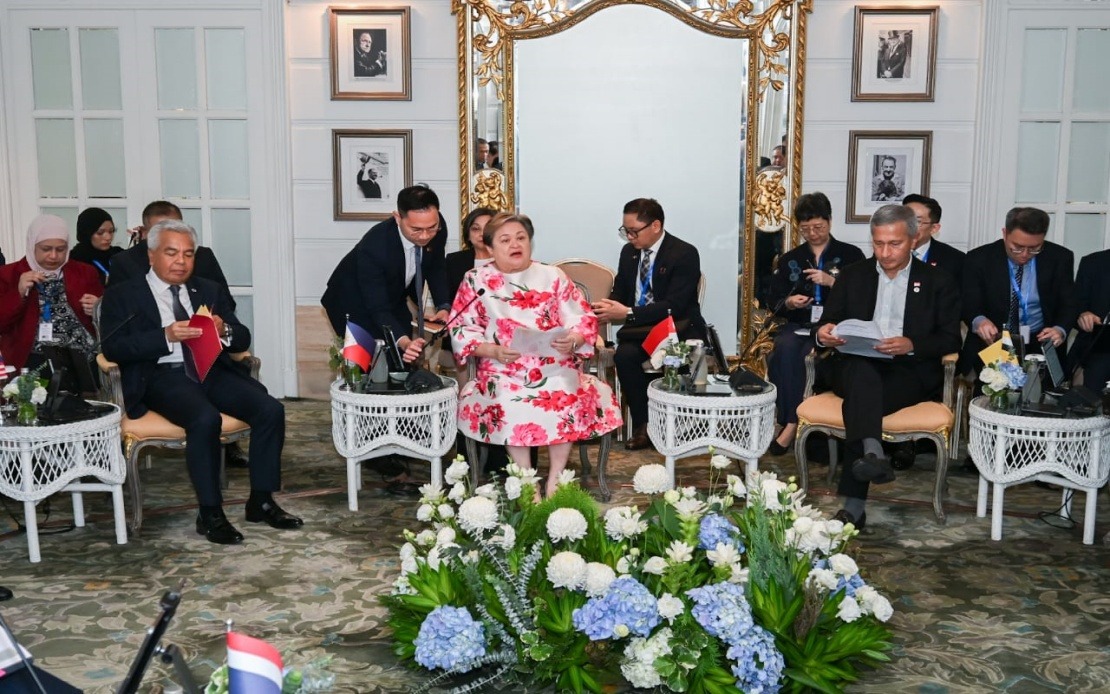
ASEAN's commitment to resolving the Myanmar crisis through its Five-Point Consensus remains unwavering, even as the country's military government continues to resist the regional bloc's diplomatic overtures. At a significant gathering of ASEAN foreign ministers in Bangkok on Sunday, representatives reaffirmed their unified stance on using the 2021 framework as the cornerstone of engagement with all stakeholders in Myanmar, signalling that the grouping will not abandon its multilateral approach despite mounting frustrations with Naypyidaw's intransigence.
Philippine Secretary for Foreign Affairs Maria Theresa Lazaro, serving as the ASEAN Chair's Special Envoy on Myanmar, stressed that the Five-Point Consensus serves as a non-negotiable foundation for ASEAN's dialogue with Myanmar's government and all other parties to the conflict. Speaking at a joint press conference with Thailand's Foreign Minister Sihasak Phuangketkeow, Lazaro emphasised that ASEAN would neither waver in its commitment nor accept Myanmar's recent parliamentary rejection of the peace plan as a reason to abandon the framework. Her remarks underscored the regional organisation's determination to maintain diplomatic channels even when faced with what appears to be deliberate obstruction from the ruling junta.
The timing of ASEAN's reaffirmation is particularly significant given that Myanmar's parliament voted last week to formally reject the Five-Point Consensus, a move that represents an unprecedented show of defiance against the regional bloc's diplomatic efforts. Rather than responding with punitive measures or isolating the country further, ASEAN chose to emphasise its commitment to the framework, demonstrating a pragmatic understanding that continued engagement, however challenging, remains preferable to complete estrangement. This approach reflects the organisation's broader commitment to non-interference and consensus-based diplomacy, even when dealing with member states whose domestic crises threaten regional stability.
During the meeting, which marked the first in-person gathering between ASEAN foreign ministers and Myanmar's Foreign Minister since the military coup in 2021, the regional bloc outlined three specific expectations it wants Myanmar to address. First among these priorities is the expansion of humanitarian assistance to Myanmar's suffering civilian population, with the Philippines preparing a dedicated humanitarian mission to assess how ASEAN can more effectively deliver aid to those affected by the ongoing conflict and economic collapse. This humanitarian dimension reflects growing international concern about the deteriorating living conditions faced by ordinary Myanmar citizens caught between military operations and armed resistance groups.
The second expectation centres on reducing violence, particularly attacks targeting civilians who have become increasingly caught in the crossfire between government forces and armed resistance movements. ASEAN's emphasis on this point acknowledges the alarming escalation in civilian casualties and displacement across Myanmar over the past three years, a crisis that threatens to destabilise the wider region through refugee flows and economic disruption. By specifically calling for violence reduction against non-combatants, ASEAN is attempting to establish a humanitarian baseline that transcends the broader political dispute, though enforcement mechanisms remain unclear.
Third, ASEAN is pushing for more inclusive political dialogue aimed at genuine national reconciliation, a goal that requires Myanmar's military leadership to create space for opposition voices and address the concerns of diverse ethnic and political groups. This requirement implicitly calls for the release of thousands of political prisoners detained since the 2021 coup and the establishment of a more open political environment, measures that would fundamentally challenge the junta's tight grip on power. For Malaysia, represented at the meeting by Foreign Ministry Secretary-General Tan Sri Amran Mohamed Zin, this dimension of ASEAN's approach carries particular weight given the country's own experience navigating ethnic diversity and political transitions.
Thailand's Foreign Minister Sihasak, whose country hosted the gathering, articulated a crucial observation about the limitations of ASEAN's approach by describing the bloc's engagement with Myanmar as a "two-way street" that requires reciprocal effort from Naypyidaw. His comments acknowledge a fundamental challenge facing ASEAN's diplomacy: the regional bloc can establish frameworks and express expectations, but ultimately Myanmar's military leadership must choose to respond constructively. Without genuine reciprocity from the junta, even the most well-intentioned regional initiatives risk becoming merely theatrical exercises that mask the absence of real progress.
The question of timeline has become increasingly important as months of ASEAN mediation efforts have yielded minimal tangible results. Rather than imposing specific deadlines, which Myanmar could simply dismiss as external pressure, ASEAN opted to signal that progress will be assessed at the regional bloc's summit later in the year. This measured approach gives Myanmar some space to demonstrate compliance while establishing a clear future checkpoint for evaluation, though observers remain sceptical about whether such timelines exert sufficient pressure on a government that has consistently prioritised military consolidation over compromise.
Notably absent from the ministerial meeting was Cambodia, whose non-participation underscores ongoing divisions within ASEAN over how to handle the Myanmar crisis. Some member states have advocated for firmer diplomatic pressure or conditional engagement, while others, particularly those with closer ties to Myanmar's government, have resisted such approaches in favour of softer engagement. Malaysia's decision to send a senior Foreign Ministry official rather than the Foreign Minister himself struck a measured tone, reflecting the country's balancing act between demonstrating solidarity with ASEAN's consensus position while maintaining pragmatic relations with Myanmar.
For Malaysia and other Southeast Asian nations, the stakes of the Myanmar crisis extend far beyond humanitarian concerns or regional diplomacy. Myanmar's instability creates potential security challenges through weapons trafficking and refugee flows, threatens regional economic integration, and tests ASEAN's credibility as an effective multilateral institution capable of addressing crises affecting its member states. The organisation's insistence on maintaining engagement through the Five-Point Consensus, despite Myanmar's rejection, reflects a calculated judgment that the alternative—isolation and confrontation—would likely prove counterproductive.
The Five-Point Consensus, adopted in April 2021 just weeks after Myanmar's military coup, calls for immediate cessation of violence, inclusive dialogue among all parties, humanitarian assistance coordinated with ASEAN, mediation by an ASEAN Special Envoy, and technical assistance from the bloc. While these objectives appear straightforward, their implementation has proven extraordinarily difficult, partly because they implicitly require Myanmar's military government to accept constraints on its power and pursue negotiated settlements with armed opponents. Myanmar's outright rejection of the framework suggests the junta believes it can consolidate control without regional mediation, a calculation that could prove catastrophically wrong if the conflict continues to expand and destabilise neighbouring territories.
For Malaysia's policymakers watching these developments, ASEAN's steadfast reaffirmation of the Five-Point Consensus demonstrates the bloc's commitment to principled multilateralism even when facing obstruction. However, it also highlights the fundamental tension within ASEAN between its non-interference doctrine and the reality that member state crises inevitably affect regional stability. As the situation in Myanmar continues deteriorating, Malaysia will likely need to balance its support for ASEAN's consensus approach with practical measures to protect its own security interests and manage the humanitarian consequences of the unfolding tragedy across the border.

