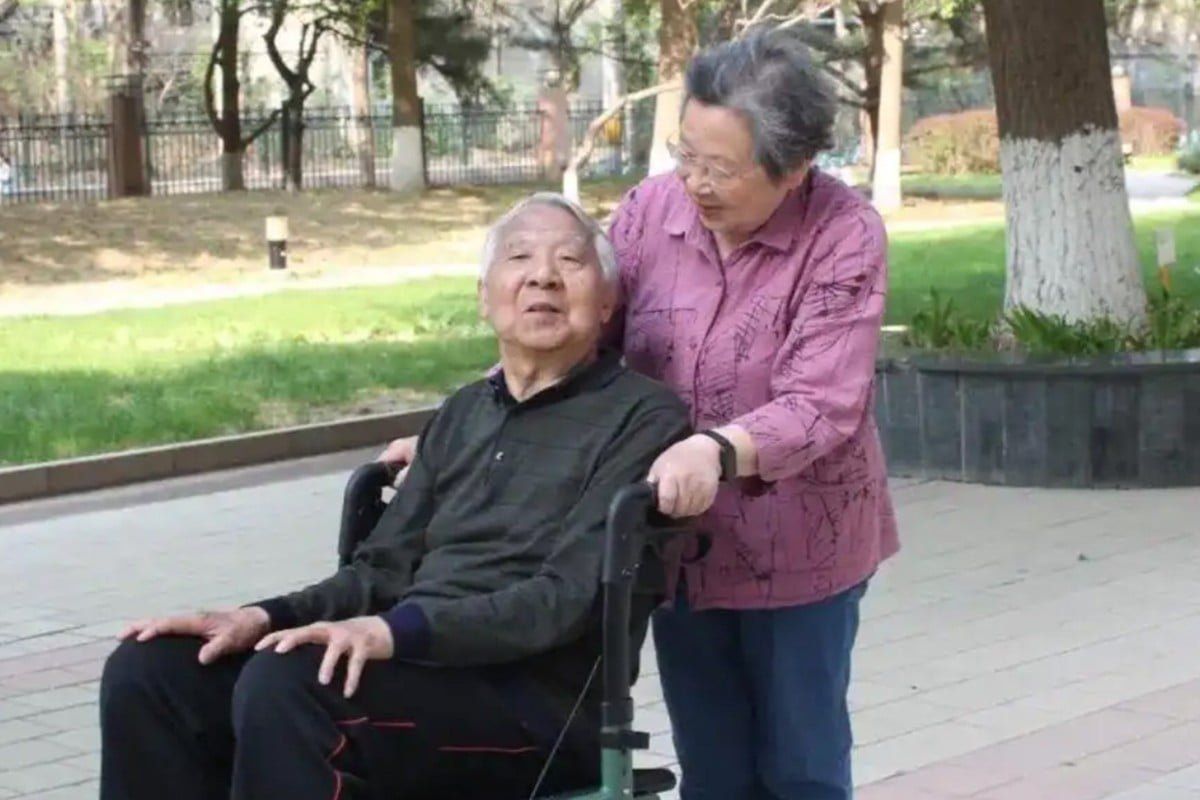
Wen Bo, a 90-year-old Beijinger, has become an unlikely source of inspiration across China by documenting her unwavering commitment to caring for her husband as he navigates the progressive decline of Alzheimer's disease. Their relationship, which began as a high school romance in the 1950s, culminated in marriage in 1960 and spanned six decades of shared experiences—from raising two sons to maintaining an active lifestyle that included swimming, walking, and international travel. When her husband, now 92, began showing signs of memory loss and incontinence in 2023, Wen made the deliberate choice to become his primary caregiver rather than place the burden on their adult children, who have their own families and professional obligations to manage.
The decision marked a dramatic shift in Wen's later years, transforming her from a retiree enjoying the fruits of a long marriage into a full-time custodian of her husband's physical and emotional wellbeing. While domestic help handles cooking and household maintenance, allowing her to focus on direct care, Wen has made it her mission to slow the disease's trajectory through cognitive stimulation and gentle physical activity. She has taught herself about Alzheimer's through voracious reading and online research, fashioning a daily regimen of mental exercises—arithmetic problems, puzzles, painting sessions—designed to engage her husband's mind and maintain whatever cognitive reserves remain. This methodical approach has yielded tangible results; her husband's decline has been measurably slower than typical progression rates, and he retains enough mobility and independence to operate his electric wheelchair without assistance.
What distinguishes Wen's approach from conventional dementia care protocols is her philosophical framework centred on preserving her husband's sense of self and agency. Rather than viewing Alzheimer's as a total erasure of personhood, she actively resists the medicalization and infantilization of dementia patients. In her nightly ritual, she insists her husband remember her name, reasoning with a poignancy that has resonated with millions: "He has to remember my name. I am his wife. I should be the last person he forgets." This is not merely sentiment; it reflects a deliberate strategy to maintain the marital bond and her husband's recognition of their relationship's primacy in his life. She encourages him to participate in household tasks at his own pace, allowing him the dignity of contributing, however modestly, to their shared domestic life.
Wen's documentation of this journey through social media diaries on RedNote has transformed a private act of devotion into a national conversation about ageing, care, and the meaning of a dignified life's end. Her posts—including updates like her husband's recent arithmetic test, which he completed with only one error despite taking longer than before—attract millions of comments from younger Chinese citizens grappling with anxiety about their own futures as caregivers. The platform has become a sanctuary of sorts, where she articulates a philosophy many find missing from their societies: "Self-respect, a sense of existence, and the feeling of being needed are essential for individuals with Alzheimer's disease." By refusing to define her husband by his illness, Wen offers an alternative model of aging that prioritizes relational continuity over clinical management.
Her advocacy arrives at a critical juncture in China's demographic history. The nation's population aged 60 and older surpassed 320 million by the end of last year, representing more than one-fifth of the total population. This unprecedented ageing presents systemic challenges: institutional care capacity remains inadequate, family structures have fractured under urbanization, and economic pressures squeeze the middle-aged sandwich generation between elderly parents and dependent children. Yet Wen's example suggests that within these constraints, alternative approaches rooted in sustained personal commitment and cognitive intentionality can mitigate decline and preserve the humanity of those afflicted by neurodegenerative disease.
The responses to her accounts reveal the hunger among younger generations for guidance on navigating filial responsibility and the management of cognitive decline in loved ones. One commenter expressed how Wen's posts "bring comfort" by demonstrating "what an ideal later life could look like: being with the person you love while living independently." Another noted that anxiety about inadequate preparation for their parents' care has been partially assuaged by Wen's practical examples and demonstrated techniques. These testimonies suggest that her contribution transcends personal caregiver chronicles; she has essentially crowdsourced a pedagogical model for dignified dementia care, one that emphasizes relational continuity and cognitive engagement over pharmaceutical intervention or institutional placement.
Wen has publicly acknowledged that her commitment has limits. She has stated that should her husband's condition deteriorate significantly beyond her capacity to manage, she would consider hospice care. This candid recognition of the boundaries of home-based care prevents her narrative from descending into unrealistic sanctimony. She is not arguing that all families can or should replicate her model, but rather that within the realm of possibility, agency and dignity should remain central organizing principles of elder care philosophy. Her willingness to make this distinction underscores the maturity of her reflections on aging and dependency.
For Malaysian and Southeast Asian readers, Wen's journey carries particular resonance given the region's own demographic transitions and the concurrent erosion of extended family structures traditionally responsible for elder care. As urbanization accelerates and fertility rates decline across the region, societies face mounting pressure to develop coherent long-term care strategies. Wen's example, while rooted in Chinese cultural contexts emphasizing filial piety, demonstrates that intentional caregiving informed by scientific understanding and emotional commitment can achieve outcomes superior to default institutional models. Her advocacy implicitly argues for policy frameworks that support family-based care through subsidized domestic help, cognitive stimulation resources, and community networks—investments that may prove more cost-effective and humane than expanding institutional capacity.
The broader significance of Wen's story lies in its challenge to medicalized narratives of dementia as inevitable decline into erasure. By documenting incremental preservation of function and relational recognition, she offers evidence that the trajectory of Alzheimer's, while progressive, is not irreversibly precipitous when met with sustained cognitive engagement and emotional presence. Her husband's continued ability to operate his wheelchair and occasionally remind her to rest speaks to the potential within apparent decline, suggesting that agency and autonomy can persist longer than pessimistic prognostications might suggest. In this sense, Wen is not merely a devoted spouse; she is a researcher of sorts, conducting a naturalistic experiment in the modification of dementia's progression through psychosocial intervention.

